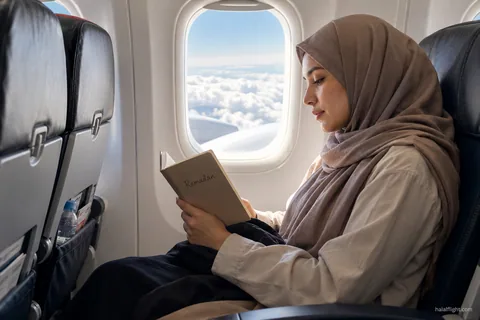
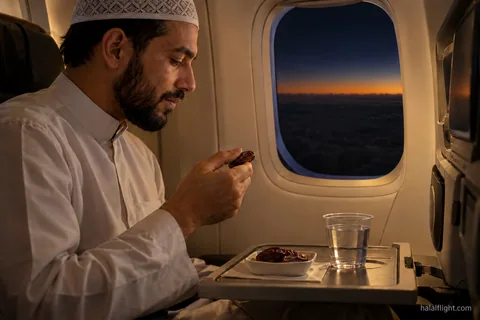
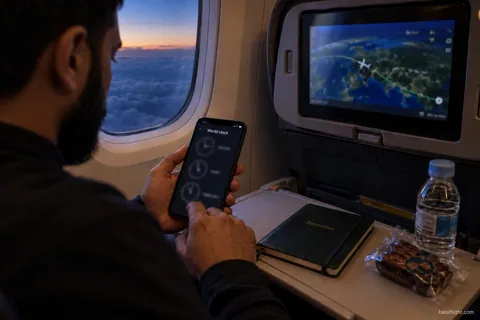
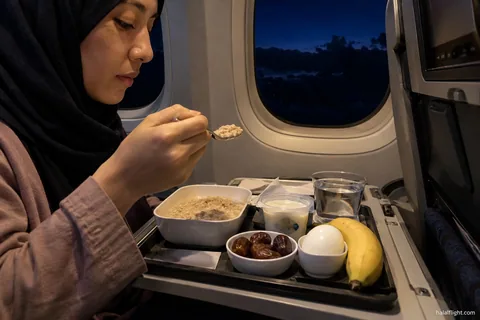
Flying while fasting raises practical questions about meal timing, time zones, sleep, connections and children. This page explains how the Ramadan guides fit together and which one to open first for your own journey.
What changes when a flight falls in Ramadan
A journey in Ramadan is still an ordinary flight, but several routine details start to matter more. The fast begins and ends according to the sun at your location, while the cabin follows a schedule set by the airline. Meal service, dim-light periods and boarding times are all planned without any reference to your fast, so the traveller has to do the matching.
Three questions come up on almost every trip: when will food actually be available, where will the sun be at that moment, and how much energy is left for the rest of the day. The guides collected here are organised around those questions, so that you can read only what applies to your itinerary instead of working through a long general article.
Everything on this site is practical planning information. Whether a particular journey permits or requires fasting is a matter of religious judgement, and that belongs to a qualified scholar rather than to a travel guide.
How the guides are grouped
The cards below fall into a few clear families, and it helps to know them before choosing.
- Fasting and rulings in context: general planning for keeping the fast while flying, and an explanation of the travel-related exemptions that scholars discuss.
- Time and place: fasting across several time zones, and how the position of the sun at altitude affects when the day starts and ends.
- Food: suhoor and iftar travel guides for flights and airports, and separate guides on what onboard meal services and iftar boxes usually involve.
- Scheduling: best departure times, overnight flights and sleep, airport connections, and what to do when a flight is delayed.
- Family travel: flying with children while the household is fasting.
Most readers need one guide from the first two groups and one from the food group, then a scheduling guide that matches the flight they have booked.
Which guide to open first
Start from the part of the trip that worries you most.
- If the main doubt is whether to fast at all while travelling, begin with the exemptions guide and the general fasting-in-the-air guide, then speak to a scholar you trust.
- If the route crosses several time zones, begin with the time-zone guide, because it changes how every other decision is made.
- If food is the concern, open the suhoor and iftar guides that match your departure or arrival, then check what the airline says about its meals.
- If the journey is long or overnight, read the sleep and departure-time guides before booking seats and meals.
- If the itinerary includes a stop, read the connections guide, and keep the delay guide nearby.
A traveller with children can add the family guide at any point; it overlaps with each of the others.
Suhoor and iftar around a flight
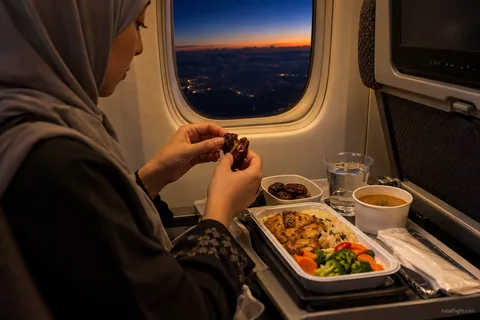
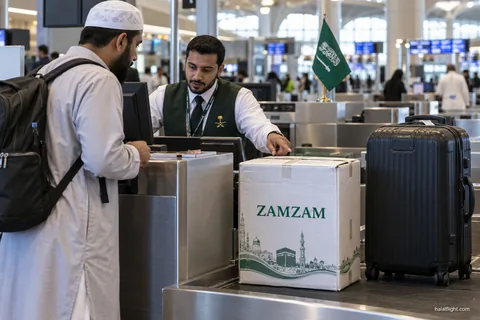
The most common mistake is assuming that the airline will serve food at the right moment. Airlines schedule service around operational needs, so a meal may arrive well before or after sunset at your location. Two habits reduce the risk.
- Treat the sunset time for your position as the key fact, not the clock time on the ticket. Check it in a prayer-times tool before departure and again after any schedule change.
- Keep a small personal supply that is allowed in the cabin and the airport, such as dates and a drink bottle filled after security, so that breaking the fast does not depend on a trolley arriving on time.
For a pre-dawn flight, suhoor is usually eaten at home or at the airport, and the airport guides explain what to look for there. For an evening flight, plan the iftar as a decision made in advance: eat before boarding, bring something for the moment of sunset, or request an onboard option where the airline offers one.
Booking meals for Ramadan journeys
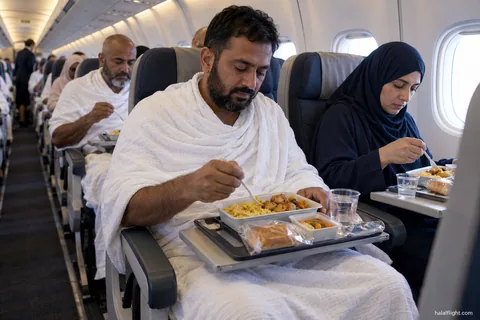
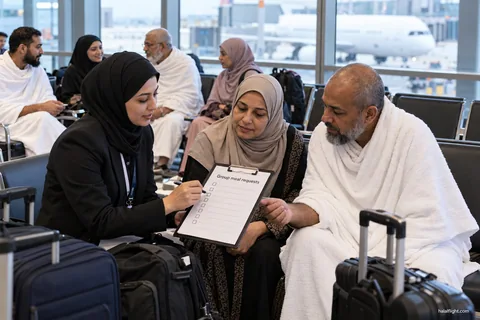
A halal or Muslim-friendly special meal is normally requested when booking or through the booking management page, within a window that each airline sets for itself. That window varies, and so does the way carriers treat requests made for the fasting period. Some airlines describe special iftar or suhoor arrangements on selected routes; others simply serve the regular halal meal at the usual time.
For that reason the guides avoid quoting deadlines or service details that change from year to year. The reliable method is simple:
- Request the meal as early as the booking system allows.
- Check the confirmation, since a request is not the same as a guarantee.
- Contact the airline a few days before departure to ask how Ramadan service is handled on your flight.
- Carry a backup, because a missed or incorrect meal is still possible.
The site has separate guides on the meal types themselves, and the directories of airlines and airports go further into how policies differ.
Time zones and the long day
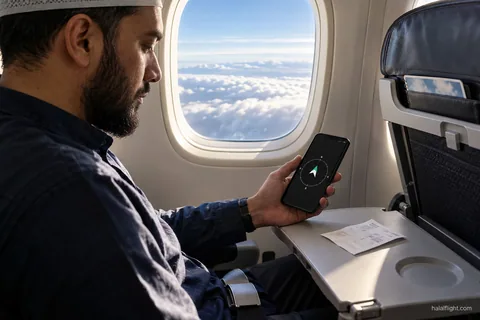
Crossing time zones can lengthen or shorten the fasting day, and eastbound and westbound routes behave differently. A flight that follows the sun may stretch the daylight period, while one that races ahead of it may shorten it. At cruising altitude the sunset seen from the window can also differ from the sunset on the ground.
Scholars have given different opinions on which location governs the fast during a flight, and on how to treat very long days. The time-zone guide sets out the questions to ask and the practical points to prepare, but it does not issue a ruling. Take the specific route to a scholar, and write down the answer so that it can be applied on the aircraft without improvising.
Sleep, energy and the choice of departure time
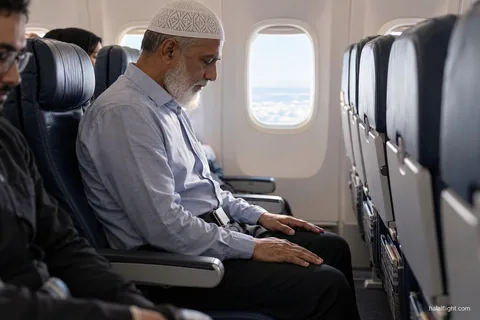
A fasting traveller has less margin for tiredness and thirst. Departure time therefore matters more than in other months. A morning departure puts most of the flight inside the fasting hours, an afternoon departure can end close to sunset, and a late-night flight can sit across suhoor.
The scheduling guides compare these patterns without recommending a single best option, since the answer depends on the route, the length of the flight and the traveller. Useful questions include how long the first meal will be delayed after landing, whether the seat will allow real rest, and how much walking the airport requires. Overnight flights deserve their own planning for sleep, hydration before dawn and the first meal after arrival.
Connections, delays and a few final checks
A stopover adds uncertainty in both directions: more time for prayer and food at the airport, but also more chances to be stuck without either. The connections guide explains how to read a layover with the sunset in mind. The delay guide covers the situation where the flight is late and the fast is due to end while still on the ground or in the air.
Before leaving home, run through a short checklist.
- Sunset and dawn times for departure, arrival and any stopover.
- The meal request and its confirmation, saved on the phone.
- Dates, water and permitted snacks in hand luggage.
- A scholar's answer for any question about the exemptions.
- The airline contact number, in case the schedule changes.
Rules for food and liquids at security vary by airport and country, so check them with the airport or the airline before packing.