Start with the terminal printed on your ticket
Kuala Lumpur is served by more than one passenger building, and Malaysia Airports, the operator, publishes a separate dining page for each: one for KLIA Terminal 1 (shown as KUL T1) and one for Terminal 2 (KLIA2, shown as KUL T2). Both pages describe a wide choice of restaurants, cafes and bars, so the listing for the wrong terminal can send you somewhere you cannot easily reach.
The practical rule is simple. Look at your boarding pass or e-ticket, note the terminal, and open only that terminal's dining page. Treat any recommendation you read elsewhere, in a blog or a forum, as a lead to check, not as a fact about the building you will actually be standing in.
- Terminal 1 page: the operator's KLIA Terminal 1 dining section.
- Terminal 2 page: the operator's KLIA2 dining section.
- Both pages link to an airport map and a mobile app, which are the places to look for locations.
The dining pages themselves are general descriptions. They do not by themselves tell you that a given outlet is halal, so the steps below show how to establish that at the counter.
Departure side, arrival side and the walk to your gate
Where you are in the airport matters as much as which terminal you are in. A restaurant in the public area is open to anyone, while a cafe past security is only open to departing passengers. If you are transferring and do not plan to leave the secure zone, outlets on the public side may be out of reach.
Work backwards from boarding
Check your gate on the airport screens or your airline app, then choose a meal that sits on your route to that gate. Large terminals can involve long walks, and some flights board from a different part of the building from where you cleared security. Follow the airport's current signs rather than a map you saved months ago, because gate allocations change from day to day.
Allow time for the answer you do not like
If the first outlet cannot answer your questions, you need time to try a second. As a rough habit, decide on the meal early and leave the last stretch before boarding free for the walk, not for queueing.
What the Malaysian halal logo does and does not tell you
Malaysia has a national halal certification system run by the Department of Islamic Development Malaysia, known as JAKIM, and many food businesses display its logo. In general this is reassuring for travellers, but a logo is a starting point and not the end of the check.
- Premises: certification normally applies to a named business at a named location, so ask whether the airport branch holds it, not only the brand elsewhere in the city.
- Validity: a certificate has an expiry date. A faded sticker or an old poster does not prove current status.
- Scope: some businesses certify only part of a menu. Ask whether the dish you want is covered.
If you are unsure, politely ask a member of staff to show the certificate or to tell you where it is displayed. Reasonable outlets are used to the question. The operator's pages do not list certification status for each outlet, so the verification is yours to do on the spot.
Opinions differ between schools and individuals on borderline matters such as shared grills or alcohol in cooking. For a personal ruling, ask a qualified scholar.
Reading a rice plate: nasi lemak and similar dishes
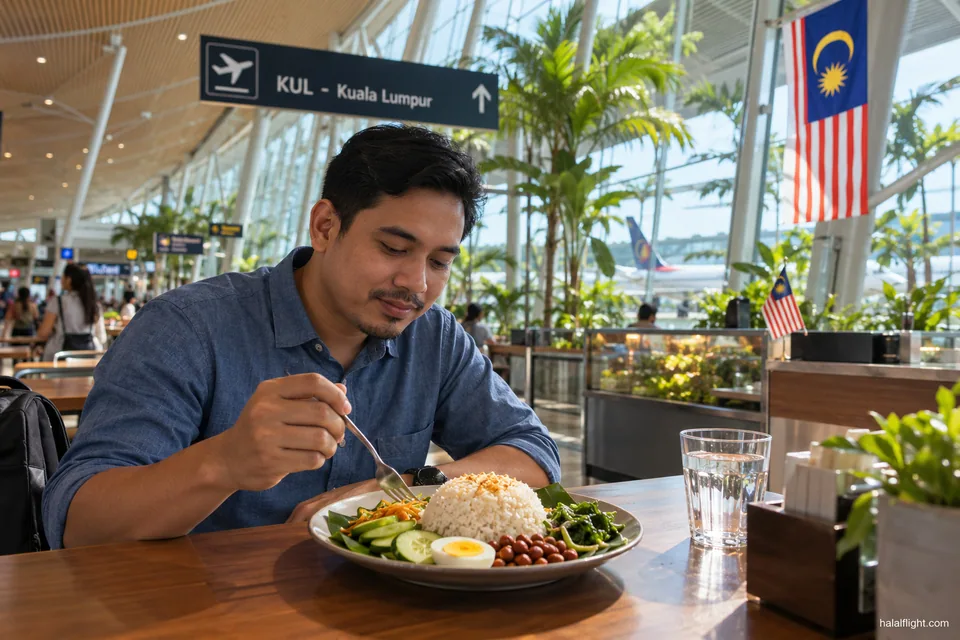
A rice plate is one of the most common quick meals in Malaysia, and nasi lemak is the best-known example. A typical plate combines rice cooked in coconut milk with a chilli sauce, a protein, egg, cucumber and small garnishes. Each element has its own ingredients, so the halal question and the allergy question are separate ones.
Check the parts, not only the name
- The chilli sauce (sambal) can include dried fish or shrimp paste, which matters for anyone avoiding seafood.
- Garnishes often include peanuts, which matter for nut allergies regardless of halal status.
- Fried items may share oil with other foods.
- Some versions come with a curry or rendang; ask which meat it uses.
Certification speaks to whether ingredients and preparation meet halal requirements. It does not tell you whether the plate is free of peanuts, shellfish, milk or egg. If you have an allergy, say so in plain words and ask what is in the dish, as a separate conversation from the halal question.
If the person serving cannot say what is in a dish, choose something simpler whose ingredients you can see.
Using the airport map and mobile app
Both dining pages point to the airport map and the airport mobile app. These are the right tools for finding where an outlet is relative to your gate, which the general dining pages do not do.
A useful routine on the day:
- Open the dining page for your terminal and pick two or three outlets that look suitable.
- Find them on the map and note which are on your side of security.
- Check that your gate is within a comfortable walk.
- Go to the outlet and verify the halal status and the dish in person.
If the app or website shows an outlet but it is closed or has changed, the shop in front of you takes priority. Directories are not always updated the moment a unit changes hands, so treat them as a guide to what might be there.
For general advice on which questions to put to restaurant staff in any airport, the wider halal airport-food pages on this site cover the method; this page concentrates on Kuala Lumpur.
Taking food onto the aircraft or onward
A takeaway bought at KLIA can be handy if your flight meal is uncertain or if you land somewhere with few options. Before you carry it past your arrival airport, though, think about two points.
Import rules at the next border
Many countries restrict meat, dairy and some fresh produce brought in by passengers, and a sealed takeaway is still food. Check the rules of your destination, and of any country where you change planes and pass through border control. If you are unsure, finish the food on board or leave it in the bin before arrival, since declaring or discarding is safer than a fine.
Keeping it safe for hours
Rice dishes and anything with egg, meat or dairy do not keep well in a warm bag. Eat them early in the journey. Fruit, nuts and sealed crackers keep better as a reserve.
Liquids such as soups, sauces and drinks are limited at security checkpoints in most countries, so a sambal pot or a drink may be taken away at your next screening.
Adding a backup that does not depend on any kitchen
Even with a good plan, an outlet may be closed, queues may be long or a flight may be moved to a gate far from the restaurants. A small backup stops a delay turning into a missed meal.
- Sealed snacks with a clear ingredient list, such as nuts, dried fruit or plain biscuits.
- A piece of whole fruit.
- An empty bottle to fill after security if you want water.
Read labels on packaged items. Gelatine, certain emulsifiers and flavourings can be of animal origin, and some products contain alcohol-based flavourings. If a label is unclear, leave it on the shelf. If you ordered a Muslim meal on the airline, keep in mind that it is a separate arrangement; the airline's own policy page explains how to request it.
Checklist for the day of travel
Use this short list at Kuala Lumpur, and adapt it if things go wrong.
- Confirm your terminal and gate on your ticket and the airport screens.
- Open the operator's dining page for that terminal and shortlist outlets.
- Locate them on the map and check they are on your side of security.
- At the counter, ask about the halal certificate for that branch, the specific dish and any allergens.
- Keep the receipt and wrapper until you have finished eating.
- Keep a sealed backup snack in your bag.
If it goes wrong
If an outlet cannot confirm its status, walk away and try the next one; do not talk yourself into it because you are hungry. If no suitable hot food is open, a packaged reserve and water will cover you until your flight. If you suspect a serious problem, such as a staff member contradicting a certificate on display, report it to the airport information desk or the airport's customer service channel listed on the operator's site.
Frequently asked questions
Is there halal food at both KLIA Terminal 1 and KLIA2?
Both terminals have restaurant and cafe listings on the operator's website, but those pages do not state the halal status of each outlet. Open the dining page for your terminal, choose a venue, then ask staff for the branch's current halal certificate and the dish ingredients before ordering. Do not assume that a recommendation for one terminal applies to the other.
How do I know if a restaurant at KLIA is really halal?
Look for a halal certificate or logo displayed at the outlet, check that it names the business and shows a valid date, and ask whether your chosen dish is covered. If nothing is displayed or staff are vague, pick another outlet. Individual rulings on borderline cases belong to a qualified scholar.
Can I eat nasi lemak at the airport if I have a peanut or seafood allergy?
Halal certification does not answer allergy questions. Nasi lemak plates often include peanuts, and the chilli sauce may contain dried fish or shrimp paste. Tell the server about your allergy, ask what is in each part of the plate and choose something simpler if they cannot say.
Can I take halal takeaway food from KLIA onto my next flight?
Airlines generally allow you to eat your own food on board, but liquids and sauces face security limits and some countries restrict meat and dairy at the border. Check your destination's import rules and eat perishable food early. Rice and meat dishes spoil quickly if left in a warm bag.
Where is the airport map for finding restaurants?
The operator's dining pages for each terminal link to an airport map and a mobile app. Use them to find where an outlet sits compared with your gate, then follow the current signs in the building, since layouts and tenants can change.