What tayammum is and what it is for
Tayammum is the dry purification that stands in for wudu or ghusl when water cannot be used. Egypt's Dar al-Ifta describes it as a substitute for water in ritual purification, allowing acts of worship that require purity, such as prayer and recitation of the Quran. It explains that the permission applies when water is truly unavailable or cannot be used because of illness, fear of harm or similar reasons.
That wording is the starting point for a flight. Tayammum is a concession tied to conditions, and the conditions are about the person and the situation, not about the setting. Being on an aircraft does not in itself decide the matter.
The same institution also notes that the concession reflects the ease of the law and that obligations are linked to a person's capacity. For a traveller, this means two things: the concession is real, and it is not to be used casually. This page explains the questions to consider and does not issue a ruling for any individual.
Is water actually unavailable?
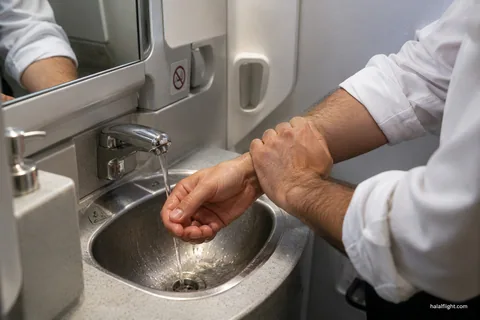
Most long-distance aircraft carry water in the lavatories, and cabin crew can usually provide bottled water. A washroom that is occupied, a queue, or a tap with a low flow is a delay or an inconvenience. Whether it amounts to being unable to use water is a different question, and scholars may answer it differently depending on the circumstances.
Consider the situations separately:
- Water is present but you are waiting for the washroom: this is a question of timing, and the prayer time itself may allow you to wait.
- Water is present but using it would be harmful to you, for example because of a skin condition or a medical device: this is a case for individual advice.
- Water has run out, or the taps are not working: you may need to ask the crew what they can provide before concluding that none is available.
- You cannot reach the washroom because the seat-belt sign is on, or turbulence makes standing unsafe: ask a scholar how to treat a delay of this kind.
Ask the crew before deciding
When it is safe to do so, ask a member of the cabin crew whether water is available and whether a lavatory is free. Do this politely and at a quiet moment, not when meal service is in progress or the aircraft is in turbulence. The crew can also tell you if the seat-belt sign is likely to remain on.
A moment's inquiry often resolves the problem, since the difference between a temporarily occupied washroom and a genuine inability to purify is exactly what the scholars' wording turns on. If you expect specific limitations on your journey, for example a flight with very little time between legs, put the question to a scholar beforehand. Advice that fits your actual itinerary is better than a general answer found at the last minute.
Travel preparation that reduces the problem
Many of these situations can be avoided by performing wudu in the airport before boarding, and by choosing a time to renew it when the washroom is quiet. The sibling guide on wudu on an aeroplane covers the practical side of using water on board.
Surfaces and method differ between schools
Scholars of the different schools discuss which surfaces are valid for tayammum and how the actions are performed. They do not all give the same answer, and this is a normal feature of the tradition and not a sign that any one view is careless. The Dar al-Ifta page on a related question notes that the four major schools agree on certain points, which shows that agreement exists on some matters while detail differs on others.
Because of this, avoid assuming that any clean seat fabric, plastic tray table, window ledge or decorative stone is automatically valid. Learn the requirements of your own school from a qualified source before travelling, and ask specifically about aircraft interiors, as these are made of synthetic materials that a general answer may not have considered.
Short videos and social media demonstrations are a poor substitute for a considered answer. They are often made for a particular situation and a particular school, and they rarely mention the conditions that must be met first.
If water becomes available, reassess
Egypt's Dar al-Ifta addresses the situation where someone performs tayammum and then finds enough water to purify before beginning the prayer. Its answer is that the tayammum is invalid, and that the person must use the water to remove the impurity, whether minor or major, and then pray. It grounds that ruling in a hadith that describes pure earth as the ablution of a Muslim even if he does not find water for ten years, and it states that the four major schools agree on this position.
The practical lesson for a flight is that circumstances can change quickly. A washroom that was occupied may become free, or the crew may bring bottled water. If this happens before you begin praying, review the full ruling and your own school's guidance, and do not carry on with an earlier assumption after the facts have changed. If the change happens during the prayer itself, ask a scholar, since the answer is not covered by this page.
Medical needs, disability and very long journeys
For travellers with a disability, a skin condition, a wound or dressing, or medical equipment, the usual options may not apply. The Dar al-Ifta page on the purpose of tayammum mentions illness and fear of harm as grounds on which water may be unusable. How that applies to a particular condition and treatment is not something a travel guide can decide.
The same is true of very long flights, where prayer times pass in rapid succession and the opportunity to use a washroom is limited. If you know about a constraint, explain it to a religious adviser in advance, together with the length of the flight, the layout of your seat and any medical advice you have received. A specific answer prepared before departure is more useful than a generic demonstration that never addressed your circumstances.
Medical advice, for example on whether washing a wound with water is safe, comes from a doctor and not a scholar.
Checklist before and during the flight
- Learn the conditions for tayammum in your school, and ask specifically about aircraft interiors.
- Perform wudu at the airport before boarding where you can, and note when you last renewed it.
- Take an empty bottle through security and fill it after screening if you expect difficulty reaching a washroom.
- Ask the crew about water and washroom availability before concluding that none can be used.
- If you do use tayammum, check again whether water has become available before you begin to pray.
- Keep the contact details of a scholar or institution you trust, and note the questions you want to ask.
- If a prayer time is about to pass and you are unsure, seek guidance in advance about what to do in that situation, as this page cannot decide it.
If something goes wrong, such as an unexpected delay that prevents access to water, make a note of what happened and consult a qualified scholar once you land about what to do next.
Frequently asked questions
Can I do tayammum on a plane because the toilet is occupied?
An occupied washroom is generally a delay and not the same as being unable to use water. Egypt's Dar al-Ifta links tayammum to water being truly unavailable or unusable. Ask the crew whether water or a free washroom is available, and ask a qualified scholar how your school treats a short wait.
What if I find water after doing tayammum?
Egypt's Dar al-Ifta states that if you find enough water to purify before beginning the prayer, your tayammum is invalid and you should use the water and then pray. Review the full ruling and your own school's guidance, and ask a scholar about any case where the change happens once the prayer has started.
Can I use my seat or the tray table for tayammum?
Schools differ on which surfaces are valid, so do not assume a clean seat, tray or window ledge is acceptable. Ask a qualified scholar in advance about aircraft interiors and synthetic materials. A general social media demonstration may not address your school or the conditions that apply.
Does being ill or disabled change the rules for tayammum?
Egypt's Dar al-Ifta mentions illness and fear of harm as reasons why water may be unusable. How that applies to your condition, equipment or treatment is an individual question. Describe it to a religious adviser before you fly, and ask your doctor about the medical side.
How can I avoid needing tayammum on a flight?
Perform wudu at the airport before boarding, note when you last renewed it, and choose a quiet moment on board to use the washroom. Ask the crew about water if there is a problem. The related guide on wudu on an aeroplane covers the practical steps in more detail.