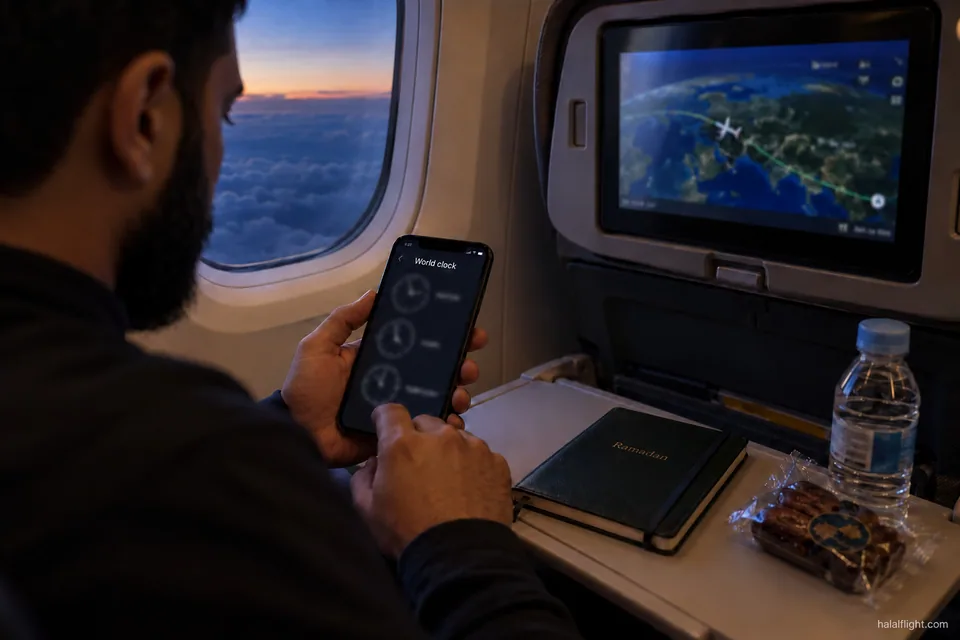
Why time zones complicate a Ramadan fast
A fast is tied to the sun: it begins at dawn and ends at sunset. On a normal day at home, the clock and the sun agree. On a journey across several time zones they stop agreeing, and that raises a practical question: which place's dawn and sunset do you follow when you are neither at the departure airport nor yet at the destination?
Scholars have not given a single answer. Some published fatwas tell the traveller to follow the sunset seen from their actual position; others tell the traveller to follow the destination's time zone. This page lays out those views and a way to prepare your own plan. Shorter questions about iftar timing in the cabin and the wider planning of fasting around air travel are covered on separate pages.
None of this replaces a ruling for your own case. If your route is complicated, take your complete itinerary to a qualified scholar before you travel.
Two published approaches to the same journey
Follow the sunset where you are
Egypt's Dar al-Ifta, answering a question about which time a person travelling by plane should use to break the fast, says the traveller breaks the fast when they see the whole disk of the sun has set from their own location, not by the clock of the departure country or the destination. Once the sun has set, later reappearances caused by the aircraft's speed are disregarded. The same fatwa says that a pilot's announcement that sets iftar by the local time of the departure country or of the aircraft's current location is not what governs. It allows one exception: where continuing the fast causes severe hardship, a traveller may break it and make up those days later.
Follow the destination's time zone
Darul Ifta Birmingham, in a fatwa on fasting whilst travelling, states that travellers follow the time zone of their destination. Another answer, published on IslamQA from a Hanafi scholar, gives a similar short instruction for fasting while flying through time zones. These answers are brief and do not separately address every in-flight situation.
What this means for you
The two approaches can give different iftar times for the same flight. Do not pick the one that suits your timetable. Ask a scholar which applies to your school and your route.
Do the clock arithmetic before you go
A practical plan starts with numbers that you can check.
- Write down the local departure date and time and the local arrival date and time for each leg.
- Calculate the real duration of each leg. A short gap between two clock times can hide many hours in the air, and a journey can end on a different calendar date from the one it began.
- Find sunset and dawn times for the departure city, any connecting city and the destination, from a timetable you trust.
- Mark where in the journey you will be in daylight, in darkness, or on the ground.
With this table you can see whether you would be fasting for much longer or much shorter than usual, and whether the question of where to follow even arises.
East, west and the length of your day
Direction affects how much daylight you meet. Flying east shortens the day, because you move toward the sunset; flying west can stretch daylight, because you keep pace with the sun. The size of the effect depends on the whole route, including departure time, latitude and any stopover, so avoid a generic rule such as always breaking early when flying east.
NOAA's solar calculator glossary explains that atmospheric refraction makes the sun appear before it rises and after it sets, and that the possible error grows at higher latitudes, closer to the poles. Whether and how that applies to iftar in the air is a matter for your scholar; the Dar al-Ifta fatwa quoted above speaks of the whole disk of the sun having set from your position.
If you are travelling on a route far to the north or south, check the section on unusual latitudes below.
Stopovers, connections and the ground
On the ground, most travellers use the timetable of the city they are in. A connecting airport therefore has its own local dawn and sunset. Once you are airborne again, the question returns, and the connecting city's iftar time does not automatically govern the rest of the flight. Plan to carry iftar food in your hand baggage so you are not waiting for a service you cannot predict, and confirm with the airline whether special meals are available through the usual request channels.
Plan the dates as well. Darul Ifta Birmingham notes that if your destination's Ramadan or Eid falls on a different day, the traveller follows the destination, and a fast may have to be made up on another day. An answer published by IslamWeb, advising someone who lives in Japan and visits Egypt during Ramadan, says to fast and end the fast with the Muslims where you are and notes that the days of a lunar month cannot be fewer than twenty-nine. If your journey crosses a country with a different start or end date, ask a scholar to work through your itinerary.
Travel concessions and when to stop fasting
Fasting while travelling is an option for many people, not an obligation in every case. A fatwa from Dar al-Ifta states that a traveller covering at least 83.5 km, on a journey that is not for disobedience, may break the fast, even without hardship, while the same text says fasting is still preferable when it causes no difficulty. It adds that fasting is disliked if it harms the traveller and a person who fears for their life must break the fast. Darul Ifta Birmingham gives a distance of 78 km (48 miles) and says missed fasts are to be made up later. The difference in distance shows why you should confirm your school's rule.
If you feel dizzy, faint or ill on a long flight, do not simply endure it. Break the fast if you are in danger, drink water and tell the crew if you need help. Ask a doctor about any medication or condition before Ramadan, and ask a scholar how to make up the day afterwards.
Date lines and extreme latitudes
Routes that cross the International Date Line, or pass near the polar regions where the sun may not set or rise for long periods, raise questions that clock conversion cannot settle. The Sistani website, for example, says that where the sun does not set or rise for long periods, one should follow the times of the nearest city with a normal day and night cycle. Other scholars hold different positions, and this is one school's guidance only.
Do not invent your own answer for such a route. Send the complete itinerary, including stopovers, the dates in each place and whether you plan to continue fasting throughout, to a trusted scholar or a fatwa service well before you fly.
Checklist: a multi-time-zone fast
- List every leg with local and elapsed times, and the date at each end.
- Look up dawn and sunset in each city you will pass through.
- Ask your scholar which place governs your fast in the air and which approach your school takes.
- Ask about the travel concession and how to make up any missed day.
- Keep iftar food, dates and water in your hand baggage.
- Request a special meal with enough notice if you plan to use one, and confirm what time it will be served.
- Save your scholar's answer on your phone for offline reading.
- Watch your health, and stop fasting if you feel unsafe.
Frequently asked questions
Which time do I break my fast on a plane crossing time zones?
Published answers differ. Egypt's Dar al-Ifta says to break the fast when you see the whole disk of the sun has set from your own location, not by clock time. Darul Ifta Birmingham says travellers follow the time zone of the destination. Ask your scholar which applies to your school and your route.
Does my phone's clock change when I fast?
No, a clock change does not move the sun. Scholars quoted on this page tie the fast to sunset, either as seen from your location or according to the destination. Do not rely on the time the phone displays after it updates unless your scholar has told you to do so.
Is it easier to fast when flying east or west?
Flying east usually shortens the day you experience and flying west can lengthen it, but the effect depends on the departure time, the latitude and the route. Work out the daylight hours for your journey rather than relying on a general rule, and ask your scholar how to treat any long day.
Can I break my fast because I am travelling?
Many scholars allow it. Dar al-Ifta mentions a minimum distance of 83.5 km and Darul Ifta Birmingham mentions 78 km, with missed days made up later. The same fatwa says fasting is preferable if it causes no difficulty. Confirm the rule for your school and your journey.
What if my destination starts or ends Ramadan on a different day?
Darul Ifta Birmingham says the traveller follows the destination and makes up any shortfall on another day. IslamWeb advises fasting and ending the fast with the Muslims where you are, and making up the difference if you fast fewer than twenty-nine days. Check your scholar's view before you travel.