Two questions that should not be mixed
A pilgrim on a flight to Makkah or Madinah may be asking two quite different things about the meal in front of them. The first is whether the food is halal: the meat, the ingredients, the preparation. The second is whether anything in it conflicts with the restrictions that apply while a person is in the state of ihram.
An airline's Muslim meal, often coded MOML, is built to answer the first question. It does not claim to answer the second, because the airline does not know whether you have entered ihram, which school of thought you follow or how your authority treats scented ingredients. A halal label therefore tells you about sourcing, and nothing more about your ritual state.
Keeping the questions apart makes the journey calmer. You check the halal side with the airline in the usual way, and you take the ihram side to your pilgrimage guide or the scholar you follow. The general meal-code system is explained in a separate guide, and the full list of Hajj and Umrah meal arrangements has its own page.
Know when you need to be ready
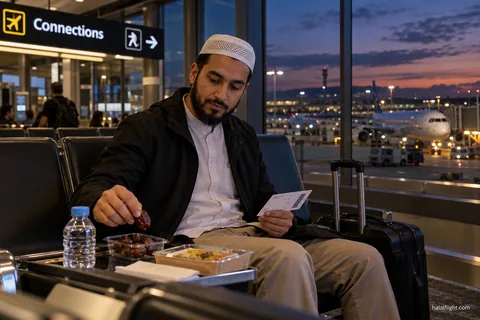
Pilgrims who travel by air often enter ihram before or during the flight, depending on the route and the advice of their group. The point at which this takes place is usually tied to the miqat, the boundary that pilgrims coming from outside must not cross without ihram. Your guide or group leader should tell you how your group plans to handle this on your specific flight.
This has a practical effect on meals. If the crew serve a hot tray around the time you need to make your intention and say the talbiyah, or while you are changing or adjusting your garments, you will be juggling several things at once. Ask your guide before boarding:
- At what stage of the flight will the group be ready for ihram?
- Should the meal be eaten before or after?
- Where in the aircraft can the group gather, if at all?
Do not guess the timing from the moving map alone. Follow the group leader's instructions and the crew's announcements.
Scented ingredients and the question of perfume
The restriction on perfume is one of the best-known rules of ihram, and it is the one most likely to raise questions about food. Scholars discuss it in some detail, and their answers are not identical.
What published sources say
Dar al-Ifta al-Misriyyah, in a published ruling, states that a person in ihram may not apply perfume to the body, clothes or food, and it reaches an opinion that scented soap is permitted because it is not regarded as perfume, while advising caution because scholars disagree. The office of Grand Ayatollah Sistani lists saffron among the substances regarded as perfume, says that eating perfume is not allowed, and says that edible aromatic oils may be used in food, though it is advisable not to smell them while eating. It also says fruits with a natural scent should not be smelled while eaten, as a precaution.
What this means for a meal
These are two different authorities, and they give different levels of detail. Neither is a general rule for every pilgrim. If your meal contains saffron, rosewater, orange blossom water or similar flavourings, take the actual ingredient list to the scholar you follow and ask. Do not turn a general concern about fragrance into a ban on ordinary food, and do not dismiss it either.
Find out the ingredients before the tray arrives
Airlines vary in how much detail they give about menus. Some publish the dish names, some publish ingredient lists on request, and some only give a general description such as chicken with rice. If aromatic flavourings matter to you, do not wait until the tray is in front of you.
- When you request the Muslim meal, ask the airline whether it can supply an ingredient list or at least say whether saffron, rosewater, floral waters or perfumed spices are used.
- If no answer comes, choose a simpler option, such as a plain vegetarian or fruit-based meal, where this suits your halal requirements.
- Carry permitted plain snacks so that a meal you decide not to eat does not leave you hungry.
A vegetarian meal is not automatically a halal answer, because it may contain alcohol-based flavourings or other ingredients. Treat it as a fallback to check, not a default.
Manage the tray in limited space
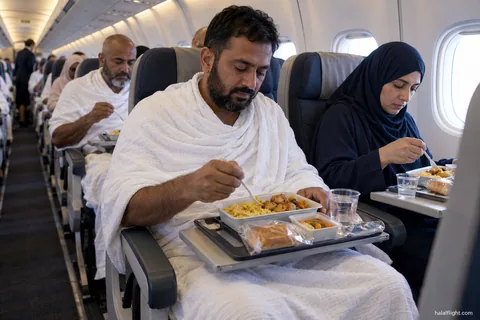
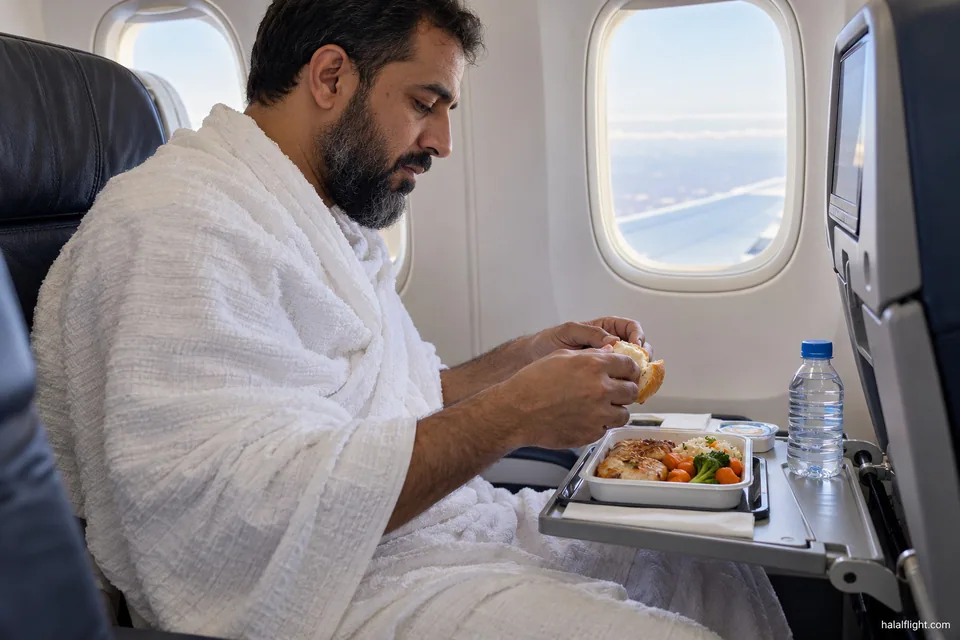
Ihram clothing for men is usually two plain unstitched sheets, and it is easy to spill on or to catch on the tray table. Women follow the clothing guidance of their own authority. In either case, a few small habits help.
- Open packets and lids slowly, and keep drinks away from the edge of the tray.
- Use napkins to protect loose fabric across the lap.
- Ask the crew for help with packaging, if you find it difficult in the seat.
- Keep the aisle clear, and follow crew instructions during turbulence or hot-drink service.
- Do not stand to reorganise your garment while the seatbelt sign is on.
If you need to eat while the group is gathering for ritual preparation, tell the person next to you, so that they are not surprised if you pause or move.
Choose snacks with clear ingredients
Plain snacks bridge the gap when a meal is unsuitable or late. Choose items where you can read the label and decide for yourself, such as dates, plain nuts, unflavoured biscuits and dried fruit. Avoid flavoured or scented products, such as rose-flavoured sweets, if you are unsure how they fit your authority's guidance on perfume.
Remember that two checks apply to a packaged product. The first is whether it is halal, which depends on the ingredients and certification. The second is whether it is suitable for ihram, which depends on the authority you follow. A product can pass one test and still need a question on the other.
Also check the rules on bringing food into your destination country. Customs rules on meat, dairy and fresh produce vary, and a pilgrim arriving with a bag of food may be asked to declare it. Read the official guidance for your arrival airport before packing.
Checklist for the flight in ihram
A short list to complete before departure.
- Ask your guide when the group will enter ihram and how the flight timing fits.
- Request your Muslim meal before the airline's deadline, and keep the confirmation.
- Ask the airline for ingredient details if scented additions matter to you.
- Take any ingredient question to the scholar you follow, using the actual ingredients.
- Pack plain, permitted snacks and water in your cabin bag.
- Wear garments you can eat in comfortably, and have napkins ready.
- Follow the crew's instructions at all times, especially during service and turbulence.
- If the meal does not suit you on the day, eat your own food, and do not argue with the crew about the menu.
If you are unsure about a ritual point at the last moment, ask your group leader before the meal, and note the question for a scholar afterwards.
Frequently asked questions
Does a Muslim meal on a plane mean it is suitable for ihram?
Not necessarily. A Muslim or halal meal addresses sourcing, such as the meat and ingredients. It does not address the restrictions of ihram, such as perfume. Ask your guide or the scholar you follow about any scented ingredient, using the actual menu.
Can I eat food with saffron or rosewater while in ihram?
Scholars discuss this, and published answers differ. Some sources list saffron among the substances treated as perfume, while others focus on perfume applied to food. Take the dish and its ingredients to the scholar or authority you follow and ask for a ruling on your situation.
When should I put on ihram during a flight?
That depends on your route, group and the guidance you follow. Pilgrims usually plan this around the miqat. Ask your pilgrimage guide before boarding, and follow the crew's announcements and safety instructions during the flight.
How can I find out what is in my airline meal before I eat it?
Contact the airline when you request the meal and ask for the dish description or ingredient list, especially for any scented additions. If it cannot tell you, choose a simpler meal or eat your own permitted food. Keep the answer in writing.
What snacks are sensible to carry when I am in ihram?
Plain items with a readable label work best, such as dates, unflavoured nuts, dried fruit and plain biscuits. Avoid heavily scented or flavoured products if you are unsure how your authority views them, and check the destination's rules on bringing food in.