Begin with position, not the displayed clock
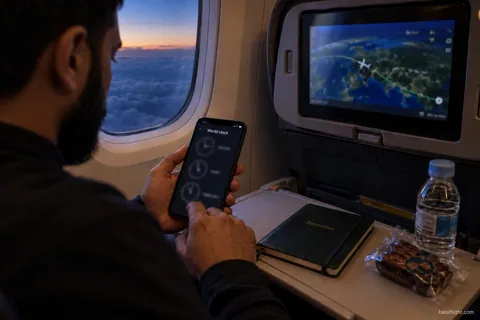
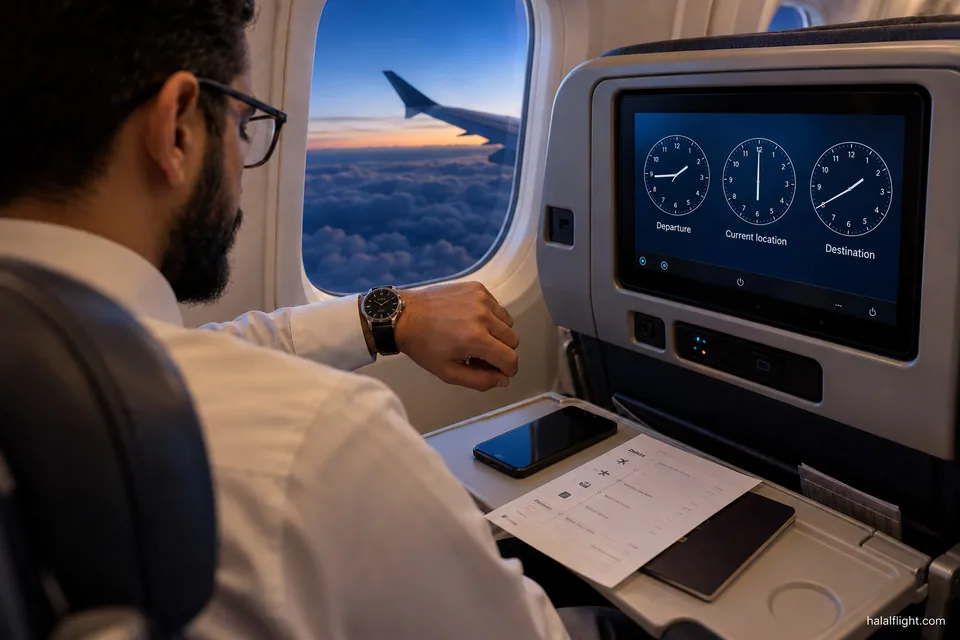
The clock on a seatback screen may show the time at the departure airport, the destination or a mixture that changes during the flight. None of these is guaranteed to describe where the aircraft is now. Prayer times depend on the sun, so the question is what your position and the solar conditions are, not what the screen says.
What the clock really represents
Before using any time as a reference, find out what it stands for. Many moving-map screens give local time at origin and destination as well as time to arrival. Your phone may also switch to a network time when it reconnects, which can be confusing in the air. Write down which time you are using and why.
The following sections explain how to plan each stage of the journey, from the ground at departure to the ground at arrival, and what to do when you are between the two.
Use airport timetables only while you are on the ground
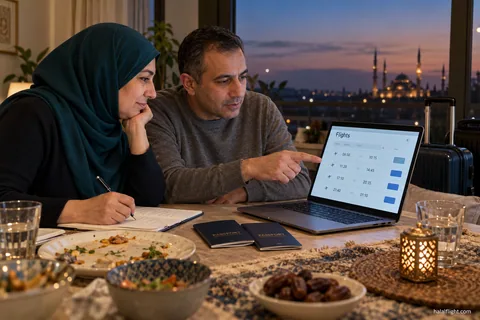
A local timetable is accurate for the city it was calculated for. At departure and during ground connections it can be exactly what you need, because you are standing in that place.
Why it does not carry over to the whole flight
Once airborne, the aircraft moves through different longitudes and latitudes. The sun’s position relative to the plane changes much faster than it does for a person on the ground, so the departure timetable cannot simply be applied hour by hour across the route, and neither can the arrival timetable.
Sensible use on the ground
- Check the times for the departure city before you leave home.
- Check again at any connection, because the date and time zone may be different.
- Note the times for your arrival city so that you can pray soon after landing if needed.
Treat these fixed points as anchors and plan the flight between them.
What the sun-based rule says
Scholars and institutions give varying guidance, and the following is only what two published sources say. A fatwa from Egypt’s Dar al-Ifta confirms that praying on a plane is permissible, that standing is required when you are able, and that a seated prayer is allowed if you fear the time will end and cannot find a suitable place to pray standing. That fatwa does not set separate rules for prayer times in flight; its only timing condition is the fear that the prayer time will expire.
The guidance published by the office of Grand Ayatollah Sistani states that where day and night are clearly distinguishable, prayer and fasting times follow sunrise and sunset, even if that makes prayers more frequent or fasts longer or shorter. It adds that where the sun does not set or rise for days or months, a Muslim should as a precaution follow the times of the nearest city with a normal day and night, and that timings from observatories may be relied on if the person trusts them.
These are different traditions with different details, so follow the authority you normally follow, and ask a qualified scholar how it applies to your route.
Check what an in-flight tool actually calculates
A phone app labelled prayer times is not necessarily able to know your airborne position, altitude or the calculation method you follow. Some apps use the phone’s last known location, some need a data connection, and some use a default setting that you never chose.
Questions to ask of any app or screen
- Does it use my current location, or the last place my phone was connected?
- Can it work offline and in flight mode?
- Which calculation method does it use for fajr and isha, and for the afternoon prayer?
- Does it account for altitude, or only for a point on the ground?
- What does it do at high latitudes?
A useful method must account for the route and for the religious calculation choices you follow. If you cannot answer these questions, treat the tool as an approximation and not as proof. Compare it against what you can see from the window, and ask a scholar which source you may rely on.
Allow for windows that change quickly
Travelling east shortens the solar day and travelling west lengthens it. On a long flight across many time zones, the interval between one prayer and the next may be quite different from what you are used to at home.
Eastbound and high-latitude routes
On an eastbound flight, night can arrive earlier than the arrival clock suggests. Near the poles, twilight can last a long time or may not end at all in some seasons, which makes timing less intuitive. The Sistani guidance quoted above gives a precautionary rule for places where the sun does not rise or set for long periods, but whether and how it applies to a flight is a question for your scholar.
Do not invent an interval
Avoid setting a fixed hourly interval between prayers just because it feels tidy. Instead, prepare the order of prayers before departure, note the likely window for each on the ground at both ends, and ask your religious adviser how to handle any uncertainty in the middle.
Direction, posture and asking the crew
Timing is only part of the picture. You also need to know the direction of prayer and whether you can stand. Sistani’s published guidance allows a traveller who cannot determine the qibla to face the direction they most probably think is correct, and says a flight attendant may be asked, who can in turn ask the pilot. It also allows the use of a compass or similar tools if you are convinced they are accurate.
Dar al-Ifta’s fatwa says standing is a pillar of the prayer when you are able, and a seated prayer is permitted if you fear the time will end and there is no suitable place to pray standing. Some airlines allow prayer in a galley or near an exit when it is quiet; ask politely and do not block aisles.
The detailed guidance on posture and direction is covered in the pages on seated prayer and on prayer timing and qibla in flight, so this page limits itself to the question of when.
Keep an offline plan and revise it
Connectivity is not guaranteed on a plane, and some phones lose location services in flight mode. Prepare so that you do not rely on a live connection.
What to save before boarding
- Prayer times for the departure city, any connection city and the arrival city.
- The date and time zone for each, written clearly.
- The name of the calculation method you follow.
- A short note from your scholar if you have asked about your route.
Revise after any change
A delay, a diversion or a changed route can move the flight across a sunrise or sunset. Update your plan when this happens. Clear notes on location, date and time zone prevent a remembered home timetable from being mistaken for information about where you are.
If fasting is part of the journey, the separate pages on fasting across time zones and on breaking the fast in flight deal with that side. Departure-time choices that avoid awkward prayer windows are discussed in the guide to choosing flight times.
Checklist and what to do if you are unsure
Use this list before and during the flight.
- Identify what the seatback clock shows.
- Save timetables for each city on the route, with dates.
- Check your app’s method and whether it works offline.
- Note when the likely prayer windows fall relative to boarding, take-off and landing.
- Agree with a scholar which source you may rely on for an unusual route.
- Plan where you can pray, and whether you can stand.
If you are unsure in the air
If you cannot tell whether a prayer time has begun or ended, do not panic. Use the best information available, such as your window view and your saved notes, and pray within the time you believe is correct. The Dar al-Ifta fatwa makes the fear of the time expiring the condition for praying seated, and Sistani’s guidance accepts reliance on trusted observatory timings when the sun cannot be observed. After landing, ask your scholar how to treat any prayer you were unable to time with certainty.
Frequently asked questions
Which time zone should I use for prayer on a plane?
Prayer follows the sun, so neither the origin nor the destination clock is decisive in the air. Use ground timetables while you are at an airport, and for the flight itself follow the method your scholar accepts. Write down the time zone of every source you use so that you do not mix them up.
Do prayer apps work in flight mode?
Some do and some do not. Apps that store times offline can display saved timetables, but they may not know your airborne position. Check the app’s settings before departure, download timetables for each city and ask which calculation method it uses. Treat the result as an aid, not as proof.
Can I pray sitting down on a plane?
Dar al-Ifta says standing is a pillar when you are able. It allows a seated prayer if you fear the time will end and cannot find a suitable place to pray standing. Rules differ between schools, so ask a qualified scholar how they apply to your seat and flight.
How do I find the qibla on a flight?
Sistani’s guidance says you may ask a flight attendant, who can ask the pilot, and may use a compass if you trust it. If the direction cannot be found, facing the direction you think most probable is allowed in that guidance. Follow your own authority on this.
What if the sun does not set normally on my route?
On routes with very long days or nights, ordinary timetables may not apply. Sistani’s guidance suggests following the nearest city with a normal day and night as a precaution where the sun does not set or rise for long periods. Ask your own scholar before travelling.