The short answer: sunset where you are
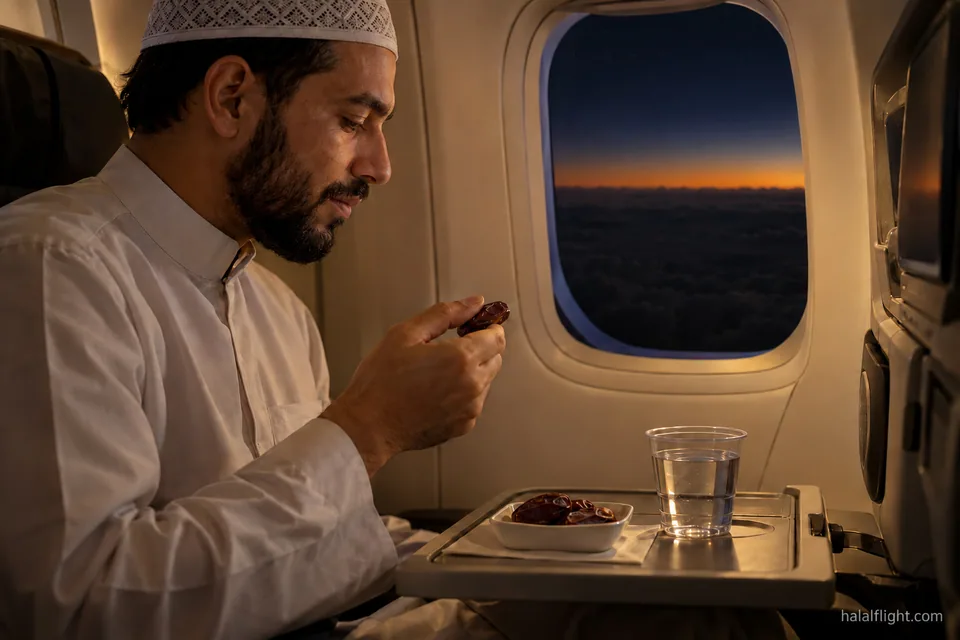
Egypt’s Dar al-Ifta, in a published fatwa on this exact question, says that a traveller on a plane breaks the fast when the sun sets at his or her own location. It tells passengers not to follow the local time of the country being flown over, nor that of the departure or destination country, and to wait until they see that the whole disk of the sun has set.
The same fatwa advises breaking the fast at the first sunset and disregarding later sunsets and sunrises caused by the speed of the aircraft. It also rejects in-flight announcements that tell passengers to break the fast according to the local time of the departure country or the aircraft’s current location. Finally, it allows a traveller to break the fast if it becomes unbearably hard, in which case the days are made up later.
Other scholars and institutions may reason differently on some points, and the final answer for your own journey belongs to a qualified scholar. The rest of this page explains how to put the principle into practice.
Why a message from home does not settle it
Family members often send a message when the sun sets in their city. That is useful as a reminder, but it describes a different place. If the aircraft is thousands of kilometres away, perhaps at a different latitude and altitude, the sun may not yet have set for you.
Common mismatches
- A message from home arrives while it is still daylight at your window.
- The seatback clock shows departure or arrival time, not local solar time.
- A cabin announcement uses the time at the airport below or behind you.
None of these can be assumed to match what you can see. If you follow the principle given above, your reference is the sun at your position, not anyone else’s clock.
Why a city timetable is incomplete for an aircraft
A prayer or iftar timetable is calculated for a fixed place. An aircraft moves quickly, at altitude, and often along a path that crosses several latitudes and longitudes. A timetable for the departure airport or a city below the route cannot be treated as a complete calculation for a moving plane.
Altitude and the horizon
At cruising height the horizon is lower than at ground level, so the sun can stay visible for longer than it would at the airport. Atmospheric refraction also bends light so that the sun appears slightly above its true position. The NOAA solar glossary explains that apparent sunset occurs slightly later than the actual crossing of the horizon and that the effect is unpredictable when air pressure and humidity change, with the error growing at higher latitudes.
Speed and direction
Flying west may keep the sun in view longer, while flying east can bring sunset sooner than the clocks suggest. The result is that no single printed time can be right for the whole flight.
Looking out of the window
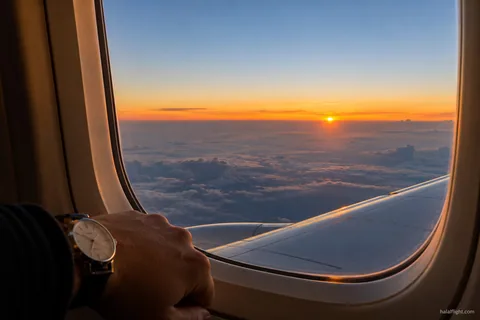
The most direct method follows the fatwa’s wording: see for yourself that the sun has set. That is easier on some seats and routes than others.
Practical points
- A window seat on the side facing the sun makes observation simpler, but cabin crew may ask for shades to be lowered on night or rest periods.
- Clouds, haze or the cabin’s lighting can make the horizon hard to judge.
- If you cannot see the horizon, you may need another method of establishing the time, and a scholar can advise which is acceptable.
When booking, you can ask for a seat on the side that will face the sunset, using the route and time of day to guess. Treat this as a preference, not a guarantee, because aircraft change heading and schedules move.
Ask the airline what it announces
Some airlines make an announcement for passengers who are fasting; others do not. In its 2026 Ramadan programme, Emirates described captain announcements that use the aircraft’s position and altitude. That is an airline’s own practice and not a universal rule, and arrangements may change, so check the current position with your operator before relying on it.
What to ask before travelling
- Does the airline announce a time for breaking the fast, and how is it worked out?
- When will the meal service start in relation to sunset?
- Is there an iftar box, a Ramadan meal or only the standard service?
Because the Dar al-Ifta fatwa rejects announcements that use the departure country’s local time or the aircraft’s current location as a basis, you may wish to discuss with a scholar how to treat an announcement that you hear. Use it as one piece of information rather than the only one, and keep your own means of checking.
For meal boxes and airline programmes, the separate page on iftar meals onboard airlines covers the food side in detail.
Keep a simple opening meal within reach
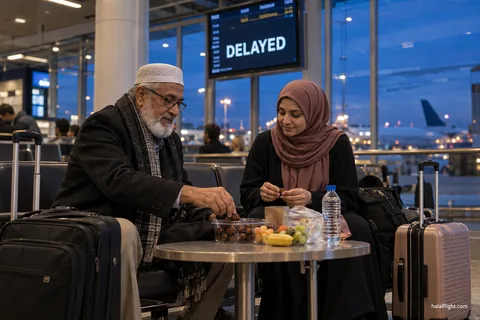
Do not depend on the trolley arriving at the right moment. Service on long flights is often planned around operational needs, and it may come before or after sunset.
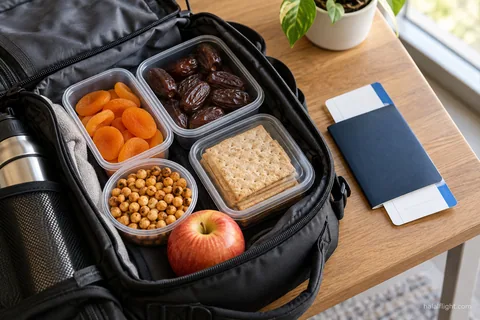
What to pack in the cabin bag
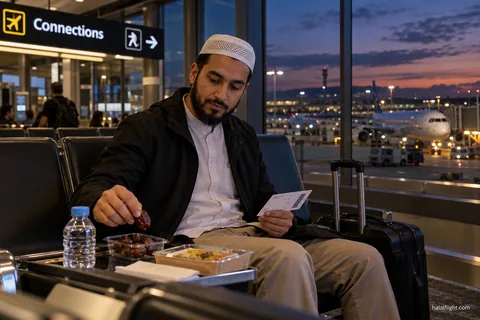
- Dates or another suitable item for opening the fast.
- A sealed snack that is easy to eat in a seat, such as nuts or a bar whose ingredients you have checked.
- An empty bottle to fill after security, or the means to ask crew for water.
Then the hot meal
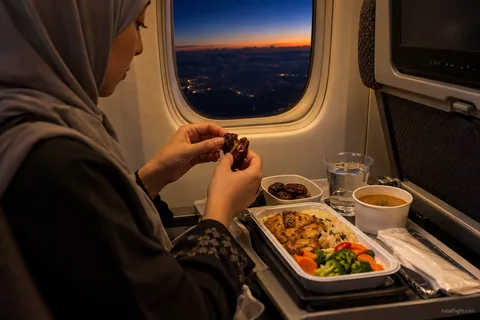
When the time is established, break the fast with the item you carry and water, then eat the cabin meal when it arrives. This way the timing of the fast does not wait for catering. If you ordered a special meal, confirm with your airline in advance, and see the guide to practical halal snacks for ideas on what travels well.
Unusual sun patterns need qualified guidance
Some journeys raise questions that a simple rule does not answer: high-latitude routes, very long daylight, a flight that chases the sun westwards, or sunlight that reappears after a valid sunset. The fatwa cited above says to break the fast at the first sunset and ignore later ones caused by the aircraft’s speed, but a polar or very long route may involve additional considerations.
What to do
- Note your route, date and the approximate hours of flight.
- Contact a qualified scholar or your local religious authority before travelling.
- Ask the specific question: when should I break the fast on this route, and what applies if I cannot see the sun?
Do not invent a rule from your destination clock or from what another passenger on a different journey does. Their route may differ from yours in ways that change the answer.
Checklist and what to do if it goes wrong
Before the flight:
- Note the route, departure time and approximate sunset time along it.
- Pack dates, a snack and water capacity.
- Choose a seat with a view if you can.
- Check the airline’s Ramadan arrangements and special-meal rules.
- Ask a scholar about any unusual itinerary.
On board, tell the crew early that you are fasting and ask politely about service timing. Watch the sun and the cabin lights rather than the seatback clock.
If the meal service is late or missed
If the trolley is delayed after you have established that the sun has set, break the fast with what you carry. If you are unwell, tired or in difficulty, the fatwa allows breaking the fast where it becomes unbearably hard, with the days made up later; seek medical help if you feel unwell and consult a scholar afterwards about what applies.
Frequently asked questions
Do I break my fast at the time of my departure city?
According to Dar al-Ifta, no. It states that a traveller on a plane breaks the fast when the sun sets at his or her own location, and not by the local time of the departure or destination country. Check the reasoning with a qualified scholar if your route is unusual.
What if the captain announces a different time?
Treat it as information, not an order. Airlines differ in how they calculate announcements, and Dar al-Ifta rejects announcements based on the departure country’s time or the plane’s ground position. Compare with what you see from the window and, if unsure, ask a scholar before the journey.
Why does the sun seem to set later at altitude?
At cruising height the horizon is lower and atmospheric refraction bends light so the sun looks slightly higher than its true position. NOAA explains that apparent sunset comes slightly later than the geometric one, and the effect becomes less predictable at higher latitudes.
What should I eat first to break the fast on a plane?
Many travellers use dates and water, which are easy to carry and need no service. Keep them in the cabin bag so they are available the moment the time is established. Eat the airline meal afterwards when it arrives, as the timing of service may not match sunset.
Can I break the fast if the flight makes it very hard?
Dar al-Ifta says a traveller may break the fast if it becomes unbearably hard, and then make up the days later. Whether your circumstances qualify is a personal ruling for a qualified scholar, and anyone feeling unwell on board should tell the crew.