The short answer for Schiphol
Schiphol has dozens of places to eat, spread over the public hall known as the Plaza and the piers beyond security. The airport's own restaurant listing mentions halal alongside vegetarian and gluten-free choices in its introduction, but the individual entries are described by cuisine and menu type, such as breakfast, Italian or sandwiches, rather than by a halal mark. In practice that means the listing helps you narrow the field; it does not settle whether a particular dish meets your requirements.
A sensible approach has three parts: decide which side of security you will be on, shortlist two or three outlets that are close to your gate, and ask each one about the specific item you want. If the answer is vague, move to a simpler choice such as sealed food with a readable ingredient list.
- Treat the airport listing as a map, not a certificate.
- Ask about the dish, not the restaurant.
- Keep a sealed back-up in your bag.
Reading the restaurant listing properly
The airport's eating and drinking pages show each outlet with a location label, for example Plaza, a named pier or lounge, or several locations, and a note on whether it is before or after security. Those labels matter more than the cuisine heading, because an attractive outlet on the wrong side of the checkpoint is no use to a passenger who has already cleared security.
What the page does and does not tell you
The listing tells you where an outlet is and what type of food it sells. It does not tell you the source of the meat, whether alcohol is used in sauces, or whether the kitchen shares equipment between meat and other dishes. Those are questions only the outlet can answer on the day.
If no halal label is visible
The absence of a halal tag is not proof that a dish is unsuitable, and the presence of a cuisine such as Middle Eastern or Turkish is not proof that it is suitable. Both conclusions would be guesses. Ask the question directly and be ready to choose a vegetarian or fish option if the staff cannot describe the supplier.
Plaza or piers: matching the meal to your route
The Plaza is the public shopping and dining area before security. The piers are the departure areas beyond it. Which one you use depends on your journey.
Starting your trip at Schiphol
You have both options. Eating on the Plaza before check-in or security can be easier if you want a seated meal with family, and you can then pass through security with time in hand. Eating after security gives you a shorter walk to the gate, but choice depends on the pier your flight uses, and you will not know the gate until it is announced on the day.
Connecting through Schiphol
A transfer passenger is usually already in the departure area. Leaving it to reach the Plaza can mean passing border or security checks again, so confirm with the airline or airport staff before you leave, and weigh that against the time left. Many connecting travellers are better served by an outlet on their pier or on the walking route to it.
- Check the before-or-after-security label on every outlet you save.
- Do not plan a meal on the Plaza during a short connection.
- Recheck the gate display before settling at a table.
A bakery example: Amsterdam Bread Company
The airport lists Amsterdam Bread Company as an outlet on the way to gates D1 to D57 and to the E, F, G and H gates, open around the clock. Its listing describes freshly baked bread topped with local seasonal ingredients, served for breakfast, lunch or dinner, along with a warm Dutch apple pie and coffee.
That description is a useful illustration of why listings need follow-up. A bakery meal can look simple, yet toppings may include meat or cheese made with animal rennet, spreads may contain gelatine, and pastries may use animal fat. None of this is stated or implied by the airport page; the point is that the page does not answer these questions either way.
Questions for a bakery counter
- Which toppings today contain meat, and where does that meat come from?
- Is there any alcohol in the sauce, dressing or glaze?
- Do the pastries contain gelatine or lard?
- Is there a sealed or wrapped alternative?
A plain bread item with a vegetable topping, checked against the ingredient information, is often the easiest option to confirm on the spot.
Allergies are a separate question from halal
The airport states that each restaurant provides an allergen list showing which allergens are in its dishes, and that gluten-free meals are available at restaurants both before and after security. The same page does not discuss halal. This is a reminder that the two checks are independent: a dish can be halal and contain nuts, or be free of allergens and still be unsuitable for halal reasons.
If you or a child has an allergy, ask for the allergen list first and follow the advice in your own care plan. Do not rely on a halal answer to cover an allergy, and do not rely on an allergen list to cover halal.
- Say the allergy and the halal requirement as two separate sentences.
- Ask whether the item is prepared on shared surfaces.
- If staff are unsure, choose sealed food with a full ingredient label.
Medical questions belong with a doctor or allergy specialist rather than with an airport counter.
Choosing between hot meals and packaged food
Hot dishes carry the most uncertainty, because stocks, sauces and shared grills are hard to see. Packaged food carries less, because the label is fixed. Neither is automatically the better choice; it depends on how much time you have and how confident the answer from staff is.
When a hot meal makes sense
Choose a hot dish if staff can name the meat supplier or tell you that the dish is meat-free, if there is no alcohol in the recipe, and if you have time to eat without rushing to the gate.
When packaged food is wiser
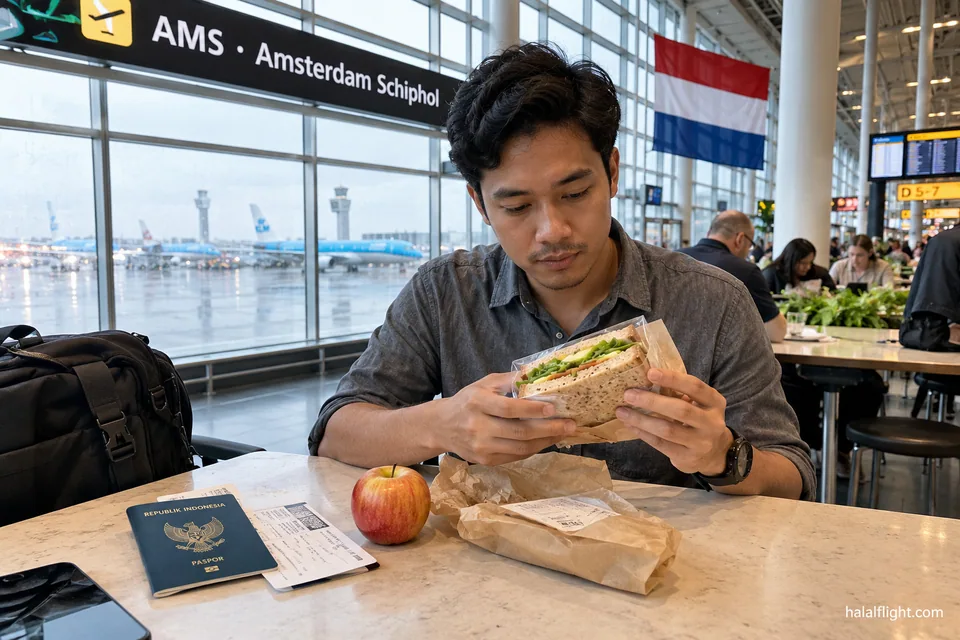
If the counter is busy, the answers are uncertain or boarding is close, a sealed sandwich, fruit, nuts or a salad pot with a complete label is a safer fallback. Read the label for gelatine, alcohol-based flavourings and meat-derived ingredients, and keep the packaging until you have finished.
For a vegetarian or fish dish, remember that some readers apply stricter or looser standards about shared kitchens. Differences exist between schools of thought, and a qualified scholar is the right person for a personal ruling.
Praying and eating in the same trip
Many travellers plan the meal around prayer times rather than the other way round. If a prayer falls during your connection, look up the airport's prayer or quiet-room information separately, and decide the order of eating and praying before you enter the departure area. The location of those rooms is a different topic from food, and it is easier to find them from the airport's own facility pages than from a food listing.
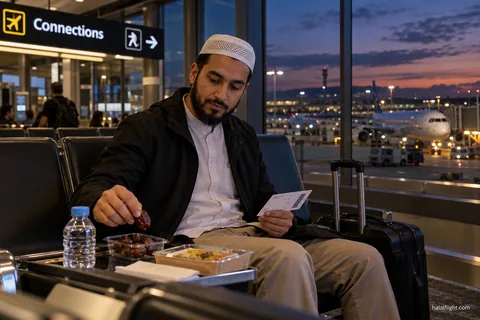
During Ramadan, the practical question changes to where you can break the fast. Packing dates and water in your hand luggage avoids dependence on any outlet. The separate guide on managing iftar during flights and airport transfers covers that situation in more detail.
Checklist before and during the visit
- Open the airport's eating and drinking pages a few days before and save two or three outlets near your likely pier.
- Note the security label on each saved outlet.
- On the day, confirm your gate and the walking time before choosing a restaurant.
- Ask about meat source, alcohol and shared equipment for the exact item.
- Ask for the allergen list if an allergy is involved.
- Decide quickly: if answers are unclear, buy sealed food with a legible label.
- Keep wrappers and receipts until you have finished eating.
- Return to the gate with time to spare; do not queue for a second round close to boarding.
If it goes wrong
If you discover after ordering that an ingredient does not suit you, politely ask whether the dish can be exchanged and accept a refusal calmly. If you have already eaten something you later doubt, the question of what to do next is a matter for a qualified scholar, not for guesswork at the airport.
Frequently asked questions
Is there a halal certified restaurant at Schiphol?
The airport's own listing mentions halal options in general terms but describes individual outlets by cuisine and location, not by certificate. Do not assume any outlet is certified. Ask the staff whether the specific dish is halal, what supplier provides the meat, and whether a certificate can be shown, then decide whether the answer satisfies your own standard.
Can I eat on Schiphol Plaza if I am transferring?
Schiphol Plaza is in the public area before security. A transfer passenger who leaves the departure area may face further checks on return, so confirm the rules with the airline or airport staff before leaving. On a short connection it is usually safer to eat in the departure area on your pier.
Does Amsterdam Bread Company serve halal food?
The airport describes it as a bakery serving bread with seasonal toppings and apple pie, open around the clock on the way to several gate groups. It does not describe the outlet as halal. Ask about toppings, spreads and pastry ingredients, and choose a plain vegetable item if staff cannot answer.
Does the allergen list also tell me if food is halal?
No. The allergen list shows which allergens are in a dish and says nothing about meat source, alcohol or religious status. Treat allergies and halal as two separate checks, and state both clearly when you order. For medical advice about allergies, consult your doctor.
What should I carry if I cannot find a suitable meal?
Carry sealed food that passes security rules and has a full ingredient label, such as fruit, nuts, dates or a packaged sandwich bought after security. Keep it in your hand luggage so that a delay, a long walk or a closed counter does not leave you without a safe option.