Plan each child separately from the adult fast
A family booking looks like one unit on a ticket, but on the day it is a group of people with different needs. A toddler needs regular milk or food and a nap, a seven-year-old may want to join in the fast for a few hours, and a teenager may be fasting fully. The adults may be fasting too, and still need to look after all of them in a crowded terminal.
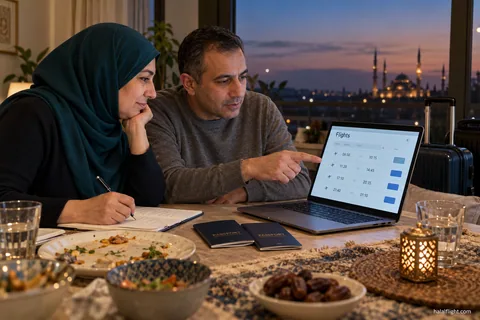
The first step is to decide, before booking, who is fasting, who is not, and what each person will eat and drink during the journey. Write this down in a few lines. Then choose flight times, meal requests and hand luggage around that plan, instead of fitting the children into an adult timetable.
Children who are not fasting should eat and drink normally throughout the journey, including while the adults around them wait for sunset. A shared seat row does not mean a shared routine.
Who is expected to fast
The UK Islamic Mission explains that children are not required to fast until they reach puberty, and that before this point fasting is not considered necessary for the child. It adds that many families see children begin regular fasting somewhere between about ten and fourteen, depending on maturity, while some children start trying short fasts at seven or eight. The emphasis is on readiness and health, not on a fixed age.
That position has practical consequences for travel:
- A child who wants to try a partial fast should do so on a day when the journey is short and easy, not on a long connection.
- If a child is tired, dizzy or unwell, the same source says eating or drinking and trying again another day is acceptable.
- A child should not feel pressured because the rest of the family is fasting.
Questions about a particular child, such as a medical condition or a child close to puberty, belong with a qualified scholar and a doctor. Neither this page nor an airline can answer them.
Child meals: what the label does and does not tell you
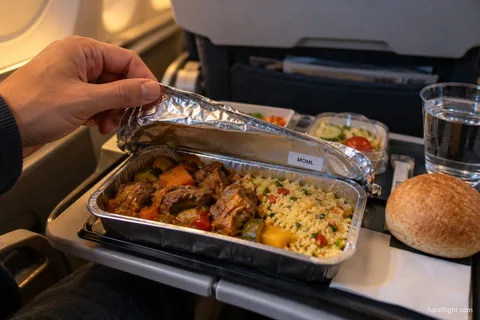
Airlines usually offer child or infant meals as a special meal. The label describes who the meal is for and the style of menu, such as smaller portions or familiar dishes. It does not by itself say that the meal is halal, free of a given allergen or suitable for a child with a medical diet.
Combining requirements
A child who needs a Muslim meal and a child meal has two requirements, and some airlines let you select only one. Look at the booking page or call the airline to ask how they handle a combined request. If the airline cannot combine them, ask which one it will prioritise and what the other meal will contain.
Allergies
Allergy information is a separate topic. Ask the airline in writing whether it can guarantee an allergen-free meal, and carry safe food of your own regardless of the answer.
Deadlines
Special-meal deadlines differ between airlines, and they often fall well before the standard check-in window. Check the airline's own special-meals page for the deadline on your flight and make the request for every child on the booking, not only for the adults.
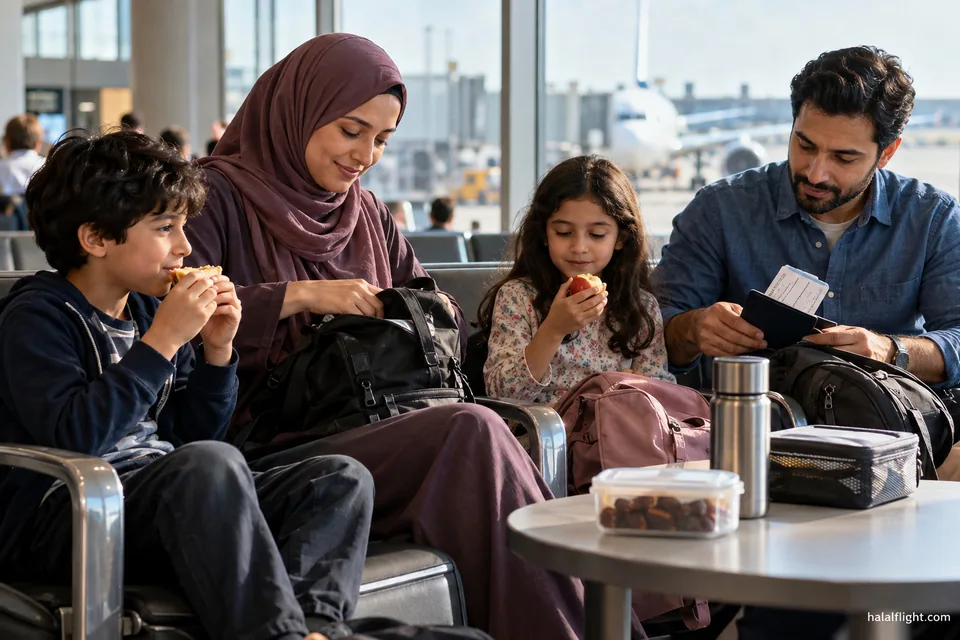
Pack snacks and drinks for queues and gate changes
Most family stress during a journey comes from gaps: a long security queue, a late gate change, a delayed boarding. Fill those gaps with food that is easy to reach and that you have already checked.
- Familiar snacks. Choose products your child already eats and that you know are permitted. Unfamiliar foods are riskier when a child is tired.
- Dry, low-mess options. Rice cakes, plain biscuits, fruit and nut-free bars travel well and reduce spills on clothing.
- A reusable bottle. Fill it after security, so that the children can drink between meals.
- Wipes and a spare top. Useful for every age and easy to forget.
Keep the food in a single bag that the supervising adult carries on their body, not in a bag that has to go through a conveyor or overhead locker while the child is hungry.
Baby food, formula and cooling at security
Rules on liquids differ by country, so check the security rules for each airport on your route before you pack. As an example, the US Transportation Security Administration says that formula, breast milk, toddler drinks and baby food, including puree pouches, may be carried in the cabin in amounts over the usual 100 millilitre limit. It asks travellers to tell the officer at the start of screening and to take these items out of the bag so that they can be screened separately. It also says that ice packs and gel packs used to keep these items cool are permitted.
Other countries have their own rules, and they can differ for the departure airport and for any connecting airport. Look at the airport or national security authority website, or ask the airline, if the route includes several countries.
For perishable food, plan how you will keep it cool and how long it will be before you eat it. An insulated bag with a freezer pack helps for a short journey, but food that has been out of refrigeration for hours should be discarded.
Share the work around sunset and boarding
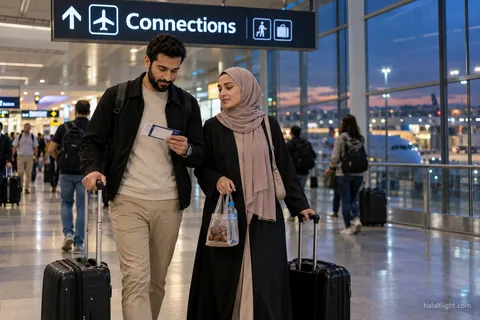
The hardest moment of the day for a fasting parent is often the one where iftar, boarding and the children all arrive together. If boarding is called near sunset, there is a real risk that nobody is eating or watching the bags.
Agree before the journey who does which job:
- One adult handles passports, boarding passes and the bags.
- The other adult stays with the children and gives them their meal first.
- Whoever is fasting breaks the fast with a few dates and water as soon as the time comes, and eats more once seated.
- If you are the only adult, keep your own food in the same pocket as the children's snacks so that you do not need to open another bag.
Choose a meeting point in the terminal before you split up, and make sure older children know where it is and what to do if they get separated.
Checklist for a family flight in Ramadan
Go through this list a week before travelling, and again on the morning of the flight.
- Decide who is fasting and who is not, and write it down.
- Request child meals and any Muslim or special meals for each child, and keep the confirmations.
- Check the airline's allergen policy if any child has an allergy.
- Pack permitted snacks, a bottle and wipes in a bag the supervising adult carries.
- Check security rules for baby food and liquids at every airport on the route.
- Check sunset at departure and arrival, and plan where the first meal will be eaten.
- Agree the sharing of tasks at boarding and a meeting point.
- Tell the cabin crew at the start of the flight if a child needs a meal early or a parent is waiting for iftar.
If the flight is delayed or the meal request is lost, fall back on the food you brought, and see the guide on flight delays during Ramadan.
Frequently asked questions
Do young children have to fast on a flight during Ramadan?
The UK Islamic Mission explains that children are not required to fast before puberty. Many families let children try short or partial fasts when they are ready and in good health. For a specific child, especially one with a medical condition, ask a qualified scholar and a doctor.
Is a child meal on a plane automatically halal?
No. A child meal label describes the passenger and the portion style, not the religious status or allergen content. Check the airline's halal policy and how it handles a combined child and Muslim meal request, and request it before the airline's deadline.
Can I take baby food and milk through airport security?
Usually yes, but the rules depend on the airport and country. The US TSA, for example, allows formula, breast milk and baby food over 100 millilitres in the cabin if declared and screened separately. Check the rules for every airport on your route before you pack.
What if my child needs to eat while the adults are still fasting?
Children who are not fasting should eat and drink as normal. Give them their usual meals and snacks on schedule, in the seat or at the gate, and let the fasting adults wait for sunset. Ask the crew for the child meal early if the service is late.
How do I handle iftar if boarding is called at sunset?
Keep a few dates and a bottle of water in an easy pocket, and agree in advance which adult looks after the bags and the children. Break the fast with the dates when the time comes, then eat a proper meal once everyone is seated.