Start with your own airline's rule
Zamzam carriage is not governed by a universal allowance. What is accepted depends on the operating airline, the departure airport, the type of ticket and whether you are connecting to another flight. Buying water on the assumption that a pilgrimage package or a general baggage allowance covers it is the most common way to end up with a container that cannot be flown.
The questions to settle before purchase are simple:
- Which airline operates each sector of the journey, including any codeshare or separate ticket?
- Does that airline accept Zamzam at all from your departure airport?
- What container does it require, and how many may you carry?
- Where is the container accepted: as a separate item at check-in, in the hold, or not at all?
Read the airline's own published conditions and, if they are unclear, ask its baggage or pilgrimage desk in writing. A screenshot of the answer is worth having on the day.
What Qatar Airways publishes
Qatar Airways has a trade-portal notice on Zamzam handling, last updated on 18 February 2025. It says that the water must be in a bottle built for flying, supplied through the King Abdullah bin Abdulaziz ZAMZAM project, and that only officially approved Zamzam water may be carried in line with civil aviation instructions.
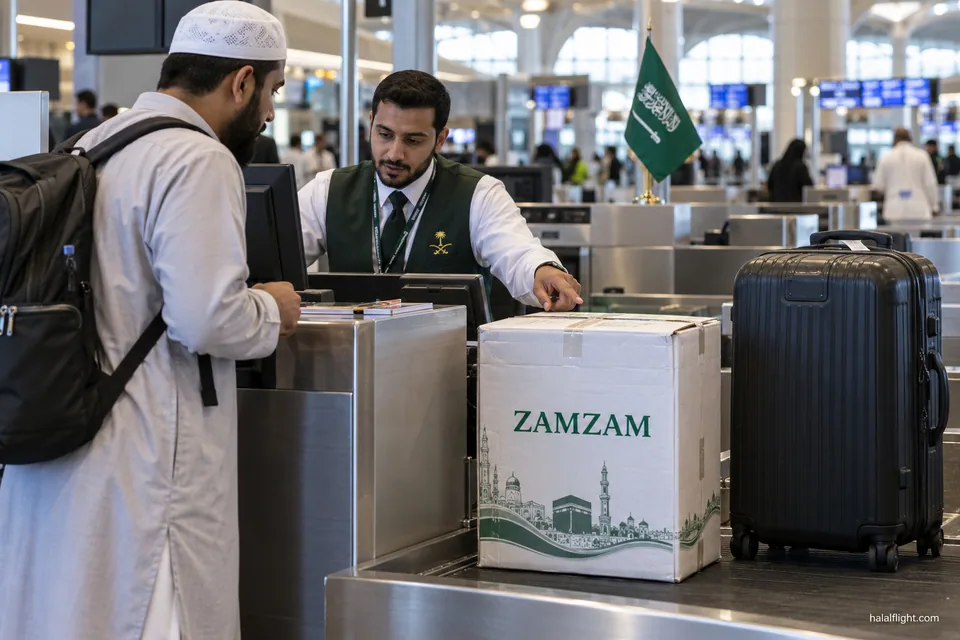
The notice states that Zamzam must not be carried in the cabin and must not be placed inside check-in baggage. It allows a maximum of one bottle of five litres per passenger. The rules cover travel from Saudi Arabia, and the water is accepted at the Saudi airports served by the airline except for TUU and AHB.
It does not describe in detail how the bottle is checked in if it cannot go in the hold with your luggage, so ask the airline how the separate handling works at your airport. Read the notice again before you travel, since carriers revise such rules.
What Gulf Air publishes
Gulf Air sets out conditions for officially approved containers and for separate handling on its special baggage page. Its rules are framed around eligibility, an authorised package and a dedicated check-in process, not around a traveller's own bottle.
The practical consequence is that an ordinary bottle filled by a traveller does not meet the acceptance conditions, whatever its size. You should use the authorised package that your carrier asks for, and follow the specific process for checking it in. The airline's website blocks automated reading, so the exact current wording should be confirmed directly on the page and, if needed, with the airline's contact centre.
Treat these two carriers as examples of a pattern, and not as a guide to what every airline does. A carrier that flies from a different airport may accept something quite different.
Approved packaging: the second requirement
Even where a carrier accepts Zamzam, the container is a separate requirement. The airlines above refer to officially approved packaging and not to a bottle brought from home. Filling your own container, or decanting from a larger one, is likely to be refused at check-in or at security.
King Abdulaziz International Airport describes a process that shows how the system works in practice. A passenger buys an official, pre-packaged container at a distribution point and then takes it to a wrapping station, where it is sealed and approved for travel. The airport states that travellers cannot fill their own containers or bring their own containers to the distribution points, and that the limit is one bottle per passenger.
Other airports run their own versions of the process, with different counters and conditions. Look for the airport operator's own page, and do not rely on advice from social media or from a friend who flew months ago.
Do not confuse separate check-in with packing in a suitcase
Wording matters here. A rule that allows Zamzam to travel in the hold as a separately checked item is different from a rule that allows it inside a suitcase. The Qatar Airways notice excludes the water from check-in baggage and from the cabin, so a bottle wrapped in clothes inside a suitcase is not what it permits.
The King Abdulaziz airport page, meanwhile, says that most airlines allow up to five litres in checked bags and that one sealed bottle may go through security. These statements do not line up neatly with the carrier notice above, which is a reminder that an airport page cannot replace the airline's own rule. Where they disagree, follow the airline you are flying and ask the airport which process applies.
Connections and separate tickets
If your onward journey changes airline, or uses a separate booking, check each carrier's rule. The water that is accepted on the first sector may be refused on the next, and a transfer may require you to collect and recheck the container.
Buying water does not confirm baggage acceptance
Madinah Airport publishes an official sales point and the requirements for buying there, and King Abdulaziz airport lists distribution points and wrapping stations. These are useful, but a purchase is only the first step. The seller establishes that the product is official; the airline decides whether it will carry it.
Before you pay, confirm the airline's quantity limit, whether your fare or destination is eligible and where the container must be presented. Keep the receipt, because staff may ask for proof that the container came from an approved source, and carry your passport and boarding pass, as the sale or wrapping step may require them.
Airports may also limit sales by passenger, so a family should not assume that one person can buy for everyone. Hours may be restricted during peak pilgrimage periods, so allow time. The airport states that counters usually operate around the clock, but advises confirming service times with staff or the airline.
Organised pilgrim groups
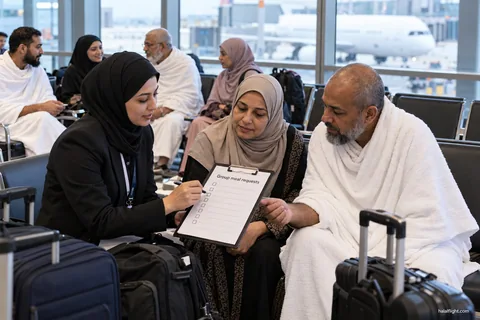
Some organised journeys include their own arrangements for Zamzam, such as collection, group allowances or distribution at the destination. If you travel with a tour operator, ask what applies to your booking before you buy a container yourself, and avoid buying a duplicate. A group allowance or a change of aircraft on the way home can alter how the water is moved.
Pilgrims should also ask who is responsible if the water is refused. Some operators will arrange delivery or compensation, while others leave the traveller to deal with the airport. Having the answer in writing avoids a dispute at the counter.
For what to eat and drink during the pilgrimage journey itself, the related pages on meals for pilgrims cover the catering side; this page concerns only the carriage of Zamzam.
Checklist if you plan to take Zamzam home
- Identify every airline on your itinerary and read each one's published Zamzam rule.
- Ask the airline in writing how the container must be checked in, and keep the reply.
- Buy only an official, approved container from the sales point or distribution counter your airport names.
- Do not fill, refill or decant a container yourself.
- Check the quantity limit, such as the one-bottle limit stated by the carrier, before buying more than one.
- Allow extra time for sealing, wrapping and a separate check-in step.
- Keep your passport, boarding pass and receipt together.
- If a carrier refuses the container, ask the staff for the reason and the correct process, and ask whether the airport has a collection or storage service.
If something goes wrong at the counter, remain polite, ask which official rule applies and contact the airline's customer service for a ruling, since the staff in front of you may not have discretion.
Frequently asked questions
Can I carry Zamzam water in my hand luggage?
It depends on the airline and airport. Qatar Airways states that Zamzam must not be carried in the cabin, while King Abdulaziz International Airport describes one sealed bottle going through security after wrapping. Confirm your own carrier's rule in writing before you buy, because the two sources do not agree.
Can I pack Zamzam inside my suitcase?
Do not assume so. The Qatar Airways notice says the water must not be placed inside check-in baggage and describes a separate handling process instead. Gulf Air also refers to separate handling and approved containers. Ask your airline how the water should be presented at check-in.
Can I fill my own bottle with Zamzam water?
No airline or airport mentioned here accepts that. King Abdulaziz International Airport states that travellers cannot fill their own containers or bring their own containers to its distribution points, and the airlines refer to officially approved packaging. Buy the sealed container the airport or airline names.
How much Zamzam water can I take on a flight?
Qatar Airways allows a maximum of one bottle of five litres, and King Abdulaziz airport states one bottle per passenger. Other carriers may set different limits or none at all. Check the airline's published figure for your route before buying, and do not exceed it.
What if I am connecting to another airline on the way home?
Each carrier applies its own rule, so a bottle accepted on the first flight may be refused on the next. Check the policy of every airline on your itinerary and ask how connecting baggage is handled, especially if you hold separate tickets or must collect and recheck your container.