Why a charter is different from a scheduled flight
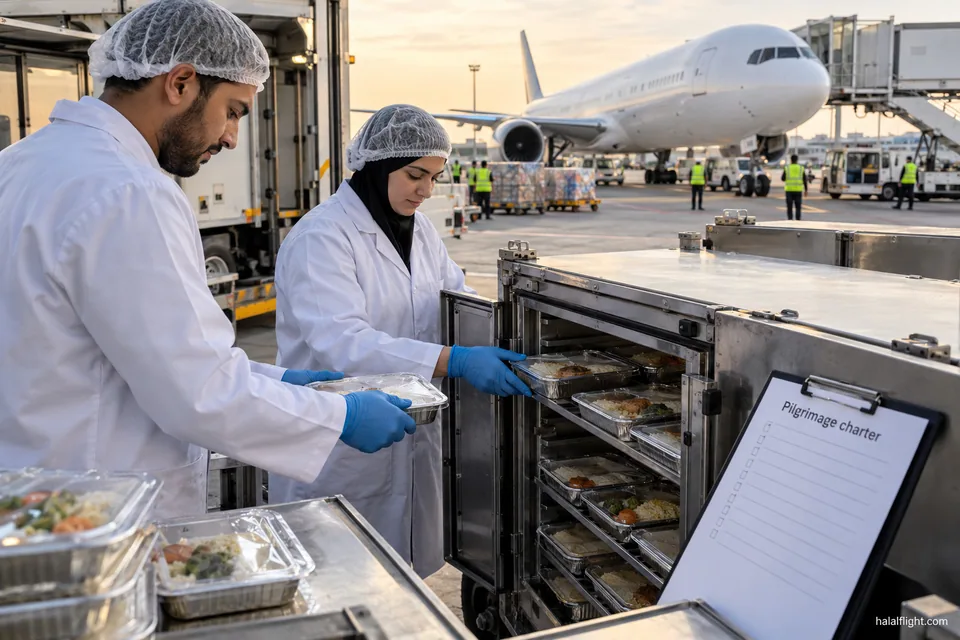
On a scheduled flight, you book directly with an airline, read its published meal policy and choose a special meal from a list. A pilgrimage charter works differently. A tour company or group organiser sells the package, a separate airline or operator supplies the aircraft and crew, and a catering company may prepare the food at each airport. The name on the brochure is not necessarily the name on the aircraft.
That has a direct effect on halal assurance. A promise of halal food from an organiser tells you what the organiser intends, but it does not show what the catering contract at a particular airport actually covers. For a group trip, the useful question is not whether the food is halal in general, but who supplies it, at which station, under which assurance and with what paperwork.
This page is about the catering arrangements behind a charter. Choosing meals for individual pilgrims, rules for Zamzam water, and eating during ihram are covered in the related guides on this site.
Identify the operator and the caterer at every station
Before paying a deposit, ask the organiser to name the operating airline, the aircraft operator if different, and the caterer used at each departure airport. A return leg from the Hijaz may use a different caterer from the outbound leg, and a stopover can add another.
- Which company operates the aircraft on each leg?
- Which company prepares and loads the food at each departure station?
- Does the halal assurance cover that specific caterer and kitchen, or only the airline's general policy?
- Who holds the certificate or supplier statement, and can the organiser show it?
If the answer is that the airline looks after this, ask the airline directly for its written statement on halal catering. A charter operator that normally flies scheduled services may have a policy that applies, but only the operator can say whether it applies to your group contract.
What halal assurance normally means for a caterer
Halal assurance is not a single universal standard. Different countries and certifying bodies publish different requirements, and some caterers rely on a supplier declaration rather than a third-party certificate. As an example of what a certification scheme can require, the Singapore licensing portal for the Islamic Religious Council of Singapore, known as MUIS, states that all raw materials must be halal and supported by documents, that premises need a minimum number of Muslim staff, and that the applicant must follow the scheme's quality management principles. It says certification is valid for one to three years.
This is a Singapore scheme and it does not apply to every airline kitchen. It does show the kind of evidence worth asking for: ingredient sourcing, staffing, a management system and a certificate with a validity date.
When you ask for evidence, check the name of the certified premises, the scope of what is certified, and the date. A certificate for a retail outlet does not cover an airline kitchen, and an expired certificate does not cover a current flight.
Get meal commitments into the booking information
A brochure that says a pilgrimage package includes meals on the flight does not tell you much. For a group booking, ask for a written description of what is included, in the same document as the price.
Points to ask for in writing
- The number of meals and snacks on each leg, including the return.
- Whether the meals are halal or Muslim meals, and who certifies this.
- How additional diets, such as vegetarian, diabetic or allergy meals, are handled.
- What happens if the flight is delayed or diverted, and who pays for extra food.
- Whether drinking water is provided in the cabin and in the departure lounge.
Written terms matter because group organisers change staff, operators and suppliers. Terms in the booking file are easier to rely on than a verbal promise from a sales agent.
Set a cut-off for individual requirements
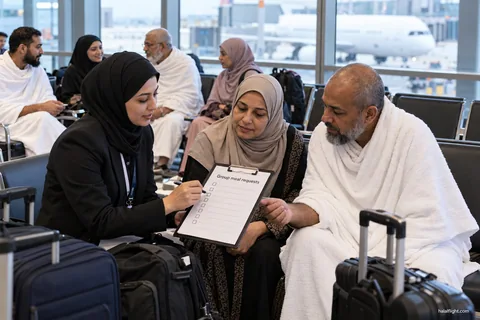
A charter group is a collection of individuals, and some of them will have diets or allergies that a standard group meal does not cover. A caterer cannot make a special meal at the door of the aircraft, so the organiser needs a clear process.
- Ask the operator for the deadline for special-meal requests for your departure.
- Set the organiser's internal deadline well before that date, so that there is time to collect and check the list.
- Collect each request on a form that names the traveller, the diet and any allergy.
- Ask for written confirmation that the list has been sent and accepted.
- Agree what happens for a late change, for example a traveller who falls ill or a replacement for a cancelled place.
A group size does not mean the kitchen will improvise. Larger groups, in fact, rely on forecasting from the caterer, and late changes are harder to accommodate.
Ask how substitutions will be communicated
Charter operations change. An aircraft may be swapped, a departure moved, a route altered, or a supplier replaced because of capacity. Ask the organiser how the group will be told if this affects the food.
A replacement operator or caterer does not automatically inherit the halal assurance of the original. Ask for a named contact who can confirm the change, for a current passenger list so that the organiser can reassess meal arrangements, and for confirmation that the new supplier meets the same requirements as the old one.
For pilgrims, a change of supplier on the return leg is the most likely source of confusion, because the group is tired and the organiser's attention is on baggage and transfers. Settle the question before departure instead of at the gate.
Use official pilgrimage rules as context, not as a meal certificate
The General Authority of Civil Aviation of Saudi Arabia publishes instructions for air carriers transporting pilgrims. These explain operational responsibilities and pilgrim baggage provisions. They are useful background for an organiser who wants to understand what carriers must do, but they are not a halal certificate for any particular meal, and they do not replace the catering confirmation for your flight.
In the same way, official guidance on the rituals of pilgrimage explains the stages and preparation for a journey, and not the sourcing of an airline meal. Keep the two questions separate. Rules about the pilgrimage journey belong with the official authorities and your group's scholar. Questions about how food was made and certified belong with the operator, the caterer and the certifier.
Checklist for organisers and group leaders
Use this list before confirming a charter, and again two weeks before departure.
- Name the operating airline, the aircraft operator and the caterer for each leg.
- Ask for a written halal statement from the operator and the caterer, with dates and scope.
- Put meals, snacks and water into the written booking terms.
- Set a deadline for individual diets and allergies, and send the list in writing.
- Agree who tells the group about a change of operator, route or supplier.
- Ask what is provided if the flight is delayed.
- Tell travellers to carry permitted snacks and water in their cabin bags as a backup.
- Keep copies of all confirmations with the group file.
If an answer is missing or unclear, treat it as unconfirmed and plan for it. A traveller can always carry dates, nuts and other permitted dry food.
Frequently asked questions
Is food on a Hajj or Umrah charter flight always halal?
Not necessarily by default. The answer depends on the operator, the caterer and the contract. Ask the organiser and the operating airline for a written statement covering each departure station, and check the certificate or supplier declaration if one exists. Without that, carry permitted dry snacks as a backup.
Who is responsible for halal catering on a pilgrimage charter?
Responsibility is often shared between the organiser, the operating airline and the caterer. The organiser sells the package, the operator flies it and the caterer prepares the food. Ask each of them who holds the halal assurance, and get the answer in writing before you pay.
Can individual pilgrims order special meals on a group charter?
Sometimes, but only if the operator accepts requests and the caterer receives them in time. Ask the organiser for the deadline, submit each request in writing with any allergy details, and ask for confirmation that it was sent. Do not assume the kitchen can improvise at departure.
What happens to the halal arrangements if the airline or caterer changes?
A replacement operator or caterer does not automatically carry over the original assurance. Ask the organiser for a named contact who will confirm the change, and ask for the new supplier's halal statement. If you cannot get it before departure, rely on your own permitted food.
Does a Saudi aviation instruction guarantee halal meals for pilgrims?
No. Official instructions for carriers transporting pilgrims cover operational duties and baggage, and are not a meal certificate. Treat them as background and check the catering confirmation for your own flight with the operator.