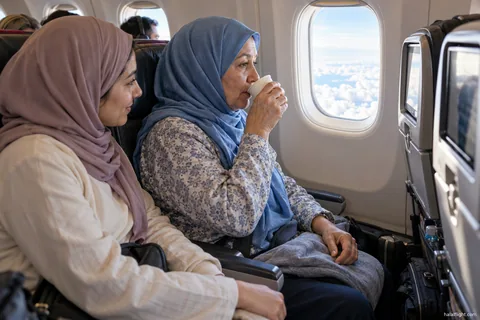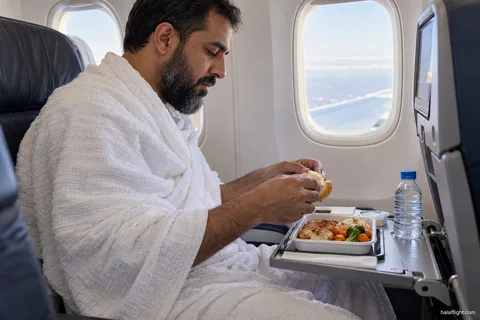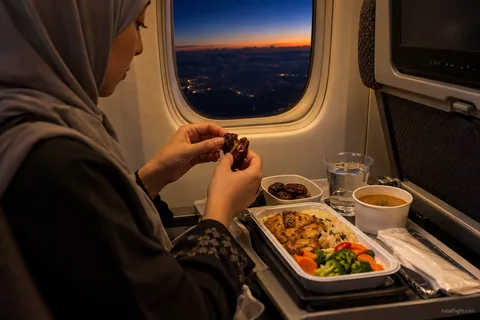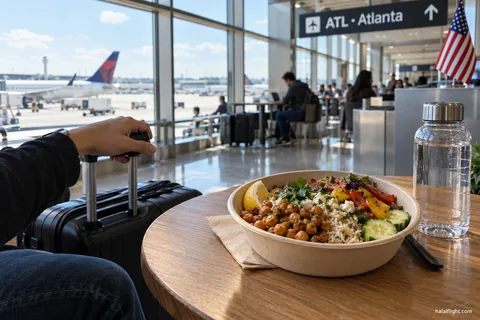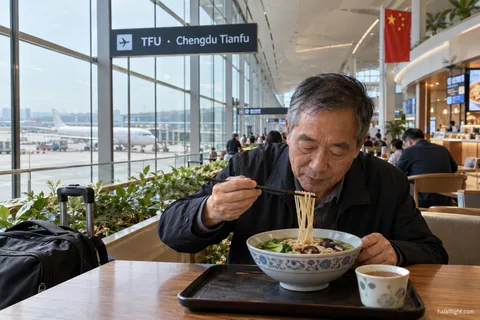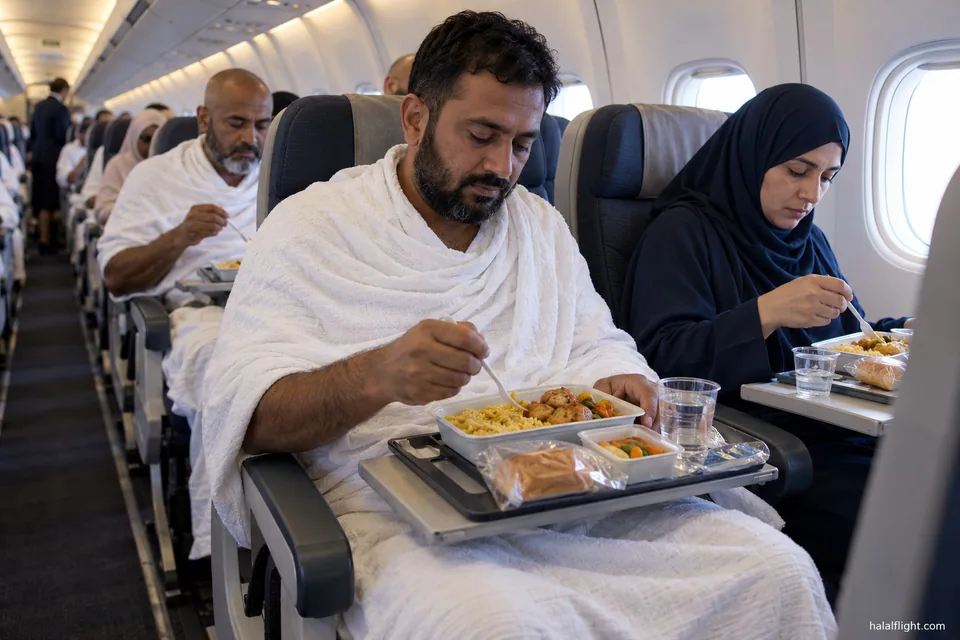
The operating airline decides what is served
A pilgrimage package is a travel product; the meal on your tray is a catering product of whichever airline operates that particular flight. Those two things are often assumed to be the same, and they are not. A package sold for Umrah or Hajj may combine a long-haul flight on one carrier with a short connecting flight, or a domestic Saudi sector, on another. Each carrier publishes its own statement about halal food, and the wording differs.
The first practical step is therefore to list every flight number in your itinerary and write the operating airline beside each one. The airline shown on the ticket can be a marketing partner while a different company flies the aircraft, so check the operating carrier named on the booking confirmation or on the airline's flight status page.
- Note the operating airline for every sector, including short connections.
- Find that airline's own page on special meals or dietary requirements.
- Look for a plain statement on halal, Muslim meals or pork and alcohol.
- Keep a screenshot of the statement together with your booking reference.
Three common ways airlines describe halal food
Reading airline pages side by side shows that the same word can mean different arrangements. Understanding the pattern helps you decide whether you need to request anything at all.
Everything on board is halal
Some airlines state that all standard meals are prepared to halal standards. Etihad's special meals page, for example, says that no advance request is needed for a halal meal because food on its own flights is prepared to halal standards. Turkish Airlines says that meals are prepared in accordance with Islamic dietary laws and that, in normal circumstances, all meals on its flights are halal. EgyptAir's page describes its standard meals as halal as well.
A separate Muslim meal must be ordered
Other airlines keep a dedicated Muslim meal, coded MOML, that has to be requested. Singapore Airlines is one example: its page says that on flights departing Singapore the Muslim meal is prepared in a halal-certified kitchen with halal-certified ingredients, while on flights departing other airports the meals contain no pork, lard, pig by-products or alcohol and halal-certified meat and poultry are sourced where operationally feasible.
Pork and alcohol free, without full certification
A third group avoids pork and alcohol but does not claim halal slaughter for every item. The wording matters, because a menu that is free of pork is not automatically halal-slaughtered. Read the sentence carefully rather than relying on a general reputation.
These examples show how the statements read at the time they were checked. Policies change, so read the live page before you fly.
Requesting the meal and meeting the deadline
Where an advance request is needed, the airline sets the deadline and the channel. Turkish Airlines, for instance, states that special meals can be requested up to 24 hours before the flight, and Etihad says most special meals need at least 24 hours' notice. Singapore Airlines publishes different cut-offs by departure city, some of them well over a day and a half before departure. A deadline that works for one airline can be too late for another, so read each carrier's page rather than using a single rule for the whole trip.
Requests can usually be made at booking, through a manage-booking page, through the airline's call centre or via a travel agent. If a tour operator issued your ticket, ask the operator whether meal codes have already been entered, and ask for written confirmation naming each flight.
- Open the airline's special meals page and note the deadline and the code.
- Add the request to each flight in the booking, not only the first.
- Check the booking again a few days later to see that the meal still appears.
- Ask the airline directly if the page does not mention halal at all.
Partner flights and codeshare sectors
Special meal availability is usually limited to the airline's own aircraft. Etihad's page makes this point explicitly: special meals are available only on Etihad-operated flights, and for partner airlines you contact the partner directly. The same logic applies to almost every carrier.
If your itinerary includes a codeshare, do not assume that a request entered with one airline will be passed on. Contact the operating airline, quote the booking reference, and ask in plain words whether a halal or Muslim meal can be provided on that flight. If the answer is vague, plan to carry suitable food of your own, subject to security rules and any limits on liquids.
Short flights deserve the same attention. Some airlines serve only a snack, or restrict the choice of special meals on flights under a certain duration. Etihad states that on its flights under 2 hours 50 minutes only some dietary and medical meals can be requested, so check what a short sector actually offers before relying on it for a meal.
Health diets alongside the halal requirement
A halal meal answers a religious requirement. It does not automatically meet a medical one. Diabetes, a nut allergy, coeliac disease, high blood pressure or a low-salt diet are separate needs, and airlines treat them as separate meal codes. Some carriers allow only one special meal per passenger per flight, which can force a choice. Singapore Airlines states that only one type of special meal can be selected per flight.
Airlines are also cautious about guarantees. Etihad notes that its gluten-free meal is not suitable for people with coeliac disease because gluten-free content cannot be guaranteed, and several airlines say they cannot accept responsibility for allergic reactions on board. If a reaction could be serious, speak to your doctor before travelling and bring your own safe food.
Diabetes and pilgrimage travel
The Saudi Ministry of Health advises pilgrims with diabetes to eat regular meals and snacks during the journey, to carry snacks for low blood sugar, to bring enough medication for the whole trip and to carry a medical report. Its guidance also says not to start rituals until treatment has been taken and a proper meal eaten. Your own doctor decides what is right for you.
Meals, group travel and the organiser's role
On group tickets the organiser often handles special requests. That is convenient, but it adds a step where information can be lost. Ask the organiser for the list of meal codes entered against your name and the date they were submitted. The detailed process for building group lists belongs to a separate page on meal requests for groups; for your own trip, the key point is that you should see the confirmation, not only be told that it has been arranged.
If your group travels on a charter, the catering may be arranged differently from a scheduled flight. Ask the organiser which airline operates the charter and whether the caterer holds halal certification, and ask for the answer in writing.
Timing, hunger and waiting after landing
The airborne meal is only part of the journey. Boarding can start hours before departure, and after landing there are immigration queues, baggage reclaim and coach transfers that may take longer than the flight itself. Ask your organiser when the next proper meal is expected after arrival, and carry something permitted and easy to eat, such as dried fruit, nuts or plain biscuits, unless you have an allergy.
Meal service and ritual preparations can overlap on some itineraries. Cabin crew run a fixed service and cannot be expected to change it for one cabin of passengers, so discuss timing with your group leader and consult the official pilgrimage guidance for your situation. Questions about what is permitted during particular ritual states belong to the sibling page on food while wearing ihram.
The return flight is a new catering order
Catering is uplifted at the departure airport, so the return from Jeddah or Madinah is supplied by a different kitchen from the outbound flight, even on the same airline. Policy statements may still apply, but menus, suppliers and meal codes can differ. Treat the return as its own request.
- Check that the meal code is still attached to the return flight after any schedule change.
- Reconfirm with the airline before leaving your accommodation, if the airline allows it.
- Keep snacks for the transfer to the airport, which can be long.
- If the return uses a different airline from the outbound, read that airline's policy again.
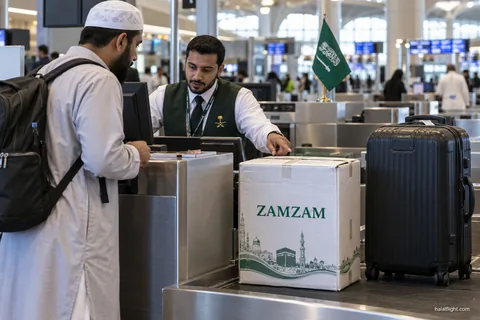
Rules for carrying Zamzam water are separate from meal availability and are covered on their own page.
Checklist and what to do if the meal is wrong
Use this list before departure, then keep it with your documents.
- Operating airline written down for every flight.
- Screenshot of each airline's halal or Muslim meal statement.
- Meal code entered on every sector and visible in the booking.
- Medical or allergy needs raised separately and in good time.
- Snacks and water for the airport, transfers and arrival.
- Organiser's contact number and your booking references in one place.
If the meal does not arrive or is unsuitable
Tell the cabin crew politely as soon as you notice, show the confirmation on your phone, and ask what can be offered. Crew cannot always produce a replacement, particularly when the meal was never loaded. Eat what you can confirm is acceptable to you, and ask your organiser or scholar about anything uncertain rather than guessing. After the trip, write to the airline's customer relations team with your booking reference, flight number and date. A clear, factual complaint is more likely to lead to a response than a general one.
Frequently asked questions
Do I need to order a halal meal for a flight to Jeddah or Madinah?
It depends on the operating airline. Some state that all meals are halal and need no request, while others keep a separate Muslim meal that must be ordered before a deadline. Read the airline's own special meals page for each sector and request the meal if there is any doubt.
Is a pork-free meal the same as a halal meal?
Not necessarily. A pork-free and alcohol-free meal avoids two prohibited items but may not claim halal slaughter of the meat. Airlines word this differently, so read the exact statement and ask the airline if it is unclear. Questions about acceptability for you personally are for a qualified scholar.
Can I ask for a halal and a diabetic meal on the same flight?
Some airlines allow only one special meal type per flight, so you may have to choose. Ask the airline whether a combined option exists, tell your doctor about the limit, and carry suitable snacks so that your blood sugar is not left to chance.
Who arranges meals if my Umrah package uses two airlines?
Each operating airline caters its own flights, and a request made with one carrier is not always passed on to the other. Ask your tour operator for confirmation per flight, and contact the second airline directly if the confirmation is missing.
Will the return flight serve the same food as the outbound?
Do not assume so. Catering is loaded at the departure airport, so the supplier and menu can differ even on the same airline. Check that your meal request is still attached to the return booking and reconfirm before you leave your accommodation.