What you can and cannot rely on at CDG
Paris Charles de Gaulle (CDG) is a large airport with several terminals and many separate departure areas. The airport operator, Paris Aéroport, publishes a restaurant directory, a terminal map and a services map for it. These tools tell you where a food outlet is. They do not tell you whether a dish is halal, and none of the sources used for this guide states that any particular outlet is certified.
That shapes the whole approach. Treat the official pages as a way to build a shortlist of outlets you can actually reach, then check the food itself with the staff or the packaging. Where a menu or label cannot answer your question, choose something simpler rather than guessing.
- Reliable use of the airport pages: finding which terminal and zone an outlet is in, and whether it sits on your route.
- Not a reliable use: assuming that a listing, a cuisine type or a name implies halal preparation.
- Best habit: decide what you need to avoid before you arrive, so the questions are quick when you reach the counter.
Individual religious rulings, for example on cross-contact or on non-halal meat served in the same kitchen, belong to a qualified scholar. This page only helps you gather the facts those rulings depend on.
Pin down your exact terminal, zone and security status
Saying that you fly from Terminal 2 is not precise enough at CDG. Terminal 2 is subdivided into lettered halls, and other terminals have their own departure areas. Before you look at food, write down three items from your booking or the airline app: the full terminal designation including the letter, the departure area or gate range if known, and whether you have already passed security or border control.
Why the letter matters
A restaurant in a different building may be a long transfer away, and some journeys between areas involve extra checks. A recommendation from a friend who flew from another hall can therefore be useless for your flight. Record the letter, then check it against the terminal map rather than against memory.
Airside or landside
Food outlets before security are open to everyone; those after security are only for passengers who have cleared it. If you are transferring, ask your airline or the information desks whether you will pass through additional control. Buying a meal on the wrong side of a boundary can leave you holding food you cannot take through, or having to walk back.
- Note your terminal letter and flight number in your phone.
- Check whether your connection is a same-terminal change or a move between terminals.
- Look at the boarding gate again before you order a cooked dish; gates can be reassigned.
Using the official directory and maps together
Paris Aéroport runs more than one airport, so make sure you are on the CDG pages and not a listing for Orly. The CDG restaurant directory lists outlets and lets you see where each one is. The terminal map shows the layout of the buildings and departure areas, and the services map shows other facilities you may want on the same walk.
A simple three-step routine
- Open the CDG terminal map and mark the area of your gate.
- Open the CDG restaurant directory and keep only outlets in that area, on the correct side of security.
- Open the services map to see what else lies on the route, so one walk covers food and any other stop.
These pages are run on a protected website and may load slowly or ask for confirmation that you are a person. If a page will not open on your phone, try again on a different connection, or ask at an information desk once you are in the terminal. Opening hours change, so a place that looks suitable the evening before may be closed at an early departure.
Recommendations from other travellers can be a useful starting point for names to look for, but they age quickly and do not replace asking on the day.
Questions to ask, with French wording
The phrase sans porc (without pork) answers a narrower question than the one most Muslim travellers are asking. A dish can be free of visible pork yet contain lardons, a stock made with pork bones, gelatine or wine. Likewise, a vegetarian dish can be sauced with alcohol. Ask about the specific items, not just the headline ingredient.
Useful phrases
- Est-ce que ce plat contient du porc, des lardons ou du jambon ? Does this dish contain pork, bacon pieces or ham?
- Le bouillon est-il à base de viande ? Is the stock meat-based?
- Y a-t-il de l’alcool ou du vin dans la sauce ? Is there alcohol or wine in the sauce?
- Y a-t-il de la gélatine ? Is there gelatine?
- La viande est-elle halal ? Is the meat halal? Follow up by asking how they know, for example whether a supplier document exists.
Staff at a busy counter often know only what the kitchen has told them. A confident answer of the kind I will check the label for you is more useful than a quick yes. If the person is unsure, or the answer changes when you press for detail, treat the dish as unconfirmed.
It also helps to have the question written in your phone in French so you can show it, particularly if the queue is long or you are tired after a night flight.
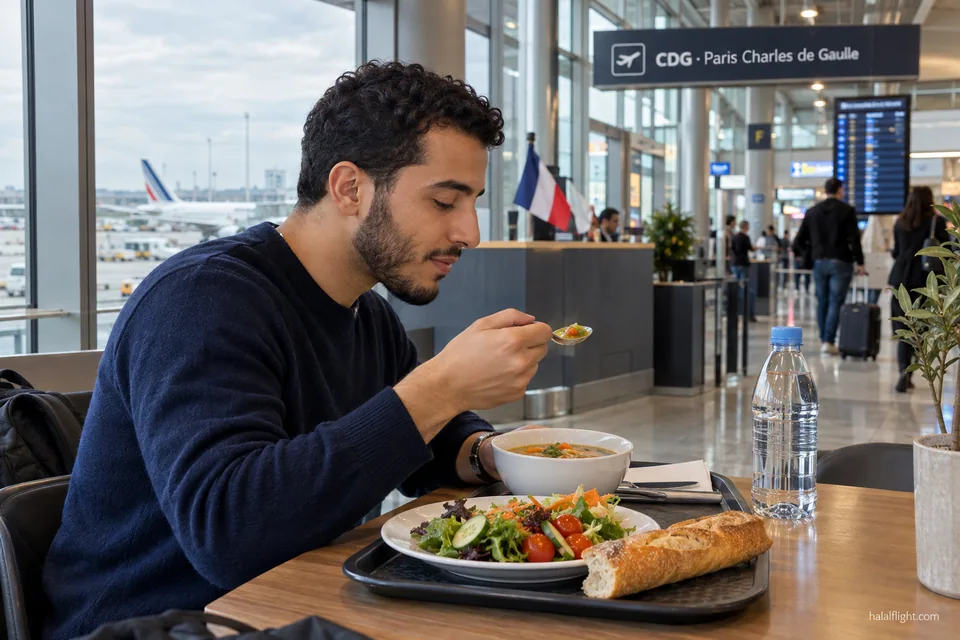
Soups, salads and bakery items
Simple-looking food is where hidden ingredients tend to sit, so these categories deserve specific questions.
Soup
Ask whether the base is vegetable or meat stock, and whether bacon, lardons or cream have been added at the end. Soups are often made in a central kitchen and reheated, so the person serving may not know the recipe. A printed ingredient list on the container is a better source than a recollection.
Salads
The salad leaves are rarely the issue. The toppings and dressing are: lardons, ham, chicken of unknown source, and vinaigrettes or sauces that can contain wine vinegar or other alcohol-based flavourings. Ask for the dressing separately if you cannot confirm it, and choose toppings you can identify.
Bakery and sandwiches
A baguette or plain bread is usually straightforward, but pastries and filled sandwiches are not. Check for cheese made with animal rennet if that matters to you, for gelatine in glazes and creams, and for ham or other cured meat. A sandwich labelled with its ingredients lets you decide at once; an unlabelled one needs a question.
- Choose a labelled product over a loose one when both are available.
- Ask whether a change, such as removing a topping, can be made without cross-contact if that is important to you.
- If nobody can answer clearly, pick a plain item such as fruit, nuts or a sealed snack.
Reading packaged food in French
For packaged food, the label is your best evidence. In France the ingredient list is printed in French, and allergens are highlighted in the text. A halal logo, if present, tells you who certified the product, so look for the name of the certifying body and treat an unfamiliar or unnamed symbol with caution.
Words worth recognising
- porc, jambon, lardons, saindoux: pork, ham, bacon pieces, lard.
- gélatine: gelatine, whose animal source may not be stated.
- vin, alcool, bière, rhum, liqueur: wine, alcohol, beer, rum, liqueur.
- arôme: flavouring, which can occasionally carry an alcohol solvent; ask the manufacturer if this matters to you.
- présure: rennet in cheese, which may be animal or microbial.
Some additives are listed only by number, and their source can be plant, animal or synthetic. Scholars and certification bodies take different positions on several of them, so if an item is important to you, check with the producer or follow your own scholar’s guidance rather than relying on a quick judgement at the shelf.
Take a photo of the label if you are unsure. It lets you look up the product or ask someone you trust before eating.
Fitting a meal into a short connection
A meal stop should not put the flight at risk. The official terminal map is the best tool for judging how far you must walk, but it cannot account for queues at security or passport control. Work backwards from the boarding time on your pass, not from the scheduled departure.
Timing rules of thumb
- If you must change terminals, shop for food only after you know the route and whether it passes through further checks.
- Buy something portable when time is tight, and eat it near the gate.
- Do not take a cooked dish away from the counter if you cannot finish it before boarding; ask for a sealed option instead.
If you are fasting, for example during Ramadan, plan for the sunset time at your location rather than at your destination, and decide in advance where you will break the fast. Another page on this site covers planning connections during Ramadan in more detail, so only the airport-specific point is made here: buy and check your food before you need it, because the end of the fast is a poor time to be searching for answers.
If prayer is part of your stop, use the services map to see what facilities are listed for the area you are in, and confirm on the day with an information desk, since access may differ before and after security.
Checklist and what to do if nothing is suitable
Even with careful planning, a counter may not have what you need or may not be able to answer. Carrying a modest reserve avoids having to compromise.
Before you leave home
- Write down your terminal letter, departure area and flight time.
- Open the CDG directory and terminal map and shortlist two or three outlets in your zone.
- Save the French questions above on your phone.
- Pack a sealed, non-perishable snack for the journey, within the airline’s rules for carry-on food.
At the counter
- Ask about the specific ingredients, not only about pork.
- Prefer products with an ingredient list you can read.
- Do not pay until you have an answer you are comfortable with.
If it goes wrong
- If you cannot verify a dish, buy plain items such as fruit, plain nuts or a sealed bottle of water.
- If you discover an ingredient you meant to avoid after you have started eating, stop, and ask a qualified scholar how your situation is treated; do not rely on a general rule.
- If your onward flight includes a meal, check whether you ordered a special meal in advance through your airline, as that is a separate arrangement from airport food.
Frequently asked questions
Is there a halal restaurant at Paris Charles de Gaulle airport?
The official directory lists outlets by terminal but does not label them as halal, and the sources checked for this guide do not confirm any specific certified outlet. Use the directory to shortlist places on your route, then ask staff about the meat source and ingredients, or look for a named certifier on packaged food.
What does sans porc mean and is it enough?
Sans porc means without pork. It does not mean halal, because the dish may still contain gelatine, alcohol in a sauce, or meat that was not slaughtered according to your requirements. Use it as a starting point and then ask about stock, sauces, gelatine and the origin of any meat.
Can I find food after security on the same terminal letter as my gate?
Usually the directory and terminal map let you see which outlets are in your departure area. Check the terminal letter and whether the outlet is before or after security, since opening hours and layouts change. If you are transferring between terminals, confirm the route and any extra checks with your airline first.
How can I ask about alcohol in a sauce in French?
You can ask: Y a-t-il de l’alcool ou du vin dans la sauce ? If the answer is unclear, ask whether you can have the dish without sauce, or choose a labelled item instead. Staff may only know the headline ingredients, so a printed ingredient list is more reliable than a spoken answer.
Is airport bread and pastry safe to eat if I avoid pork and gelatine?
Plain bread is often simple, but pastries, glazes, creams and filled sandwiches can include gelatine, animal-derived ingredients or ham. Read the label or ask staff for each item. Where you cannot confirm the ingredients, choose a different product, and consult a qualified scholar for any rulings that depend on your circumstances.