Is there suhoor on a plane? What airlines actually offer
For most flights the honest answer is that there is no dedicated suhoor service. Airlines run their catering around departure and arrival times, so a meal labelled breakfast on your itinerary may be served well after dawn, or an overnight flight may have a late dinner and nothing before the sun rises at your position.
A few carriers have published Ramadan programmes that touch the pre-dawn meal. Emirates said in a 2022 announcement that its Ramadan boxes were served on selected destinations at iftar or suhoor times, and that at some gates dates and water were available during iftar and suhoor boarding. Its 2026 announcement describes iftar boxes and in-flight imsak and iftar timing but does not mention a suhoor service. A 2023 Qatar Airways release carried suhoor in its headline, yet the text described only iftar.
The lesson is to read the announcement for your own season, to ask the airline about your flight and to plan as if nothing will be served. This page covers the food and the timing around the pre-dawn meal on board. Airport departures and sleep patterns are covered in separate guides.
Why an airline breakfast is not the same as suhoor
Suhoor is eaten before dawn, so that the fast begins with some food and drink inside you. Airline breakfast follows the operational timetable: it is usually served a set time before landing, whatever the sun is doing.
This matters in two ways. On an eastbound night flight, a breakfast served an hour before landing may come after dawn at your position, which is too late to count as suhoor. On a westbound flight, dawn can be delayed and a breakfast may arrive early. Neither case is a fault of the airline; the meal simply was not planned around a fasting schedule.
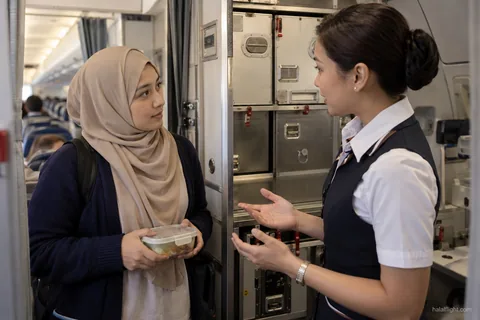
Ask the crew on boarding when the meal services are planned and whether a lighter early service can be offered to fasting passengers. Some crews are glad to help, others are limited by workload, and a polite request made early gives the best chance.
Working out when the pre-dawn meal must end
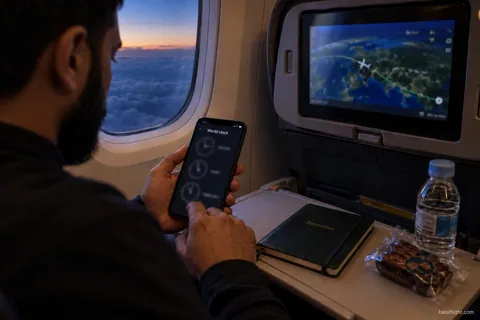
The end of the pre-dawn meal is set by dawn, not by sunrise, and dawn on a moving aircraft is not the same as dawn at your home or destination. Emirates describes an in-flight tool that calculates imsak, the start of the fast, and iftar from the aircraft's longitude, latitude and altitude and the sunrise and sunset times for the area it is passing over.
Egypt's Dar al-Ifta discusses the same principle in its fatwa on breaking the fast on a plane, noting that higher elevation means sunset comes later and sunrise earlier for the person concerned, and it extends the reasoning to the dawn times for prayer and suhoor. Some carriers announce the time, others do not. If yours does not, you will need to choose a method with your religious adviser before you fly.
A practical habit follows: finish eating a good margin before the time you have decided on, rather than aiming for the last minute. In a dark cabin you cannot check the horizon yourself, so a margin protects you from mistakes.
Food that does not depend on the galley
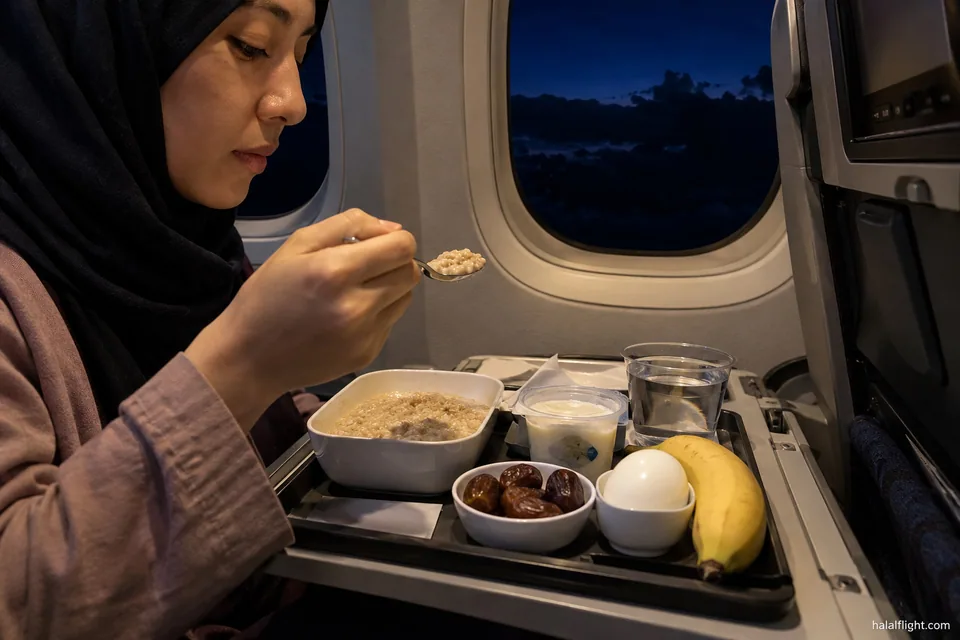
The surest way to have suhoor on a plane is to carry it. Crew may not be able to heat items, the galley may be busy and lights are often dimmed. Food that is safe at room temperature, easy to open in a narrow seat and permitted under your hand-luggage rules avoids all of that.
What suits a pre-dawn meal
The Northern Care Alliance, an NHS organisation, recommends slow-releasing carbohydrates such as oats or wholemeal bread at suhur, with protein such as eggs or yoghurt to stay full longer, and plenty of water between iftar and suhur. On a plane, that translates into practical choices:
- Wholemeal bread or a plain wrap with a filling that does not need cooling for long.
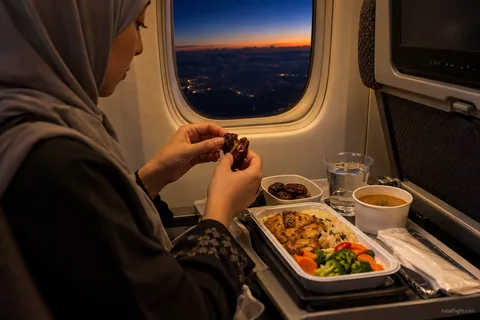
- Dates, which are compact and keep well.
- Nuts or a cereal bar, if you are not allergic and the airline permits them.
- A sealed water bottle filled after security, and water from the crew.
Yoghurt and eggs are the cold-chain foods. If you bring them, keep to the storage instructions on the pack, and do not leave them unrefrigerated for hours.
Ordering ahead: special meals and what they can and cannot do
Special meals do not turn a breakfast into suhoor, but they can reduce uncertainty about ingredients. Emirates states that all its meals are halal certified and that dietary meals can be booked up to 24 hours before departure through Manage Your Booking. Qatar Airways states that all meals are halal and asks for special meal requests at least 24 hours before departure through Manage Booking.
Neither page says that a dietary request will move the time of service. If you want an early light meal, ask the crew; if you want a specific kind of food, request it in advance and keep your own snack as a back-up. Remember too that special meals may not be offered on every route, so check the airline's page for your flight.
If you miss suhoor
Missing the pre-dawn meal on a flight is a common problem, and it is worth being clear about what it does and does not mean. Egypt's Dar al-Ifta explains in a fatwa that suhoor is recommended, not required, that missing it loses a benefit but is not a reason to abandon the fast, and that real hardship is a separate ground assessed on its own.
That is the published position of one fatwa body, and your own adviser may give you more detail. The practical consequence is that a late or absent meal should not be confused with a valid exemption. If you start the day without a full suhoor, drink water while you can, rest, and tell the crew if you feel faint. If you develop real difficulty, seek advice on what to do and whether the day needs to be made up.
Checklist for suhoor on a flight
- Read the airline's Ramadan announcement for your travel season and ask whether your route has any pre-dawn service.
- Decide with your adviser how you will determine dawn in the air, and ask the crew how the airline announces it.
- Pack a self-contained suhoor: bread or a wrap, dates, a safe protein and water.
- Book any dietary meal at least 24 hours ahead where the airline requires it.
- Eat with a margin before your chosen dawn time.
- Keep wrappers and a small bag so that you do not disturb neighbours in a dark cabin.
- If the meal does not happen, drink water, avoid a rushed decision and take advice.
Frequently asked questions
Do airlines serve suhoor on night flights during Ramadan?
Rarely as a dedicated service. Emirates said in 2022 that its Ramadan boxes were served on selected destinations at iftar or suhoor times, but its 2026 announcement mentions only iftar boxes and timing. Ask the airline about your flight and plan to carry your own pre-dawn meal.
How do I know when to stop eating suhoor on a plane?
The end is set by dawn at your position, not by destination sunrise. Emirates describes a tool that calculates imsak from the aircraft's location and altitude, and Dar al-Ifta in Egypt notes that altitude moves dawn earlier. Ask the crew about announcements and agree a method with your adviser.
What is the best food to carry for suhoor on a flight?
Food that is safe at room temperature and easy to eat in a seat. The Northern Care Alliance suggests slow-releasing carbohydrates such as oats or wholemeal bread plus protein, and plenty of water. Dates, a wrap or a cereal bar work, provided they meet the security rules for your airport.
Can I order a halal meal to use as suhoor?
You can order a special meal in advance. Emirates and Qatar Airways both give a 24-hour deadline for special meal requests and state that their meals are halal, but a meal booking does not change the time the service happens. Ask the crew if an early light meal is possible.
Does missing suhoor on a flight excuse me from fasting?
According to a fatwa from Egypt's Dar al-Ifta, no. It states that suhoor is recommended and that missing it is not a valid reason to abandon the fast, while real hardship is a separate matter. Individual rulings belong to a qualified scholar, so ask yours if you are unsure.