There is no single global airline halal certifier
Aviation has international bodies for safety and operations, but none of them certifies that a meal is halal. Each airline caterer, and each airline that sources its own food, relies on halal certification from an organisation chosen under national rules, commercial arrangements or the airline's own policy. The result is a patchwork rather than one worldwide seal.
A Muslim passenger therefore meets several possible situations: a caterer certified by a state-backed body, a caterer certified by an independent organisation, an airline that applies its own written halal specification, or a meal sourced from a supplier whose certificate sits further back in the supply chain.
- The name on the certificate matters more than the word "halal" on a menu.
- Two certificates can both be genuine and still apply different rules.
- The airline's own page usually states which approach it follows; where it does not, ask.
Public bodies and independent organisations
Some countries run halal certification through a government agency or a statutory religious council. The Majlis Ugama Islam Singapura (MUIS) is an example: it administers Singapore's halal certification scheme, and Singapore's business licensing portal sets out the requirements for applicants. A government scheme normally applies to businesses in that jurisdiction and follows the rules of the country.
Elsewhere, independent organisations certify under their own published criteria. In the United Kingdom, the Halal Monitoring Committee (HMC) and the Halal Food Authority (HFA) are two such bodies. The Halal Food Authority describes itself as the UK's leading halal certification body, offering certification for food, beverages, cosmetics, pharmaceuticals and other products.
These are separate organisations with separate criteria. A traveller who trusts one does not have to accept another, and neither stands in for a global standard.
Where standards differ: slaughter and stunning
The best-known difference is stunning. The Halal Monitoring Committee states on its website that it does not accept or certify stunned meat or poultry, and that its criteria require animals not to be stunned. Other certifiers permit certain recoverable methods under conditions they publish. Neither position is something an outsider should settle in the cabin.
Why this matters for flights: a meal can be genuinely certified and still not meet the standard you follow, because the certifier's rules and your own rules are not the same.
Questions to ask
- Does the certifier permit stunning, and under what conditions?
- Does the certificate cover poultry, red meat and ingredients separately?
- Does it cover gelatine, enzymes and flavourings?
Religious rulings belong to a qualified scholar; the aim here is to help you find the facts that a scholar or you will need.
Recognition between countries
Some authorities keep lists of overseas certifiers they recognise for specific purposes, such as importing certified products. Singapore's MUIS operates such a framework for foreign certifiers. Recognition is a regulatory arrangement for a defined purpose, and it does not mean that every religious position or production method has been judged identical.
When a destination country accepts a certifier from your departure country, the practical message is that paperwork can be accepted. It does not tell you whether your own standard is satisfied.
- Look at the date and the scope of any recognition list.
- Check that the certifier you care about appears on it, rather than assuming.
- Treat recognition lists as a source of names to research, not as a guarantee of equivalence.
Matching a certificate to the actual kitchen
A genuine certificate is only useful if it matches the place and the product. Compare the following details with what you are being served.
- Business name: does it match the caterer or supplier named by the airline?
- Address or site: is the kitchen at your departure airport the one listed, or is it another branch?
- Activity covered: food preparation, a named product range, or only a retail outlet?
- Validity dates: is the certificate current?
- Issuer: can you find the certifier's own contact route?
An authentic certificate for a sister kitchen in another country does not establish the status of meals prepared at your station. Airlines often use different caterers at different airports, which is why a rule that applies on the outbound leg may not apply on the return.
How airlines tend to describe their arrangements
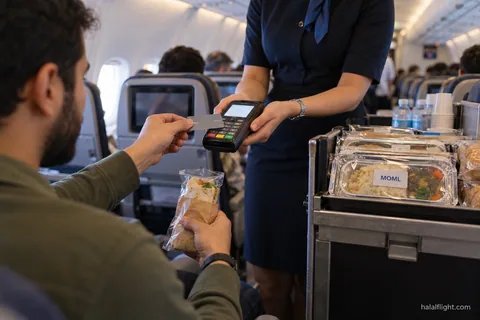
Airline websites vary widely. Some describe a halal-certified catering partner, some describe a Muslim meal prepared to a written specification, and some give little detail beyond a meal code. The code (MOML for a Muslim meal) is a booking label and not a certification claim.
Read the airline's special-meals page for statements about certification, and note the exact wording. Phrases such as "prepared in accordance with" a standard, "certified by" a named body, and "suitable for Muslims" are not interchangeable. If the page does not name a certifier, that is not proof of anything either way; it simply means the question should go to the airline.
How halal certification is applied across an airline's catering chain, and how Muslim meals compare with ordering on board, are covered on their own pages.
Contacting a certifier or airline
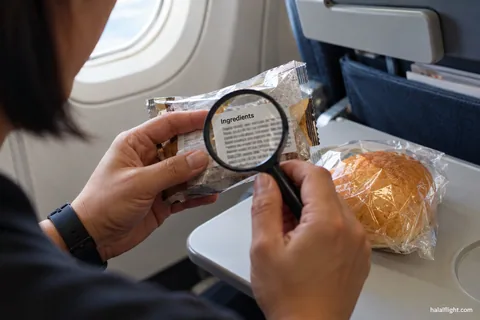
When a logo or statement is unclear, use the certifier's official website or published contact details, not a number printed on a leaflet or a social media post. Provide only what is needed: the company name, the product or flight meal, the departure airport and a photograph of the mark.
Be factual and courteous. Cabin crew and customer service staff often cannot produce a certificate on the spot, and that on its own does not mean something is wrong. A written reply from the airline or caterer, with a certificate reference, is a better basis for a decision than an assumption in either direction.
If a certifier says it has not certified the business or product you name, or that a mark is not theirs, report that to the airline politely and in writing.
Checklist before you rely on a certificate
- Find the name of the certifier on the airline's page or certificate.
- Open the certifier's own website and read its criteria on stunning, ingredients and cross-contact.
- Check that the certificate covers the right company, site and activity.
- Confirm the validity period and ask for a current copy if in doubt.
- Ask the airline in writing which caterer serves your departure station.
- Keep copies of replies with the flight date.
- Carry a reserve meal you have checked yourself if the answers are incomplete.
This approach keeps the focus on facts a traveller can verify and leaves rulings to scholars.
Frequently asked questions
Is there one halal certificate accepted on all flights?
No. There is no worldwide authority for airline halal food. Caterers and airlines use different national or private certifiers with their own criteria, so read the name on the certificate and check what the issuing body requires for slaughter, ingredients and production.
Does HMC certify stunned meat?
The Halal Monitoring Committee states on its FAQ page that it does not accept or certify stunned meat or poultry and that its criteria require animals not to be stunned. Other certifiers may have different rules, so check the one named on your airline's meal.
Is a certificate from another country's kitchen valid for my flight?
Not automatically. Certificates apply to a named business, site and activity. A genuine certificate for a kitchen in another city does not show that meals prepared at your departure airport are covered. Ask the airline which caterer serves your station.
What does recognition of a foreign certifier mean?
It means an authority accepts that certifier for a defined regulatory purpose, such as products entering its market. It does not mean every school of thought sees the two systems as identical. Check the scope and date of the recognition list.
Who do I contact if a halal claim looks doubtful?
Start with the certifier named on the claim, using the contact details on its official website, and copy the airline's customer relations team. Give the company name, flight details and a photo of the mark, and keep the request factual.