A label and a certificate answer different questions
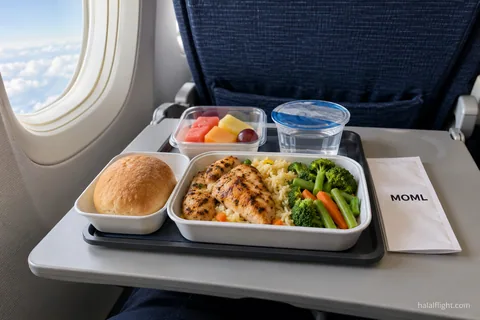
Passengers often use "halal meal", "Muslim meal" and "halal-certified meal" as if they were one thing. They are not. A Muslim meal is a category on the airline's special-meal list. It tells the caterer which rules the airline has chosen to apply to that tray. Halal certification is a statement by an independent body that a product, a premises or an activity has been assessed against a standard.
The two can overlap completely, partly or not at all. An airline may serve a Muslim meal with no certificate behind it, or may certify its whole catering operation so that a separate Muslim meal adds little. Reading the wording each airline uses is the only reliable way to tell which situation applies on your flight.
- The label describes a request you made and the airline accepted.
- The certificate describes evidence about something specific, issued by a named body.
- Neither automatically proves the other.
What the Muslim meal label tells you
On booking systems the category usually appears as MOML. Its published definition differs between airlines, so the code alone is only a starting point. Singapore Airlines, for example, describes Muslim meals without pork, lard, pig by-products or alcohol. Lufthansa describes its Muslim meal as free of pork, game and alcohol, and states that all meat and poultry used are certified as slaughtered according to halal guidelines.
What the label does not promise
A confirmed request means the airline has noted a dietary category against your booking. It does not tell you who supplied the chicken, whether the kitchen is certified, or whether the flavourings are alcohol-free beyond the airline's own wording. Treat the airline's published definition as the real content of the label, not the three or four letters in your booking.
What a halal certificate tells you, and what it leaves out
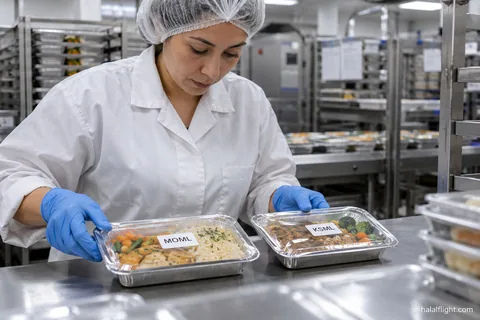
A certificate is only as useful as its scope. The Islamic Religious Council of Singapore (MUIS) shows this clearly because it runs separate schemes: one for individual products, one for a whole manufacturing plant and everything made there, and one for food preparation areas such as catering establishments and central kitchens.
Why scope matters on a flight
Consider three different documents that could all be described loosely as "halal-certified":
- A certificate for one ingredient, such as a particular supplier's chicken. It says nothing about the sauce, the dessert or the tray assembly area.
- A certificate for a kitchen. It covers preparation in that kitchen, but not necessarily meals loaded at another airport.
- A published airline policy that all meals are halal. It is a commitment by the airline and should be read together with whatever third-party evidence supports it.
When someone says a meal is certified, the useful follow-up is always: certified by whom, covering what, and at which airport?
Four airlines, four different positions
Published policies show how varied the picture is. The statements below come from the airlines' own pages and may change, so check the current wording before you travel.
- Singapore Airlines: Muslim meals on Singapore departures are prepared in a halal-certified kitchen using halal-certified suppliers. On departures from other airports the meals are prepared without pork, lard, pig by-products or alcohol, and the airline works with overseas caterers to obtain halal-certified meat and poultry where that is operationally feasible. The page does not claim that overseas meals are certified.
- Emirates: states that all its meals are halal certified, so passengers wanting halal food are covered by the standard service.
- Turkish Airlines: says its meals are prepared under Islamic dietary rules and that, under normal circumstances, all meals on its flights are halal.
- Lufthansa: offers a separate Muslim meal with the exclusions and meat statement described above.
These four positions are not interchangeable. An airline-wide policy, a kitchen-based certificate and a meal-level definition each give you a different kind of assurance.
Why the label and the evidence can drift apart
Long-haul airlines usually load meals at several airports, and each airport may have a different caterer. Even when the airline's name is the same, the supply chain behind a tray in Singapore may differ from the one behind a tray in another city. This is why the Singapore Airlines page separates its home departures from the rest of the network.
Other points where the two diverge:
- Operating carrier. On a codeshare, the airline that sold the ticket may not be the one that feeds you. Its policy is the one that applies on board.
- Short-notice changes. A caterer may substitute a product when stock runs short, and the certificate for the original item no longer applies.
- Add-ons. Snacks, desserts and bread served outside the main tray may follow different sourcing from the meal you confirmed.
None of this implies that airlines act carelessly. It simply means that one statement about a flight cannot be assumed to cover every meal on every sector.
Questions worth putting to the airline
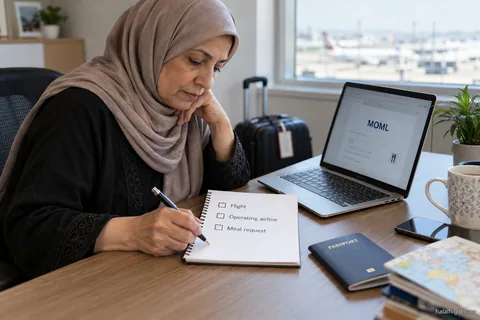
If certification matters to your decision, ask specific questions rather than a general "is it halal?". Short, concrete questions get concrete answers.
- Does your published policy describe the meal as halal-certified, or only as prepared without pork and alcohol?
- If certified, which body issued the certificate and does it cover the kitchen, the products or both?
- Does the same arrangement apply on my departure airport and on the return sector?
- Does the statement cover the meat only, or also desserts, bread and sauces?
- Who is the operating carrier on each segment?
Ask in writing where you can, through the airline's contact form or the booking-management page, and keep the reply. A written answer is easier to refer to later than a call-centre conversation.
Reading the answer you receive
Replies vary in precision. Some will be a short reassurance; others will name a certifier. Compare what you receive with the scope categories above.
Answers that are specific
These name a certifying body, state whether the certificate covers a product, a kitchen or the operation, and say which airports are included. They can be checked against the certifier's own published information, for example a public directory or the certifier's contact point.
Answers that are general
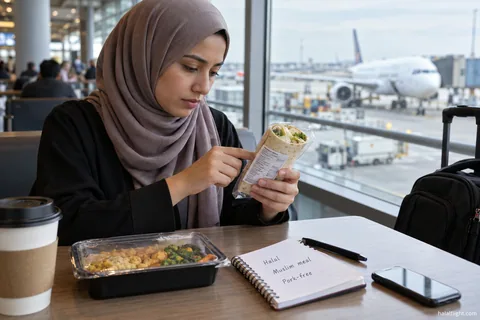
"Our meals are halal" without a body, a scope or a location is a statement of policy, not evidence you can verify. You may still decide it is enough for you, but recognise what it is. Whether a given level of assurance is sufficient is a personal religious judgement; a qualified scholar can advise on it, and views differ.
Practical checklist and what to do if something looks wrong
Before you fly:
- Read the airline's own dietary page for the exact wording of its Muslim meal and any halal statement.
- Decide whether you need certification evidence or whether the airline's published definition is enough for you.
- If you need evidence, ask the questions in the earlier section and keep the reply.
- Request the Muslim meal anyway where the airline offers one, unless it states that all meals already meet the standard.
- Check each segment, not only the first.
If something looks wrong on board:
- Ask the cabin crew to check the tray label against your request before you eat.
- If the meal is wrong, ask what alternatives are loaded and note the flight number and date.
- After the flight, send the airline your booking reference and a short factual description. Keep any packaging with a brand name.
Frequently asked questions
Is a Muslim meal on a flight automatically halal-certified?
No. A Muslim meal is a request category defined by each airline, usually excluding pork and alcohol and sometimes specifying halal-slaughtered meat. Whether any third-party certificate stands behind it depends on the airline and the departure airport. Read the airline's own definition, and ask for the certifying body and scope if that matters to you.
If an airline says all meals are halal, do I still need to book a Muslim meal?
Check the airline's wording. Emirates states that all its meals are halal certified, and Turkish Airlines says all meals are normally halal, so a separate Muslim meal may not be needed. Other dietary needs, such as allergies, still require a separate request. Confirm the position for your own flight before relying on it.
What do the different MUIS halal certification schemes mean?
MUIS describes a product scheme for individual products, a whole-plant scheme covering a manufacturing facility and everything made there, and a food preparation area scheme for catering establishments and central kitchens. A certificate under one scheme does not extend to the others, so always check which one applies.
Can the same airline offer certified meals on one route and not on another?
Yes. Singapore Airlines, for instance, says Muslim meals on Singapore departures come from a halal-certified kitchen and suppliers, while at other airports it works with local caterers and seeks halal-certified meat where feasible. Policies are tied to the departure airport and operating carrier, so check each sector separately.
How do I ask an airline for proof of halal certification?
Write through the airline's contact form or booking page. Ask which body issued the certificate, whether it covers a product, kitchen or the whole operation, and whether it applies at your departure airport. Quote your flight number and date, and keep the reply. Whether the answer is sufficient is a personal matter you can discuss with a qualified scholar.