The two questions every flying worshipper faces
Prayer on a plane raises two separate practical questions. The first is when: which of the five prayers will come in while you are in the air or in transit, and how much of each window will you actually have? The second is where: in which direction is the qibla from a moving seat?
Scholars generally accept that prayer is permissible on an aircraft, and the details of how to do it depend on the school you follow and on your circumstances. This page helps you plan the timing and the direction. How to cope with standing and the physical movements is dealt with on a separate page about praying while seated, and wudu is covered in its own guide.
Map the prayer windows against your itinerary
Build a simple timeline
Before travelling, write down the departure time, the arrival time and the local time at each end. Then look up the prayer timetable for the departure city and for the arrival city. The prayers due during the trip are those whose windows fall between boarding and the time you can realistically pray after landing.
Think about the sun, not the clock
Guidance published by Darul Iftaa Chicago says that each prayer should be performed within its time, determined by the sun's position relative to the traveller during the flight. A phone that updates to destination time does not change where the sun is, so the displayed time on its own can mislead you. The separate guide on calculating prayer times across time zones explains the calculation; here the point is to identify which windows you will meet.
Plan the connection too
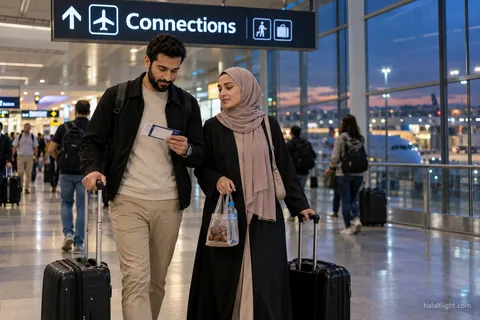
If you change planes, the transit airport gives a possible place to pray on the ground. Check the connection length and whether the prayer window will still be open when you arrive. A delayed landing can leave less time than planned, so keep a margin.
Travel concessions and combining prayers: ask before you fly
Many travellers wonder whether they may shorten or combine prayers while travelling. The answers depend on the school of jurisprudence, the distance and the circumstances. For example, guidance on the Sistani website says a traveller shortens the noon, afternoon and night prayers to two units each if the journey is 44 km or more in each direction. Other schools set different distances and conditions, and the rules about combining are not the same everywhere.
Boarding a plane does not automatically give you any adjustment. Put the question to a qualified scholar in advance, with your exact itinerary in hand, so that you know which prayers you may shorten or combine and which you may not. Individual rulings belong to a scholar, not to a travel website.
Finding the qibla from your seat
Why a saved direction is not enough
The qibla is the direction of the Kaaba in Makkah from where you are at that moment. A direction noted in the departure city becomes outdated once the aircraft turns or travels some distance. The nose of the plane does not necessarily point the right way either.
Ways to find it
- Onboard map. Many in-flight displays show the aircraft's position and heading. Compare it with the position of Makkah.
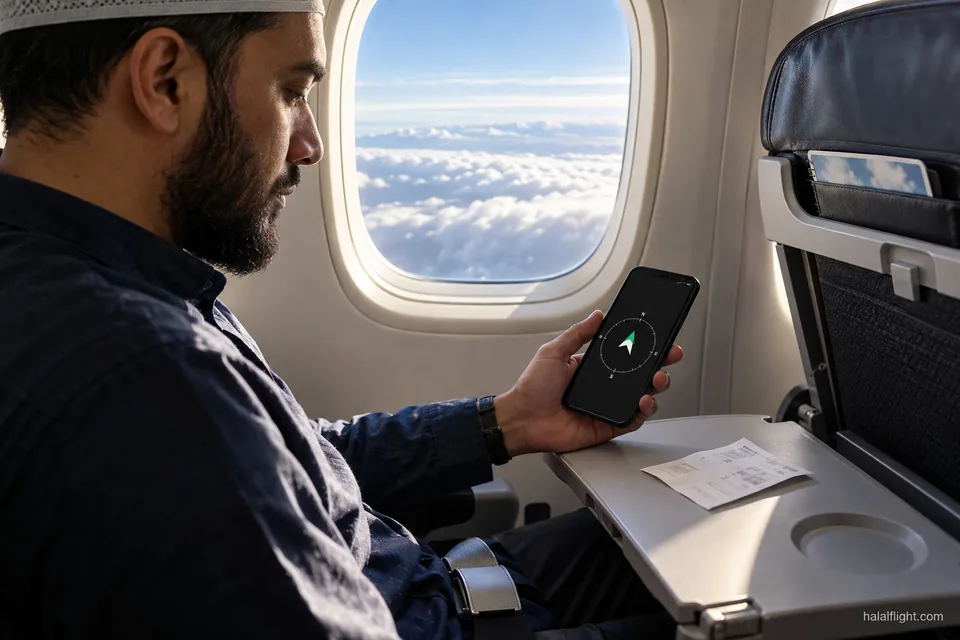
- Compass or qibla app. Darul Iftaa Chicago notes that apps can help, although looking outside is better where possible. Use them as a guide and recognise their limits, as cabin electronics and metal can disturb a compass.
- Ask the crew. Guidance on the Sistani website says you may ask a flight attendant to check with the pilot, and you may rely on information you trust even if the person giving it is not Muslim. Be polite and avoid asking at busy service moments.
If your phone must be in flight mode, a downloaded or offline qibla tool still works, so test it before you leave.
What if the aircraft turns while you pray?
Scholars discuss this directly. A ruling listed at al-feqh.com under the Permanent Committee fatwas states that you should face the qibla as far as you can, and that if the plane turns away from it during prayer you continue facing it as much as you are able, based on the principle of ease in Islamic law. The same source says voluntary prayers may be performed in whichever direction the plane is flying.
Darul Iftaa Chicago states that obligatory prayer must face the qibla, that you should adjust if the plane changes direction, and that a deviation of up to 45 degrees is tolerated. It adds that for voluntary prayers one may face the direction of travel. These views come from different institutions, so what applies to you depends on your school. If your scholar gives a different answer, follow your scholar.
Guidance on the Sistani website also covers the case where you cannot work out the direction: face the direction you think most likely, and, if you cannot favour one direction over another, pray facing whichever way you are facing. This is one scholarly position, not a universal one.
Space, crew and cabin conditions
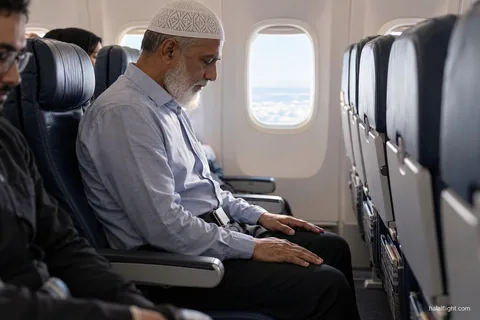
Direction and timing are only useful if you can actually pray, so think about the physical setting.
- Ask a member of the crew politely whether a suitable space is available when movement is permitted. Do not stand in an aisle, an exit area or a working galley without their agreement.
- Remain seated with your seat belt fastened whenever the sign is on or the crew ask you to.
- Do not move a service trolley or reach into crew areas to make room.
- If the cabin is crowded, ask your scholar in advance what you should do in your seat.
The practical plan must always respect safety instructions. A request that is refused calmly is better than an argument in the aisle.
Preparing for a plan that changes
Delays, turbulence, diversions and gate changes can disrupt even a careful plan. A few preparations help.
- Save your timetable, your scholar's answers and a qibla tool offline.
- Note when each window closes, not only when it opens.
- Decide in advance which prayer you will make first if two windows are close together.
- Keep a margin at connections, and check the flight status before you land.
If something unexpected happens, avoid inventing a new rule in a busy cabin. Contact your scholar when you land, explain what occurred and ask what to do next.
Checklist: timing and qibla before you board
- List the five prayer windows for departure and arrival cities.
- Mark which windows fall in the air or during a connection.
- Ask your scholar about shortening or combining, giving your full itinerary.
- Download an offline qibla tool and check it works in flight mode.
- Look at the in-flight map after take-off and again whenever you plan to pray.
- Ask the crew politely if you need help with the direction or a space.
- Keep your scholar's contact details or an online question service to hand.
- If a prayer goes wrong because of a delay, do not guess; ask afterwards.
Frequently asked questions
How do I know which prayers fall during my flight?
Write down your departure and arrival times, then check the prayer timetables for both cities. The prayers due are those whose windows open or close between boarding and the time you can pray after landing. Remember that the sun's position, not your phone's clock, decides the window, and allow extra time for delays.
Can I use a qibla app on a plane?
Apps can help as a guide, and Darul Iftaa Chicago notes this, though it says looking outside is better where possible. Cabin metal and electronics can disturb compass readings, and you may need flight mode, so download an offline tool before you leave and cross-check it with the onboard map.
What if the plane changes direction during my prayer?
Rulings summarised at al-feqh.com say to keep facing the qibla as far as you can. Darul Iftaa Chicago says to adjust and tolerates a deviation of up to 45 degrees for obligatory prayers. Your school may differ, so ask your scholar which position you should follow.
Can I ask the cabin crew which way the qibla is?
Yes, you can ask politely, ideally when they are not busy. Guidance on the Sistani website says you may ask a flight attendant to check with the pilot and rely on trusted information. Crew may not know the exact bearing, so also use the onboard map or a compass tool.
Do I pray at departure time or arrival time?
Neither clock decides on its own. Darul Iftaa Chicago says to pray each prayer within its time, based on the sun's position relative to you during the flight. For a route crossing many time zones, ask your scholar to confirm how to handle each prayer.