Why altitude changes what you see
A published sunset time is calculated for a point on the ground, usually a city, and refers to the moment the sun appears to meet a flat horizon at that place. A passenger at cruising level observes from a very different position. The viewpoint is higher, the aircraft is travelling at several hundred miles an hour, and the horizon visible from the window is further away and lower than it is from a street.
For that reason a ground sunset cannot be copied into a flight plan as though height and the changing position of the aircraft made no difference. The timetable on your phone answers the question for a fixed point, while the question on a flight is about a moving one.
This page explains the astronomy and the practical consequences for people who fast. It does not give a ruling on when to begin or end the fast in the air. That belongs to a qualified scholar, and the sibling pages on breaking the fast during flights and on fasting across time zones deal with the religious side in more detail.
Direction and route decide how much daylight you meet
The Earth rotates beneath the aircraft, and the flight travels with or against that rotation. Flying east carries you towards darkness and shortens the day you experience, while flying west keeps you in daylight for longer and can stretch a single sunset across many hours. The route, the latitude and the departure time determine which of these you get.
Why one fixed correction fails
It is tempting to add a fixed number of minutes to a city timetable for altitude. That would be misleading, because the daylight you meet depends on where the aircraft is at each moment and how quickly it is moving through the day. Two flights from the same airport at different times of year can give very different results.
A flight in high latitudes in summer or winter adds another layer: the sun may barely set at the surface and the transition between day and night can be slow and shallow.
Apparent sunrise, apparent sunset and refraction
The Earth's atmosphere bends light, so the sun can be seen when it is geometrically a little below the horizon. Calculators that report the apparent moment of sunrise or sunset allow for this effect, and the NOAA Solar Calculator labels its results in just that way, giving apparent sunrise, apparent sunset and solar noon for a chosen location and date.
That wording matters. A casual glance at a basic map or a weather widget may use a simpler definition, and the difference can be a few minutes. A calculation designed for a fixed observer on the ground is also not the same as one designed for a moving observer in the air.
NOAA also states that its calculator is for research and entertainment purposes and that observed values can differ because of atmospheric conditions. Treat it as a planning aid. The page says nothing about aircraft observers, and it does not offer an input for the height of the observer.
Dawn and sunrise are two different markers
People preparing for suhoor sometimes read a sunrise time and treat it as the start of the fast. Dawn, the beginning of morning light, comes earlier than sunrise, and it is the dawn definition that most fasting timetables use for the start of the day. Sunrise is a later event, when the sun's upper edge appears.
Different institutions calculate dawn using different solar angles, so two respectable calendars can disagree by several minutes. When you take a time from an app, find out which method it uses and whether it matches the one followed by your mosque or scholar.
- Dawn: the beginning of first light, relevant to the start of fasting.
- Sunrise: the visible appearance of the sun, later than dawn.
- Sunset: the visible setting of the sun, relevant to ending the fast.
- Twilight after sunset: a separate phase, relevant to some prayer timings.
What a fasting traveller can safely take from this
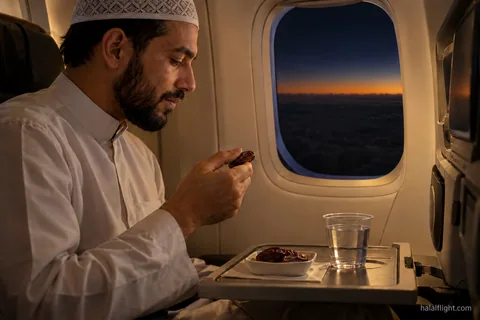
Scholarly bodies have addressed fasting on aircraft, and their answers are concerned with the place where the traveller actually is at the time. The Federal Territories Mufti Office in Malaysia, for instance, advises that a person who continues fasting on a flight breaks the fast at sunset at the aircraft's current location, whatever the clock says in the home city or the country below. It points to direct observation as the basis, and says an announcement from the crew based on the local time can also be relied on.
Where cloud or the angle of the aircraft hides the sun, the same article cites a scholar who advises looking for signs of night approaching, such as darkness rising from the eastern horizon. Whether those methods suit you, and which school you follow, is for a scholar to answer. Practices and conclusions differ, and a traveller with a specific route should ask before departure.
Avoid false precision from generic tools
A city calculator gives an exact-looking figure to the minute, and that precision can be misleading when applied to a moving aircraft. A small error in position, altitude or the definition used can move the result by minutes, and the true answer may depend on what is visible from the cabin.
Some airlines state that they calculate inflight timing for the holy month from the aircraft's position and altitude. If your carrier says it does so, read its explanation and ask how the times will be communicated. If it does not publish a method, assume that you will need to rely on your own preparation and on guidance you trust.
Use tools for what they do well
City timetables are valuable before and after the flight, for suhoor at home and for iftar on arrival. NOAA's calculator and similar tools are good for understanding the pattern of the day on the ground. For the airborne portion, treat their output as background information, not as a final answer.
Unusual routes need earlier advice
Some journeys make ordinary timetables especially unreliable. Polar and near-polar routes, very long westbound flights that stay in daylight for most of the sector, and itineraries that cross many time zones in a few hours can all produce a day that does not match any ground schedule.
If your route is of this kind, speak to a scholar before you travel and describe the flight number, the departure time, the route and any stops. Ask what to follow, how to record the times and what to do if the sun cannot be seen. Having the answer in advance is more reliable than trying to work it out at the window.
Medical conditions are a separate matter. Anyone who is ill, pregnant or taking regular medication should speak to a doctor about fasting during travel.
Checklist for a flight that crosses sunrise or sunset
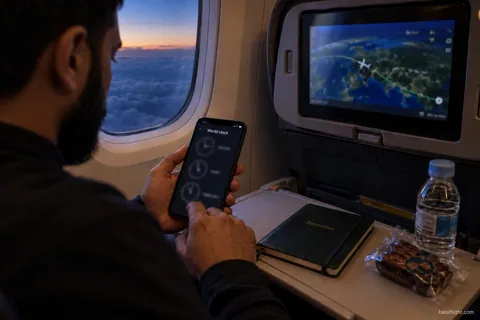
- Note the departure and arrival times, with the time zones, and the likely position of the aircraft at sunset or dawn.
- Look up ground times for the departure and arrival cities, using the method your scholar follows.
- Ask your scholar which location or method to follow in the air, and write the answer down.
- Check whether the airline publishes any information about inflight timing, and ask the crew politely what announcement to expect.
- Sit on the side of the aircraft that gives you a view of the horizon if you intend to observe the sun, though seating is never guaranteed.
- Keep water and a date within reach in case you need to break the fast.
- If the sun cannot be seen or the situation is unclear, do not guess: follow the guidance you have been given or contact your adviser.
Frequently asked questions
Does the sun set later when you are high up in a plane?
Generally the sun stays visible for longer from a higher viewpoint, because the horizon is lower and further away. The size of the effect depends on altitude, route and direction of travel, so no single figure applies. Treat a city timetable as a planning guide only, and ask a qualified scholar which time to follow in the air.
Can I use a sunset app on my phone during a flight?
An app gives a time for a fixed point on the ground, usually using a set method and angle. It does not account for a fast-moving aircraft, and its precision can look more reliable than it is. Use it for preparation, and check how your scholar or the airline advises dealing with the air portion of the journey.
What is the difference between dawn and sunrise for fasting?
Dawn is the beginning of first light and comes before sunrise, which is when the sun's edge appears. Fasting timetables normally start the fast at dawn. Different institutions use different angles to calculate it, so check which method your calendar uses and keep to the one your scholar recommends.
Which location should I follow to break my fast on a flight?
Scholarly bodies give answers that focus on the traveller's actual position at sunset. The Federal Territories Mufti Office in Malaysia, for example, advises breaking the fast at sunset at the aircraft's current location, not at the home city. Because schools differ, confirm the approach with your own scholar.
What if clouds hide the sun from the cabin window?
Cloud or aircraft position can make direct observation impossible. A scholar cited by the Malaysian Mufti Office advises looking for other signs of night, such as darkness rising from the eastern horizon, and crew announcements may also help. If you remain unsure, ask your adviser before travelling for guidance suited to your route.