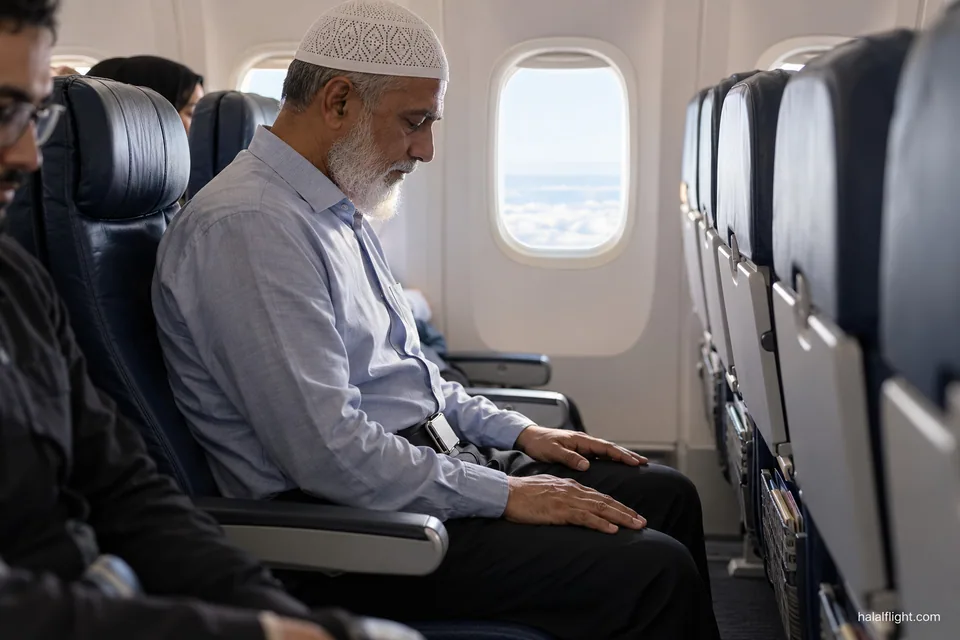
Is it allowed to pray sitting on a plane?
The answer scholars give is conditional. Standing is a pillar of the obligatory prayer for anyone who can do it, and a seat being close at hand does not remove that duty. Seated prayer is accepted when there is a real incapacity or hardship, and different institutions describe the conditions in different ways.
Egypt's Dar al-Ifta states in a published fatwa that standing is one of the pillars of the prescribed prayer, and that if a person cannot stand, they may pray seated when they fear the prayer time will end and cannot find a suitable place to pray standing. Other bodies describe further situations. The sections below compare these views so that you can prepare questions for your own scholar.
This page deals only with praying in a seat. Prayer timing, qibla direction and wudu are each covered on separate pages.
Incapacity or preference: how scholars draw the line
What counts as real hardship
A resolution of the Jordan Iftaa Board on sitting on a chair in prayer cites al-Nawawi, who says the test is evident hardship, such as severe difficulty, complications of an illness, or fear of drowning or dizziness on a ship. It also records Imam al-Haramain's view that the hardship must be enough to cause a loss of humble focus in prayer. The same resolution says that someone who can stand but prays seated has an invalid prayer.
What does not count
Tiredness, a wish to avoid the queue, or reluctance to disturb the person next to you are not mentioned in these sources as grounds for sitting. A passenger who is simply uncomfortable should ask whether a standing option exists, such as a suitable space when crew allow, or the airport before departure or during a connection.
Turbulence and long delays
Darul Iftaa Chicago says that sitting is also allowed if there is significant turbulence throughout the prayer time. This is one school's guidance, and the details of when turbulence counts should be confirmed with your scholar.
How the prayer is performed from a seat
Scholars who permit seated prayer also describe what to do about the movements. The Jordan Iftaa Board resolution states that whatever a person can do, they must do, and whatever they cannot do, they approximate. A valid excuse for sitting does not excuse performing bowing and prostration properly if you can. Someone who cannot bow or prostrate normally while seated should nod the head, with the prostration lower than the bowing.
In practice, this means:
- Make your intention and begin facing the qibla as well as you can.
- Recite as you normally would, remaining upright in the seat.
- Bow by lowering the head and upper back slightly, as far as the seat allows.
- Prostrate by lowering the head further than for the bow, without leaving the seat.
- Sit for the tashahhud and finish with the salam.
Your school may prescribe specific details, such as where to place the hands, so ask a scholar rather than copying another passenger. Passengers differ in age, health and the rules they follow, and what suits one person may not suit you.
Does a seated prayer need to be repeated?
This is a point on which sources differ, and you should find out your own school's position before the flight.
Darul Ifta Birmingham, answering a question on airplane prayer, states that a person who cannot stand, face the qibla or perform bowing and prostration should pray seated in the seat and repeat the prayer later. Darul Iftaa Chicago similarly says that if no space is available, one may pray in the seat but must repeat the prayer later because essential elements were missing.
Other approaches, including the fatwa from Egypt's Dar al-Ifta quoted above, describe seated prayer as permitted where incapacity exists without mentioning repetition in the part summarised here. The difference may reflect the school, the reason for sitting or the wording of the question. Do not decide this on the plane. Ask your scholar and write down the answer.
Check for a standing option first
Before praying in the seat, it is worth asking whether a standing option exists, since the sources above treat incapacity as the reason for sitting.
- Ask a member of the crew politely whether a suitable space is free, and accept their answer if it is no.
- Look at the timetable. If the prayer window will still be open after landing or at a connecting airport, the standing option on the ground may be available.
- Do not stand in an aisle, an exit row or beside a working galley unless the crew agree.
If the prayer window will close before you reach the ground, and no standing space is allowed, you can see why the scholars quoted above discuss seated prayer. Keep a note of the time left, and never assume a prayer can wait until after arrival without confirming with a scholar.
Cabin rules that apply whatever you decide
Praying in the seat does not suspend safety rules.
- Keep your seat belt fastened whenever the sign is on or the crew ask you to.
- Keep your seat upright for take-off and landing if instructed.
- Do not obstruct exits, aisles or a neighbour's legroom.
- If the crew ask you to pause, do so, and ask your scholar afterwards how to handle an interrupted prayer.
- Keep your voice low and your movements small, which is courteous to nearby passengers.
If a restriction seems to conflict with your prayer, explain calmly. Crew are generally trying to keep the cabin safe, and a quiet request is more likely to help than a debate.
Preparing questions for your scholar
Because the sources vary, preparation matters more than memorising a single answer. Take these questions to a qualified scholar or a fatwa service:
- Do I qualify for seated prayer, given my health, age or the flight conditions?
- How should I bow and prostrate from the seat?
- Must I repeat the prayer after landing?
- What should I do if the cabin crew interrupt me?
- How should I plan the day if a prayer window closes mid-flight?
Write the answers in a note on your phone so they are available offline. Individual rulings belong to a scholar who knows your circumstances, not to a travel guide.
Checklist: if you expect to pray in your seat
- Confirm with a scholar whether your circumstances allow seated prayer.
- Learn how to nod for bowing and prostration, with the prostration lower than the bow.
- Ask whether the prayer must be repeated later and make a plan to do so.
- Check if a standing space can be arranged with the crew.
- Choose a seat that gives you room if you can, such as an aisle seat for easier access.
- Track the time left in the prayer window.
- Keep belts fastened and follow all crew instructions.
- Record what happened, so you can ask about it after landing if you are unsure.
Frequently asked questions
Can I pray sitting on a plane if I am able to stand?
Scholars quoted in published fatwas say standing is a pillar of obligatory prayer for those able to do it, and that someone who can stand but prays seated has an invalid prayer. Sitting is allowed for genuine incapacity or hardship. Ask a qualified scholar how this applies to your situation.
How do I bow and prostrate in a plane seat?
The Jordan Iftaa Board resolution says to do what you can and to nod the head for what you cannot, with the nod for prostration lower than the nod for bowing. Your school may add details about hands and posture, so ask a scholar rather than copying fellow passengers.
Do I have to repeat a prayer I said sitting on a plane?
Darul Ifta Birmingham and Darul Iftaa Chicago both say, in the answers cited here, that a prayer offered in the seat in these circumstances should be repeated later. Other bodies may not mention repetition. Because schools differ, ask your own scholar before the flight.
Is turbulence a valid reason to pray sitting?
Darul Iftaa Chicago says sitting is allowed if there is significant turbulence throughout the prayer time. A short bump is different from turbulence lasting the whole window. Ask a scholar how your school treats it, and always follow crew instructions to stay seated.
Can I stand in the aisle to pray?
Only if the crew agree. Aisles, exits and galleys are working areas, and safety instructions take priority over any prayer plan. Ask politely whether a suitable space exists, and if the answer is no, ask your scholar what applies to your seat.