Three labels, three different promises
Airline menus and special-meal pages use three families of wording, and they are not interchangeable. A pork-free description names a single excluded ingredient. A Muslim-friendly or Muslim-style description is a marketing or catering phrase that the airline defines for itself. A halal description, when it is backed by a standard, says that the whole chain meets a religious and regulatory definition.
The practical consequence is simple. If your own practice requires halal meat and halal ingredients, a pork-free meal answers only the first of several questions. If the airline uses the other two phrases, the next step is to find out what it actually means by them, because the words alone do not settle it.
- Pork-free: pork and pork derivatives are left out.
- Muslim-friendly or Muslim-style: defined by the airline or caterer; read the conditions attached.
- Halal: should come with a named standard, supplier or certifier you can ask about.
What a pork exclusion does not tell you
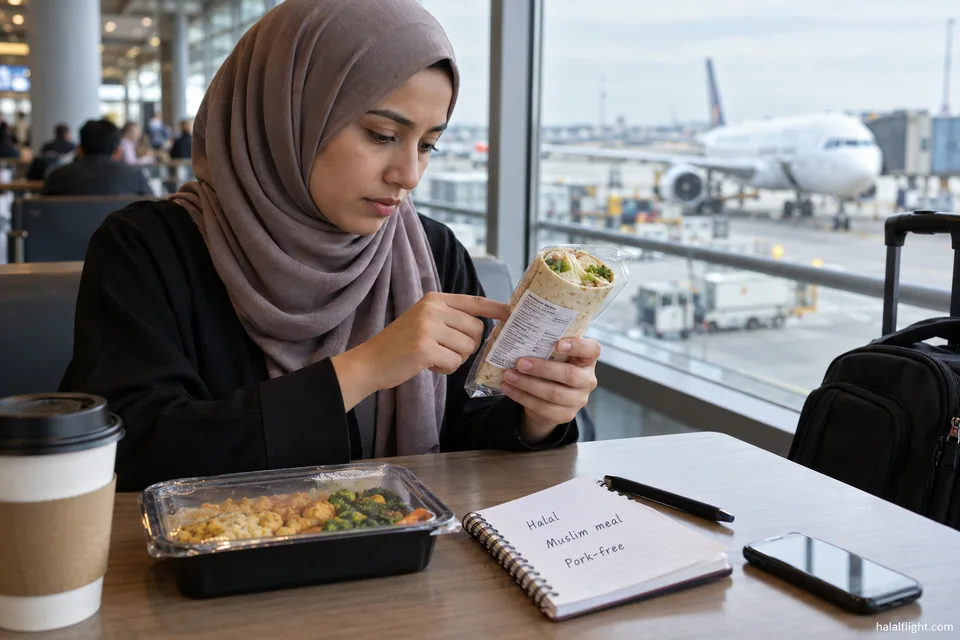
Leaving out pork removes one category of forbidden food. It does not explain how any other meat was slaughtered, whether a sauce was made with wine or another alcohol-containing ingredient, or who supervised production in the kitchen. A chicken dish without pork can still come from an animal that was not slaughtered according to halal requirements, and a pork-free dessert can still contain gelatine of unknown origin.
Questions a pork-free label leaves open
- How was the meat or poultry slaughtered, and under which standard?
- Are alcohol-based flavourings, extracts or cooking wines used anywhere in the recipe?
- Do animal-derived additives such as gelatine, shortening or enzymes appear in the ingredients?
- Is the meal prepared on shared equipment with pork products?
Each of these has its own page on this site, so the point here is only that a pork exclusion is a starting condition, not a conclusion.
Reading Muslim-friendly and Muslim-style wording
These phrases invite a follow-up question rather than answer one. Ask whether the term describes a menu choice (dishes that happen not to contain obvious forbidden items), an ingredient exclusion (a fixed list of omitted products) or an independently certified process. Those are three very different levels of assurance, and the same words can sit on top of any of them.
Airlines sometimes state the limit themselves. Iberia, for instance, describes its Muslim meal as free of pork products and alcohol while expressly stating that it is not halal. That is a useful model of how to read these descriptions: the exclusions listed are real, and the disclaimer is equally real. A published press report on another carrier records a spokesperson calling its meals Muslim-style and not halal, with staff giving the customer different explanations. The lesson from both is to rely on the written policy, not on a verbal answer at the airport.
Avoid expanding the phrase into a bigger promise than the airline made. If the page lists what is excluded, treat that list as the whole commitment unless the airline adds something more.
What a positive halal statement looks like
A halal claim that you can rely on says what is done, not only what is avoided. Consumer guidance from MUIS, the Islamic Religious Council of Singapore, goes beyond avoiding pork and also discusses slaughter requirements and intoxicants, which shows how much a complete definition covers.
Delta provides a contrasting wording on its special-meals page: its Muslim meal is described as halal certified and as containing no pork, pork by-products or alcohol, with a note that preparation and cooking style may vary. That is a clearer statement than a bare exclusion, because it names certification. Even so, the useful follow-up is to ask who certifies it, whether the certificate covers the kitchen at your departure airport, and whether it applies to every item on the tray or only the main dish.
Signs that a halal claim is substantive
- A named certifier or recognised standard.
- A statement that covers meat, poultry, sauces and accompaniments, not only the main.
- Clarity on whether the claim applies at every departure point or only some.
- A written source, such as the airline's special-meals page or confirmation email.
Where the wording differs by route and operator
Airline policies are written for networks, but meals are loaded in specific places. A carrier may cater long-haul departures from a hub under one arrangement and short regional flights under another, and a flight sold by one airline may be operated by a partner with its own policy. The label on the booking site therefore describes the airline in general, not necessarily your flight.
Record three details with any answer you obtain: the operating airline, the departure airport and the travel date. Another carrier's stronger statement cannot fill a gap in the one you are flying with, and a policy that was clear last year may have been updated since. Treat any wording you read as something to confirm before travelling, not as a permanent fact.
Practical ways to confirm what a label means
Start with the airline's own special-meals page and read the description of the Muslim or halal option word by word. Then decide which of the three levels it matches: exclusion only, airline-defined, or certified.
- Request the special meal at booking, or by the airline's stated deadline. Delta, for example, states that orders can be placed up to 24 hours before departure through its booking channels, but each carrier sets its own cut-off.
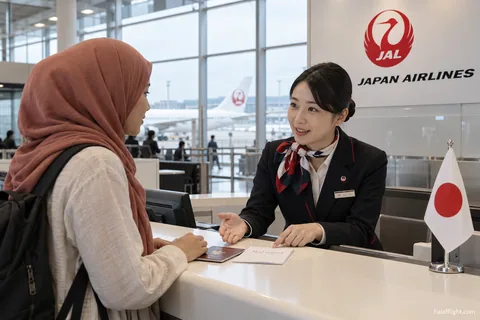
- Ask customer service in writing: what does this meal exclude, and is it halal certified, and by whom?
- Ask whether the answer applies to the specific flight number and departure airport.
- Keep the reply, either a screenshot or an email, and bring it with you.
A written answer is far more useful than a phone conversation, and it gives you something to show cabin crew or the ground team if the meal does not match.
Deciding what to eat when the assurance is limited
Sometimes the airline can confirm only an exclusion. In that case you decide whether that limited assurance meets your own requirement. Some travellers accept a pork-free and alcohol-free meal; others do not and look for other options. Differences exist between schools of thought and between individuals on how much assurance is needed, so questions about what is acceptable for you belong with a qualified scholar rather than with an airline or this guide.
Fallback options if the answer is not enough
- Choose a fish or vegetarian meal, if that suits your practice, and check its ingredients separately.
- Bring sealed food from a source you trust, subject to the rules of the airline, airport security and the destination country.
- Eat before departure or plan a halal meal at a connecting airport.
Checklist before you rely on any label
- Read the airline's description of the meal, not a third-party summary.
- Note whether it says pork-free, Muslim-friendly, or halal, and what follows the term.
- Look for a certifier, a standard or an explicit disclaimer.
- Confirm the operating carrier and departure airport.
- Request the meal before the airline's deadline and keep the confirmation.
- Ask in writing if anything is unclear, and keep the reply.
- Decide in advance what you will do if the answer does not meet your needs.
Frequently asked questions
Is a pork-free airline meal automatically halal?
No. Pork-free only says one ingredient is excluded. It does not state how other meat was slaughtered, whether alcohol-based flavourings are used or who supervised preparation. Ask the airline whether the meal is halal certified and by whom, and read any disclaimer it publishes next to the meal name.
What does Muslim-friendly mean on an airline menu?
There is no single definition. The airline or caterer decides what it covers, and it may mean only that obvious forbidden items are left out. Read the conditions on the special-meals page and ask in writing whether the meal is certified, rather than assuming the phrase equals halal.
Can an airline Muslim meal say it is not halal?
Yes. Iberia, for example, describes a Muslim meal without pork products or alcohol while stating that it is not halal. The name of the meal and its conditions can differ, so always read the full description before booking.
How do I find out who certifies an airline's halal meals?
Look first for a certification statement on the airline's special-meals page. If there is none, write to customer service and ask which certifier or standard applies, and whether it covers your departure airport. Keep the reply, because policies and catering suppliers can change.
Should I choose a vegetarian meal if I cannot confirm the halal status?
Some travellers do, but a vegetarian meal can still contain alcohol-based flavourings or animal-derived additives such as gelatine. Check the ingredients and the airline's description, and ask a qualified scholar if you are unsure what suits your own practice.