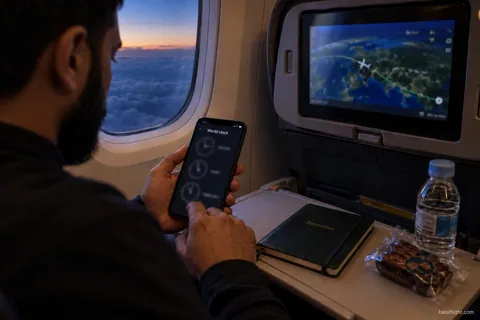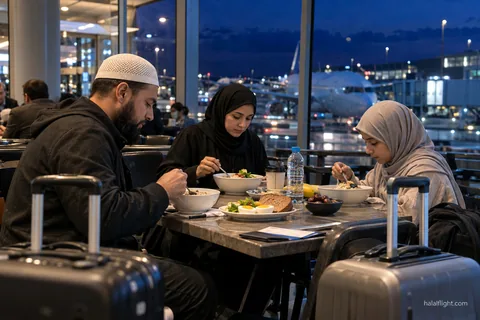
Should you fast on a flight? The short answer
There is no single answer that fits every passenger. Whether a Muslim traveller fasts on a given flight depends on the traveller's own circumstances and on the scholarly guidance they follow. Travel is one of the recognised reasons for an allowance in the Qur'an, but the details differ between schools of thought and between individual cases.
What a page like this can do is set out the questions that scholars usually ask, so that you arrive at your religious adviser with a clear description of the journey. It cannot give a personal ruling. Treat what follows as preparation for that conversation and for practical planning, not as a fatwa.
Two things are worth settling well before the departure date: whether you intend to fast on the travel day at all, and, if you do, how you will know when the fast ends while you are in the air. Everything else on the day becomes easier once those two decisions are made.
What counts as travel in the guidance
Scholars generally treat travel as a status with conditions rather than a feeling. Published fatwas show the kind of conditions involved, and they do not all agree.
Examples from published fatwas
- Egypt's Dar al-Ifta, in a fatwa on constant travel, names a minimum journey of 83.5 km and a lawful purpose, and states that fasting remains preferable for a traveller who can do so without difficulty.
- Jordan's Iftaa department, answering a question from a couple on a short training course abroad, set out four conditions in the Shafi'i view: a journey of more than 81 km, a lawful purpose, departure before dawn, and a stay at the destination of less than four days, not counting arrival and departure days.
- An IMAM-US summary of Ayatollah Sistani's guidance uses different distance measures and treats frequent travellers and people who intend to stay ten days differently again.
These sources are mentioned to show that the rules have moving parts, not to tell you which one applies. The numbers, the starting point of the journey and the length of stay are exactly the details your adviser will ask about.
The time you leave matters
One condition appears repeatedly: when the journey begins relative to dawn. The Jordanian Iftaa fatwa on travelling by plane in the afternoon says that a traveller who plans to leave after dawn should start the day fasting and intend to complete it, because fasting was already obligatory before the journey began. It adds that if severe hardship appears after setting out, the person may break the fast because of that hardship, and must make the day up.
A separate Jordanian fatwa, about airline crew flying by day, records that the Shafi'i, Hanafi and Maliki majority requires departure before dawn, while the Hanbali position allows a traveller who has left the city's houses to break the fast even if the journey began during the day. The same text suggests that a person who set out after intending to fast should ideally keep fasting to avoid disagreement.
In practice, this means a morning flight and an evening flight can lead to different conclusions even on the same route. If your ticket allows a choice, the departure-time question is a good one to bring to your adviser before you pay for a fare.
Comfort, hardship and the length of the stay
Sitting in an air-conditioned cabin with a screen and a pillow does not by itself answer the question. Scholars separate the status of being a traveller from the separate matter of hardship, and a comfortable journey does not cancel a recognised status in every view. Equally, a difficult one does not create an allowance where none exists.
The destination end of the trip also counts. Several sources give weight to how long you intend to stay and whether you are returning to your own home town. Someone flying out for three nights and someone relocating for a term are not in the same position, and neither is a person who flies every week for work.
Frequent travel is its own heading in some traditions. The IMAM-US summary, for instance, says that pilots, navigators and similar workers do not break the fast for work travel, while an occasional business traveller may. If your job involves regular flying, say so plainly when you ask.
What to tell your religious adviser
A good question is specific. Vague questions such as 'can I fast on a plane?' tend to receive general answers. A written summary takes two minutes to prepare and prevents misunderstandings.
- Your home town and the destination, with the approximate distance between them.
- The departure time, the scheduled landing time and any connection, including the time zones crossed.
- How long you plan to stay and whether you will return to your own residence afterwards.
- How often you travel in a normal year, for work or family.
- Any medical condition, medication or pregnancy that affects fasting.
- Whether you have already started the day fasting.
Ask someone you trust and who knows the school you follow. If you do not have one, a local mosque or a recognised fatwa body can usually point you to a scholar who answers travel questions.
Food, timing and health if you do fast
If you decide to fast, you need a reliable way to know when the fast ends. Jordan's and Egypt's fatwa bodies both give guidance on the topic, and Egypt's Dar al-Ifta says the relevant sunset is the one at the aircraft's own position, not the clock of the departure or arrival country. Because this is a question of its own, the timing detail belongs on the dedicated pages about time zones and breaking the fast; here the point is only to decide in advance which method you will use.
On the health side, flying is dry and tiring even for people who are not fasting. A hospital-based advice sheet from the Northern Care Alliance, an NHS organisation, recommends drinking water between iftar and suhoor to prevent dehydration and says mild dehydration can bring headaches and tiredness. Those effects are likely to feel stronger on a long journey. The Muslim Council of Britain publishes a Ramadan guide with advice on looking after physical and mental health during the month.
If you have diabetes, a heart condition or take regular medication, talk to your clinician before the trip about dosing times and about what to do if you feel unwell. Medical advice and religious advice should be consistent with each other, and an airline meal cannot replace either.
Airline meals do not decide the question
The trolley schedule is set by the airline's operations, not by Ramadan. Even carriers with a Ramadan programme describe it as applying to selected routes. Emirates, for example, has said in a press release that Ramadan meal boxes are offered to fasting customers on select destinations, which means you should not assume any given flight offers one.
Treat the arrival of food as a separate matter from the religious decision. If you are fasting, carry something permitted and easy to eat, and ask the crew how the airline works out iftar on your flight. If you are not fasting on that day, you can eat the normal meal without any special arrangement, because the airline's standard meals do not depend on the fasting decision.
A practical checklist before you fly
- Decide with your adviser, in advance, whether you will fast on the flight day.
- Write down the route, departure time, stay length and any medical details you gave.
- Choose how you will identify the end of the fast in the air, and ask the crew on the day.
- Pack dates, a small permitted snack and an empty water bottle to fill after security.
- Carry any medicine in your cabin bag with the prescription or a doctor's note.
- Keep a note of any day you do not fast so that you can make it up later, if your adviser says that applies.
- If you feel unwell in the air, tell the crew early and decide with a clear head rather than pushing on.
If the plan changes because of a delay or a diversion, the same questions apply again with the new timings. That is easier to handle when you already know which scholar to contact.
Frequently asked questions
Can I break my fast just because I am on a plane?
Not automatically. Scholars attach conditions to the travel allowance, such as distance, purpose and, in some views, the time you set out relative to dawn. A published Jordanian fatwa says a person leaving after dawn should begin the day fasting. Ask a qualified scholar about your exact journey.
Does the length of my stay at the destination change the answer?
It can. Jordan's Iftaa department sets a stay of less than four days, not counting arrival and departure days, as one condition in the Shafi'i view, while IMAM-US describes a ten-day rule in Sistani's guidance. Tell your adviser how long you plan to stay and where you will live.
I fly for work every week. Does that make a difference?
It may. Dar al-Ifta in Egypt says constant travel still counts as travel, while IMAM-US says people whose work regularly involves travel, such as pilots, do not break the fast for it. Traditions differ, so describe your job and travel pattern when you ask.
What if I start fasting and then feel ill on the flight?
Published fatwas treat real hardship as a separate ground. Jordan's Iftaa says a traveller who suffers severe hardship after setting out may break the fast because of the hardship and must make the day up. Tell the crew if you feel unwell, and seek medical help if symptoms are serious.
Will the airline serve food at the right time if I am fasting?
Not necessarily. Ramadan programmes are described as applying to selected routes, and the normal service follows the airline's schedule. Ask when booking whether your flight has a Ramadan offer, carry your own permitted food, and ask the crew how iftar is determined on board.