Start the clock in your kitchen
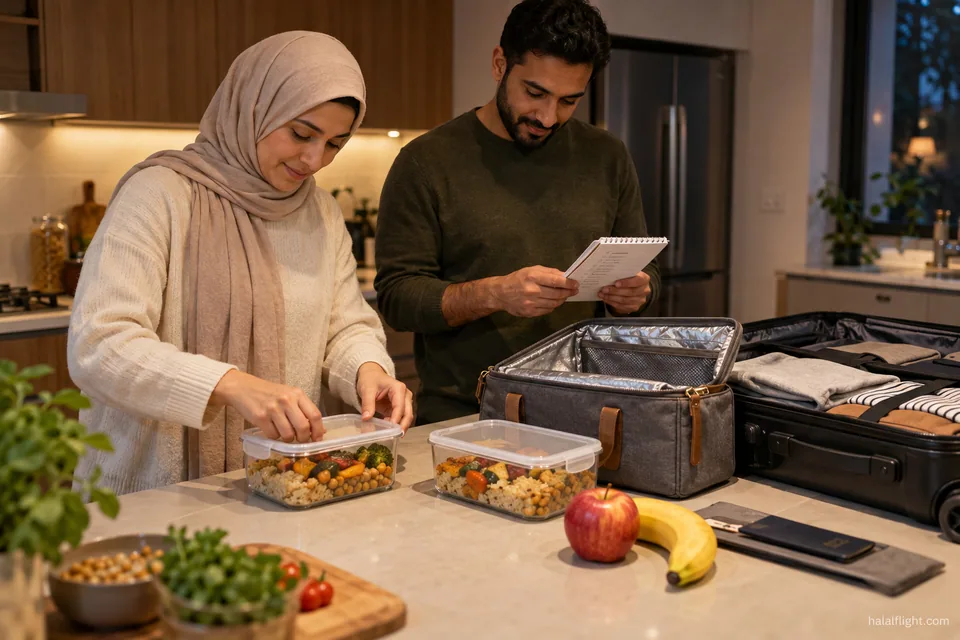
The time your food spends out of refrigeration begins when it leaves your fridge, not when the aircraft pushes back. Add the journey to the airport, queues at check-in and security, boarding, the flight itself, any connection and the trip from the arrival airport to wherever you will eat. On a long-haul journey with a stopover, that can easily exceed a full day.
The consequence is straightforward: perishable food is a first-meal solution, not a whole-journey solution. Food safety agencies generally advise against leaving perishable food in warm conditions for more than about two hours, and for less than that in hot weather. Cabin temperatures are not the issue; the long stretches before boarding and after landing are.
Treat a long-haul trip as three groups of food: a chilled meal for early in the journey, sturdy items for the middle, and sealed shelf-stable items for the end and for emergencies. The remainder of this page works through each group.
Divide the journey into meals
Write a simple timeline from departure to arrival and mark every point where you will realistically want to eat.
Eat the perishables first
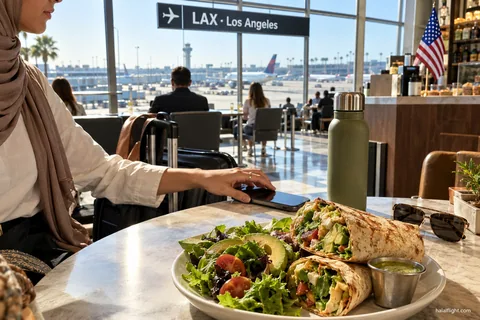
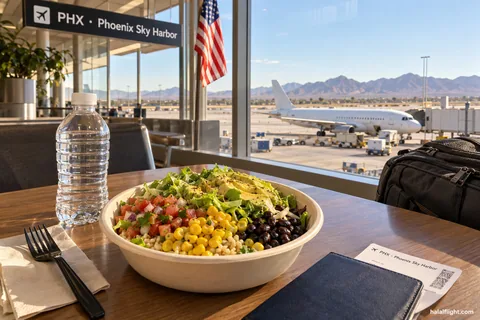
Plan the chilled item, such as a rice dish with cooked chicken, a sandwich or a salad, as the first thing you eat, ideally in the departure lounge or soon after take-off if a meal is not served. Opening the cool bag once and finishing the contents is safer than reopening it repeatedly.
Then the sturdy foods
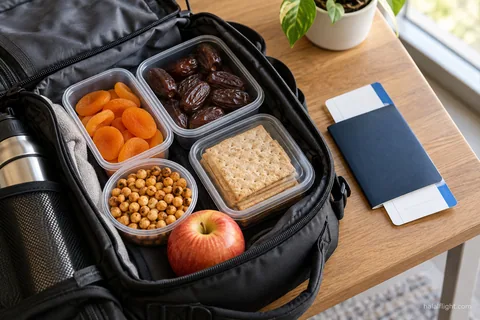
Choose dry or low-moisture foods for later: flatbreads, plain biscuits, dried fruit, roasted nuts, seeds, hard cheese if your destination allows it, and individually wrapped bars with a halal-suitable ingredient list. Moist cooked meat, dairy-based sauces, cut fruit and anything with mayonnaise are the items to eat first or leave at home.
Keep a final reserve
Hold back one sealed, shelf-stable item for the last hours, for an unexpected diversion, or for a missing special meal. If your airline serves a Muslim meal, your packed food is a supplement, not a replacement; the airline meal request is covered on other pages here.
Keep food cold in a way security will accept
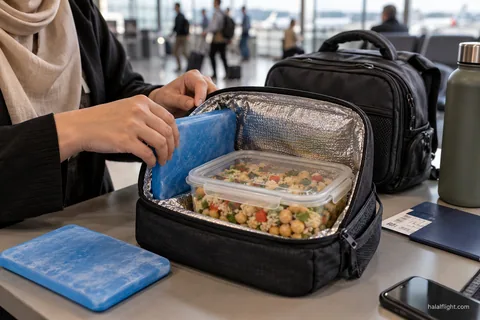
Use an insulated bag and more than one cold source. The United States Department of Agriculture's food safety guidance for packed lunches recommends an insulated bag and at least two cold sources for perishable foods. Frozen gel packs are the usual choice, but they are also the part most likely to be questioned at a security checkpoint.
- Ask the security authority of your departure airport, and of any airport where you will be re-screened, what it accepts. Rules for frozen packs and for food vary between countries.
- Pack frozen items solid. Liquids and gels in carry-on baggage are limited in many countries; the United States Transportation Security Administration, for example, describes a quart-sized bag of containers of 3.4 ounces or 100 millilitres or less, with larger containers going in checked baggage. Soups, sauces, yoghurt and hummus can count as liquids or gels.
- Expect that any item that alarms during screening may receive further inspection, so keep food accessible near the top of your bag.
Food temperature planning and security permission are separate questions. A pack that works well at home may not be allowed through, so test the plan before the day of travel.
Pick food that needs no galley
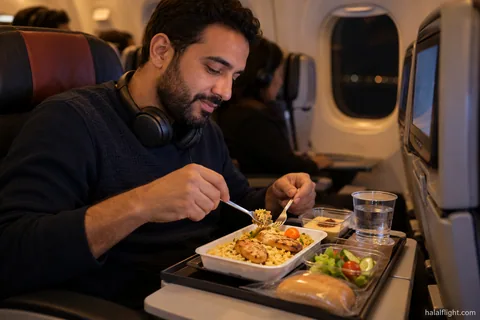
Do not rely on a microwave, a refrigerator or a hot-water tap on board. Cabin crew are busy, and many airlines will not heat or store personal food. If assistance with your food is essential, for example for a medical diet, contact the operating airline before departure instead of asking on the day.
- Use leak-proof containers with firm lids and a spoon or fork packed in your cabin bag.
- Choose dishes that are fine at room temperature or cold, such as wraps, rice salads, cold roast chicken, boiled eggs or bean dishes.
- Avoid anything that needs assembly on a small tray table or that has a strong smell in a closed cabin.
- Bring wipes and a small bag for rubbish.
Drinks count as liquids at most checkpoints, so buy one after screening if you need it.
Think about the final border
Home-made food that is perfectly ordinary in one country can be restricted in another. Meat, dairy and many plant products are the usual problem items, because border agencies control them to protect agriculture and animal health. A food being halal, and for personal use, does not exempt it.
United States Customs and Border Protection states that agricultural items can be taken from baggage at the border, and lists restricted items as including meats, fruits, vegetables, plants, soil and products made from animal or plant materials. The agency explains that the United States Department of Agriculture decides which products may enter, and that confiscated items are destroyed. Other countries run similar systems with their own lists, and rules in the European Union, the United Kingdom, Australia and elsewhere differ from each other.
- Find the destination's official border or biosecurity page before you pack.
- Keep sealed items in original packaging where possible.
- Declare food if the arrival card or officer asks; honest declaration is generally safer than discovery.
- When in doubt, eat the risky item before arrival or leave it at home.
Detailed country-by-country meat and dairy rules are covered on a separate page, so this section is only a reminder to check.
Transit and connection issues
If you change aircraft in a third country, your food passes through additional screening and may cross a border you do not think of as your destination. Some transit airports re-screen all hand baggage, and in some places a transit passenger who clears immigration must declare food as if arriving.
Keep the following in mind:
- Stay airside if you can, and eat the most restricted item before landing in the transit country.
- If a stopover is long, choose shelf-stable food for that leg instead of perishables.
- Check whether items need to be thrown away before an onward international flight, then eat or bin them in good time.
Container and ingredient notes for halal travellers
Because the goal is a trustworthy halal meal, the contents matter as much as the logistics.
- Prepare the food at home from ingredients you trust, and bring the packaging for any manufactured items so labels can be re-read later.
- If you buy snacks at the airport, read the ingredient lists; hidden animal-derived ingredients are a separate topic covered in other guides.
- Label containers with the contents and the date prepared.
- Pack meat and dairy separately from fresh produce to reduce leaks and cross-contact in the bag.
Questions about whether a particular product satisfies a particular school's view are for a qualified scholar rather than for a packing guide.
Checklist and what to do if it goes wrong
Before you leave
- Draw a food timeline from kitchen to arrival.
- Pack a chilled first meal in an insulated bag with two cold sources.
- Add sturdy snacks and one sealed reserve.
- Check security rules at every departure and transit airport.
- Check the destination's rules on meat, dairy and plant products.
If a problem arises
- Cold pack confiscated: eat the perishable items first and discard any that have warmed.
- Food is judged restricted at the border: hand it over or declare it; do not hide it.
- Food has been out of the cold for too long: throw it away rather than risk illness.
- Nothing suitable available on board: use the reserve and ask the crew whether any item can be verified.
Frequently asked questions
How long can packed halal food stay safe on a long flight?
Perishable food should not sit unchilled for long: agencies commonly advise about two hours, less in hot weather. Because the clock starts when it leaves the fridge, treat chilled meals as a first-meal option and rely on shelf-stable items for later.
Can I take ice packs through airport security?
It depends on the country and airport. Frozen gel packs are often allowed when solid, but rules vary and may change. Check the official security page for your departure airport and any transit airport, and keep the packs easy to reach for inspection.
Will the cabin crew heat or store my food?
Do not count on it. Many airlines do not heat or refrigerate personal food, and crew workloads are high. Pack food that is fine cold or at room temperature, and contact the airline before departure if you have a medical need for assistance.
Can I bring home-made halal meat dishes into another country?
Often not. Many countries restrict meat and dairy, whatever the religious status. United States Customs and Border Protection, for example, lists meats and animal products among restricted agricultural items. Check the destination's official page and eat risky items before landing.
Should I still order an airline Muslim meal if I pack my own food?
Usually yes, where the airline offers one. A packed meal is a backup, and the airline meal may save your supplies for delays. Make the request by the airline's deadline and keep your own food as a reserve.