Where will sunset find you? Map the day first
On a travel day in Ramadan, iftar can fall in a taxi, in a security queue, at a gate, on the aircraft or in a transit hall in another country. The ticket does not say which. The most useful planning step is to lay the day out as a timeline and mark the three or four places where sunset could plausibly catch you if the flight runs on time, runs late or is cancelled.
Do this with local sunset times for each airport on your route, taken from a source you trust, and with the real departure and arrival times from your booking. Then give each possibility its own small plan. A plan for the departure hall needs different food and a different prayer location from a plan for the aircraft.
This page is about the logistics of airports and transfers. The question of when exactly to break the fast once airborne is covered in a separate guide, and the problem of long delays has its own page too.
Four common situations and what to do in each
Sunset before boarding
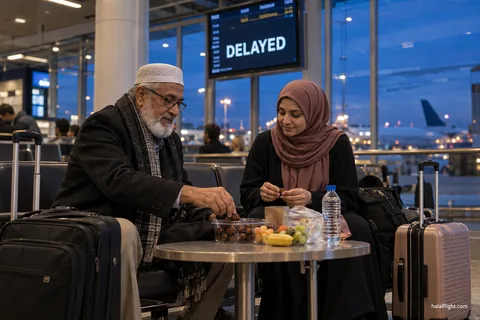
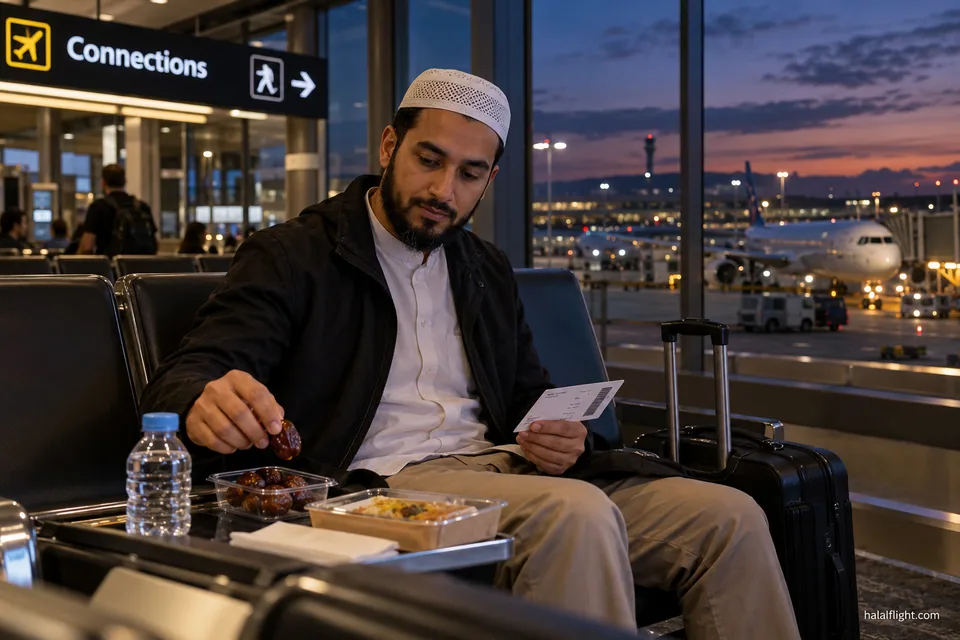
If you will be airside at sunset, find out where you can eat and pray before you pass security. Once through, your options are limited to what is open in the terminal. Eat a proper meal in the departure hall if boarding is tight, or carry something you can eat at the gate.
Sunset while boarding or taxiing
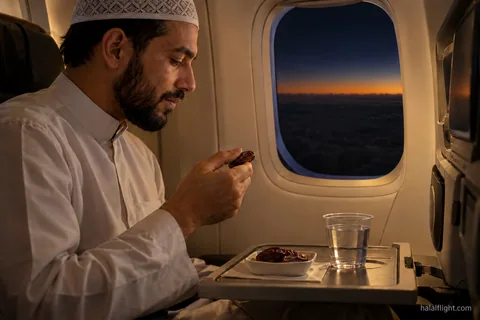
This is the least convenient moment. Crew need passengers seated, and meal service has not started. Dates and water from your own bag solve it, as long as you follow seatbelt and stowage instructions.
Sunset in the air
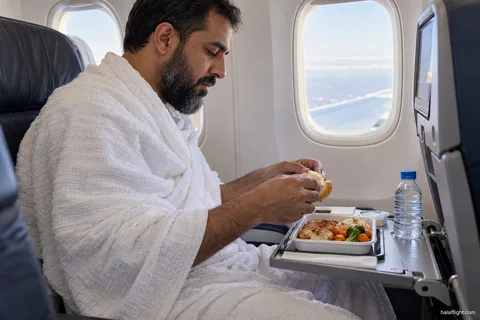
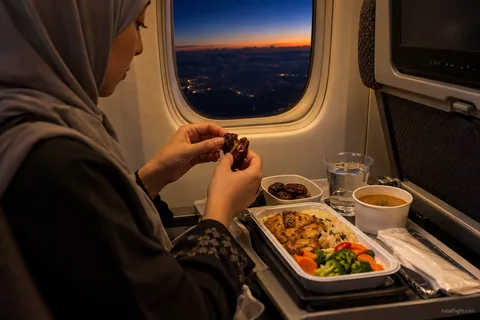
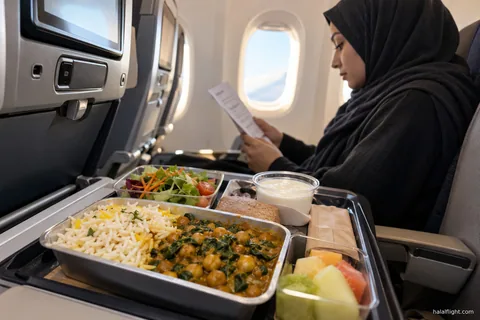
Here the food comes from the airline, if it offers any, plus your own. The guide to onboard iftar meals deals with the boxes in detail, and the guide to breaking the fast in flight deals with timing.
Sunset during a transfer
You might be walking between terminals, queueing at transit security or waiting at a gate in a different country. Plan the food for this one most carefully, because everything depends on the connection time.
Airline help on the ground
Some airlines extend Ramadan arrangements beyond the cabin. Emirates has said that iftar boxes containing water, laban, a banana and dates are handed out at select boarding gates during iftar time, and that its lounges at Dubai International offer dates, coffee and Arabic sweets with prayer rooms and ablution facilities. Qatar Airways has described iftar at its Al Safwa, Al Mourjan and Global Premium lounges in Doha.
Two cautions apply. These are announcements for particular seasons, not permanent services, and they cover selected gates or lounges. Lounge access also depends on your ticket or membership, so a standard economy passenger cannot count on it. Ask the airline before travelling, and treat any gate offer as a bonus.
Airports: finding food and a place to pray
Airport operators publish their own information, and it is better to use it than a forum post from years ago. Hamad International Airport in Doha gives a useful example. Its website says prayer rooms are spread throughout the passenger terminal, each with separate areas for men and women and dedicated washing facilities, and that travellers leaving the airport can pray at a public mosque just outside the terminal, within walking distance of the Departures Hall.
The same airport's interactive map has quick filters for food and for prayer rooms, which helps when you land with little time. A 2023 Qatar Airways release listed Harrods Tea Room, Armani Ristorante and Evergreens Organics as places offering iftar at the airport; because that release is dated, check that any outlet is still operating and when it opens.
At any other airport, look for the same things on the operator's website: a terminal map, the food and drink directory with opening hours, and the location of prayer facilities relative to your gate.
A simple first bite, then a proper meal
Many travellers break the fast with dates and water and have a fuller meal a little later. On a transfer day this works well, because the first bite can be taken wherever you are, while the second meal can wait until you sit down.
- Dates and a sealed water bottle for the first bite.
- A light, filling item such as a plain sandwich or fruit that survives a bag.
- A plan for the main meal: a restaurant if time allows, or the aircraft meal if the airline serves one.
Avoid very heavy or very sweet food straight after a long fast if you are about to board, and keep to what you know suits you. If you have a medical condition, follow your clinician's advice on breaking the fast.
Transfers: connection time decides everything
A short connection leaves no room for a sit-down meal. Before you book, look at the minimum connection time and imagine walking the distance between gates while fasting. If sunset falls in the transfer window, a longer connection or an earlier flight may be better than a tight one.
Also check whether the transit area has food that is acceptable to you. Halal status varies between outlets and countries, so ask staff, look for certification on display, and have a back-up of sealed food in your bag. Security rules on liquids and food differ between airports, so check them for every airport on the route.
On the timing question, the Egyptian fatwa body Dar al-Ifta says that the traveller breaks the fast at sunset at the aircraft's own location and not by the departure or arrival clock, and Emirates describes calculating onboard iftar from position and altitude. That is why your phone's local sunset may not match the cabin announcement.
Checklist for iftar on a travel day
- Mark sunset times for every airport on your route against your flight times.
- Identify, for each possible location of sunset, where you will eat and where you can pray.
- Pack dates, sealed water and a simple snack in your cabin bag.
- Check the airline and airport websites for Ramadan notices for your travel date.
- Ask staff at the gate or in the lounge about iftar boxes instead of assuming.
- Keep your boarding pass and passport in one place so that a meal does not make you late.
- If the flight is delayed past sunset, move to the nearest food outlet and prayer room straight away.
If everything goes wrong, a few dates and water still do the job, and a longer meal can follow when you are settled.
Frequently asked questions
Where can I pray and break my fast at the airport before boarding?
Most large airports have prayer rooms, but locations differ. Hamad International Airport says on its website that prayer rooms are spread through the terminal with separate men's and women's areas and washing facilities. Check your airport's website or map and note the nearest room to your gate.
Will the airline give me an iftar box at the gate?
Only sometimes. Emirates has said that boxes with water, laban, a banana and dates are handed out at select boarding gates during iftar time, but that applies to selected gates and seasons. Ask the airline before travelling and bring your own dates as a precaution.
What if sunset falls during a tight connection?
Plan a first bite that you can eat on the move: dates and water are enough. Choose connections long enough to reach a prayer room and a food outlet, and check opening hours. If time is short, eat the simple items first and have a fuller meal on the next flight.
Is the sunset time in my destination city the right time for iftar on the plane?
Not necessarily. Dar al-Ifta in Egypt says the relevant time is sunset at the aircraft's own location, and Emirates describes calculating onboard iftar from the aircraft's position and altitude. Ask the crew how your airline sets the time and consult your religious adviser.
Can I bring food through security for iftar?
Rules differ by country and by item, especially for liquids, gels and fresh food. Dates and sealed dry snacks are usually easy to carry, but check the security guidance for your departure airport and any transfer airport. Buy water after screening where that is allowed.