Two codes, two systems of dietary law
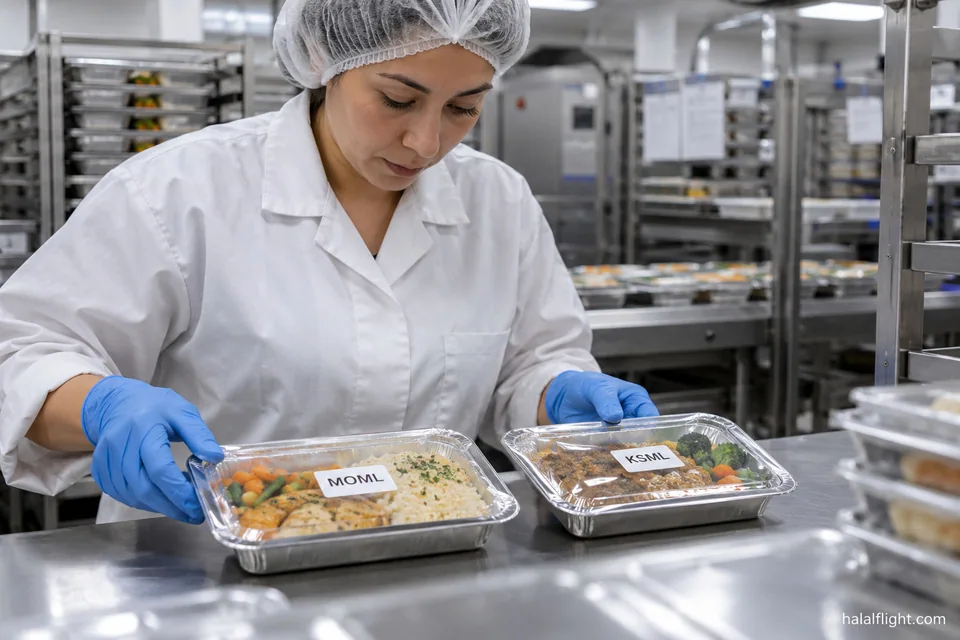
On an airline booking, MOML identifies a Muslim meal and KSML identifies a kosher meal. The codes come from the same industry list, which can make the meals look like variants of one idea. They are not. Each follows a different body of religious law, is supervised by different authorities, and answers to different believers.
Airlines describe them in their own terms. Delta states that its Muslim meals are halal certified and contain no pork, pork by-products or alcohol, and that its kosher meals are prepared by kosher caterers under rabbinical supervision. Those two sentences already show the gap: one describes ingredients and certification, the other describes who supervises the kitchen.
What the two standards share
Both traditions prohibit pork, and both place conditions on how meat animals are slaughtered. Both also require attention to ingredients that are not obviously animal-derived, and both rely on certification because a plain ingredient list cannot show how food was handled. These overlaps explain why some travellers regard a kosher meal as the nearest alternative when no halal option is available.
The overlap, however, is partial. Agreement on pork does not mean agreement on everything else, and a sealed kosher tray is evidence of a Jewish standard, not of a Muslim one.
Where the standards part company
Meat and dairy
OU Kosher explains that kosher law bars cooking meat and milk together or eating such dishes, and that rabbinic rules extend this to separate meals and utensils. Halal rules contain no equivalent separation, so a kosher meal is arranged around a restriction that has nothing to do with halal.
Slaughter and supervision
Kosher meat and poultry must be slaughtered by the method called shechita, performed by a trained slaughterer, followed by inspection and salting or broiling to remove blood. Halal slaughter has its own requirements, and scholars differ on some details such as stunning. A kosher slaughterer is not performing a halal slaughter, and a halal certifier does not supervise a kosher kitchen.
Fish and shellfish
According to OU Kosher, a kosher fish must have fins and scales and all shellfish are prohibited. Views on shellfish in Islam vary between schools, so the two systems do not draw the line in the same place.
Wine and grape products
OU Kosher states that wine and grape products must be prepared under strict Orthodox rabbinic supervision. A kosher meal can therefore contain wine-based ingredients that were made kosher, which a Muslim traveller who avoids all alcohol in food would not want.
Why a kosher meal is not a halal meal
A kosher label documents compliance with Jewish dietary law. It does not document halal certification, and nothing in the kosher process addresses the halal conditions for slaughter or for alcohol. Whether a particular Muslim may eat kosher-certified food in a particular situation is a question of individual religious judgement, and different scholars have given different answers. This guide cannot settle that question, and the airline's staff cannot either.
If you are considering a kosher meal because no halal option exists, do the practical checks yourself: read the ingredient information, ask the airline whether any wine, spirits or alcohol-based flavouring is used, and ask a trusted scholar for guidance before you rely on it.
How airlines describe each meal
Published definitions give you the airline's own words, which matter more than appearances. Turkish Airlines says its kosher meals are kosher-certified, packaged and double-sealed, and also states that the meals on its flights are prepared in accordance with Islamic dietary laws. TAP Air Portugal describes its Muslim meal as containing no pork, no pork by-products and no alcohol, with meat and poultry certified as halal-slaughtered, and describes its kosher meal as strictly kosher food prepared to comply with Jewish dietary laws.
The pattern is consistent: the Muslim meal is defined by ingredients and certification, the kosher meal by supervision and sealing. Read your own airline's definition and ask what certification applies to your departure airport, because catering sources can differ from one airport to another.
Booking deadlines are not the same
Each category can close at a different time. Delta asks for both its Muslim and kosher meal requests at least 24 hours before departure, and Turkish Airlines accepts special meal requests up to 24 hours before. Air France, according to the current page content used for this guide, publishes a forty-eight-hour requirement for kosher meals, compared with twenty-four hours for most other special requests on eligible flights. TAP states 72 hours for kosher meals on flights departing from Luanda.
These examples show that the deadline for your category may be longer than the one you assumed. Check the figure for your airline, your route and your meal type, and request when you book. Changing from one meal to the other close to departure may no longer be possible.
Choosing between the two in practice
If you are a Muslim traveller, the first choice is the halal or Muslim meal, or the airline's standard meal where the carrier states that all meals are prepared according to Islamic law. Kosher is a fallback considered only on the basis of your own scholar's view. If you are travelling with someone who needs kosher food, book each meal separately, since airlines record special meals per passenger.
Kosher meals are delivered sealed, as Turkish Airlines describes, so keep the package intact until you have checked the label, and follow any instructions printed on it.
Checklist when the tray arrives
Before opening
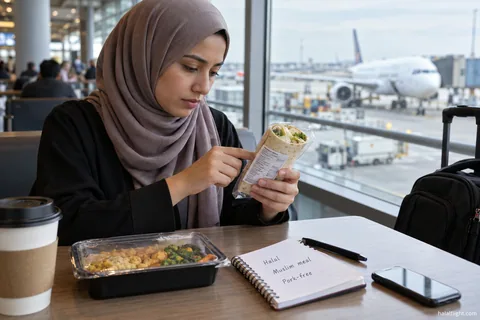
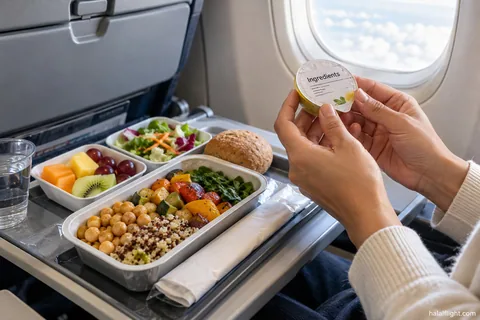
- Compare the label with the category you requested.
- Look for a certification mark and note who issued it.
- Keep the wrapper until you have identified every item.
If something does not match
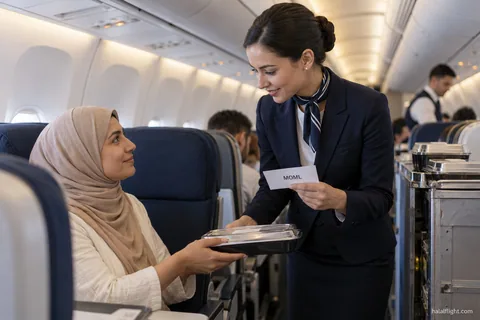
Ask the crew about an unexplained substitution before opening the tray. Check bread, sauces and desserts, since separately supplied items may follow different rules from the main meal. If you cannot identify the meal and you are not willing to accept it, use the snacks you packed, and report the problem to the airline afterwards with your booking reference. Individual religious rulings belong to a qualified scholar, so seek advice on the doubtful cases rather than relying on the cabin crew.
Frequently asked questions
Is a kosher airline meal halal?
Not automatically. A kosher label shows compliance with Jewish dietary law and does not itself show halal certification. The two standards overlap on pork but differ on slaughter, supervision, wine and shellfish. Whether to accept kosher food is a personal religious question to put to a qualified scholar.
What do MOML and KSML stand for?
They are airline special-meal codes: MOML for a Muslim meal and KSML for a kosher meal. Delta describes its Muslim meals as halal certified without pork, pork by-products or alcohol, and its kosher meals as prepared under rabbinical supervision.
Can I swap a kosher meal for a halal one on board?
Rarely. Special meals are loaded in fixed numbers according to the requests received, so an on-board swap is usually impossible. Request the correct category before departure and repeat the request if your booking changes.
Do halal and kosher meals have the same booking deadline?
Not always. Delta and Turkish Airlines use 24 hours, but Air France is reported to need 48 hours for kosher meals, and TAP asks for 72 hours for kosher meals on flights from Luanda. Check your airline's page for your route.
Why do kosher meals come sealed?
Airlines deliver them in sealed packaging. Turkish Airlines, for example, says its kosher meals are kosher-certified, packaged and double-sealed. Keep the seal intact until you have checked the label, and ask the crew if you are unsure how to open or heat the meal.