What makes a good flight snack
A snack earns its place in your bag if it survives being squashed, needs no refrigeration, passes through screening without a debate and can be opened with one hand in a narrow seat. For a Muslim traveller, there is a fifth test: you must be able to see what is in it.
Meal service on a long flight can be late, small or missing something you can verify. A few well-chosen snacks mean you are never forced to choose between an unverified item and going hungry, and they give you a fall-back if a special meal is not loaded. Think of them as insurance, not a replacement for the airline meal.
- Dry and shelf-stable: no chilling, no spills.
- Sealed and labelled: the wrapper identifies the product and ingredients.
- Familiar: a long flight is a poor time to test a new food on your stomach.
- Tidy: minimal crumbs, mess and smell.
Snack types that usually travel well
Dried fruit and fruit bars
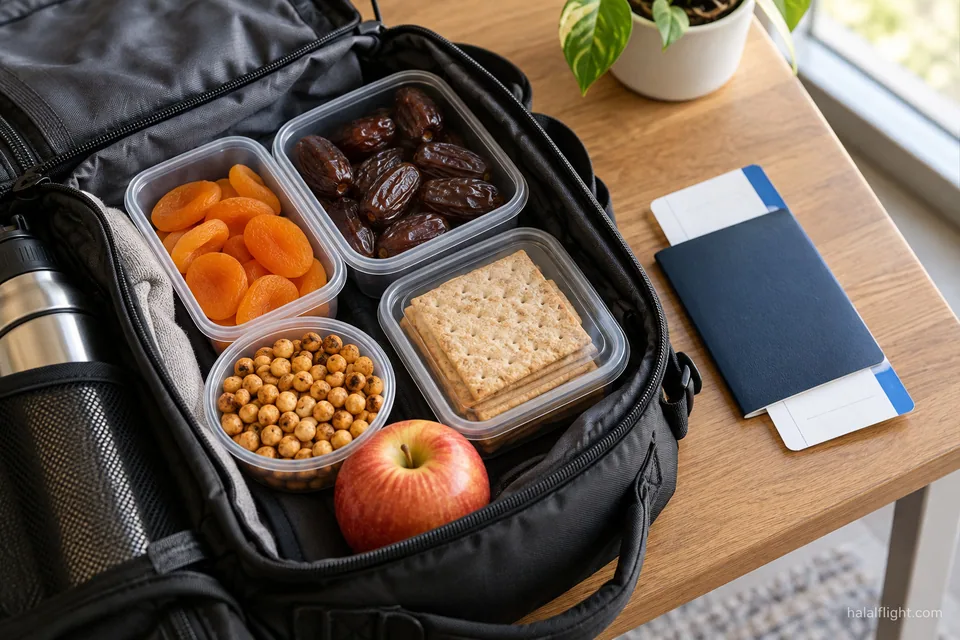
Dates, apricots, figs, raisins and plain fruit bars are light, keep for days and can be shared. Date-based snacks are also convenient for breaking a fast on a flight, and the topic of fasting and prayer on board is covered elsewhere on this site. Check the ingredient list for glazing agents and added flavourings, because some dried fruit is coated.
Nuts, seeds and roasted pulses
Unsalted or lightly salted nuts, seeds and roasted chickpeas are filling and compact. Consider other passengers: nut allergies are common, and crew may ask for nuts not to be opened on some flights.
Crackers, rice cakes and plain biscuits
Simple crackers and rice cakes are the least likely to need a second look, though flavoured varieties can add cheese powder, whey or flavourings. Plain versions keep your checking to a minimum.
Cereal and oat bars
Bars are convenient but vary widely. Some contain gelatine, marshmallow, glazes or milk-derived ingredients. Pick products with a halal certificate or an ingredient list you have read in full.
Reading labels before you pack
The snack’s name is not a guide to its ingredients. A fruit-flavoured chew, a yoghurt-coated bar or a savoury snack can all contain items that need a halal check. Read the label at home, where you have time and can look things up, rather than at the gate.
- Gelatine: common in chewy sweets, marshmallow, gummy fruit and some coated bars. The American Halal Foundation’s ingredient guide flags non-halal gelatine in sweets, yoghurts and pastries.
- Flavourings: may use a carrier such as ethanol or may be built on animal-derived inputs. The sibling page on alcohol-based flavourings explains how to approach this.
- Colours and glazes: red colours from insects and shellac-type glazes appear in some sweets and dried fruit.
- Dairy ingredients: whey and cheese powders depend on the rennet used in the cheese.
- Certification: a recognised halal logo is more informative than an ingredient list alone.
Keep the original wrapper, or photograph it, so that you can identify the product later if you have a question. Decanting snacks into an unlabelled bag removes the one piece of evidence you have.
Screening: solids, spreads and liquids
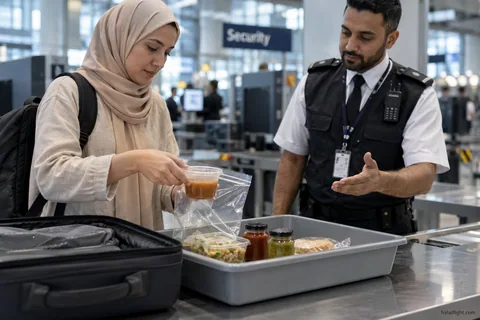
Dry snacks are generally easier at the checkpoint than anything soft or spreadable. UK government guidance notes that food items and powders can obstruct X-ray images, so bags may be manually rechecked, and suggests putting such items in hold luggage to minimise delays. It also says there are limits on liquids in hand luggage.
That has a clear consequence for dips and spreads. Hummus, nut butter, jam, soft cheese and yoghurt can behave like liquids or gels under screening rules, so check the rule for your departure airport before packing them. In the United States the familiar cabin limit is containers of 3.4 ounces (100 millilitres) in a single quart-size bag; other countries publish their own rules. Pack a dry alternative if you are not sure.
Frozen and chilled food
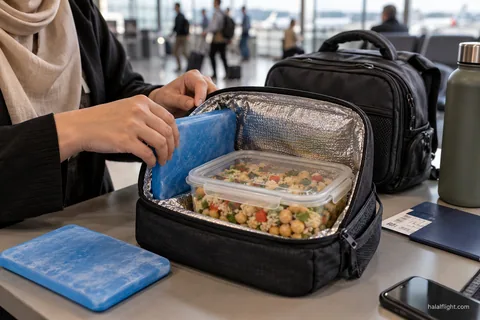
UK guidance states that frozen items cannot usually be carried in hand luggage, with exceptions such as baby food, baby milk and some medicines. Chilled food brings a separate problem: without refrigeration, delays shorten how long it stays safe to eat. Shelf-stable snacks avoid both issues. The sibling pages on liquids at security and on keeping homemade food fresh go deeper on each.
Allergies and the people around you
A cabin is a shared, enclosed space. Sealed single-serve packs are easier to open, easier to close again and less likely to scatter in turbulence than a large open bag. Strong smells from spiced, fishy or fermented snacks can be unwelcome in a crowded cabin, even when the food is entirely allowed.
Follow any crew announcement about allergens, especially nuts. If you have your own allergy or intolerance, keep ingredient information accessible, since a snack that is halal can still be unsuitable for you. Pack in a way that avoids cross-contact, for example by keeping nut-containing items in a separate sealed bag.
Quantity and how to organise your bag
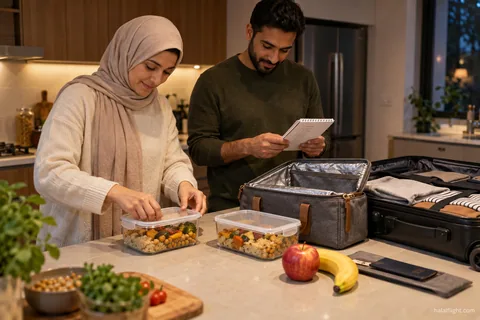
Pack a day’s worth of snacks for a day of travel plus a margin for delays, rather than a week’s supply. A small, soft pouch at the top of your carry-on means you can pull out the food for screening if asked, without unpacking the whole bag. Put heavier items at the bottom of the bag, and leave soft fruit and anything that can burst away from papers and electronics.
- One snack bag, easily reached, with sealed packs only.
- A small reusable container for opened portions.
- Wipes or a napkin for tidy eating at the seat.
- An empty bottle to fill after security, rather than carrying liquids through the checkpoint.
If you will fast during the flight, put the food you plan to eat at the break of fast in the most accessible place, and check the airline’s meal timing before you board.
Food at the border: fruit, nuts and leftovers
Snacks that were fine at departure may not be allowed in at arrival. Fresh fruit, nuts, seeds, dried foods and anything containing meat or dairy can be restricted or may have to be declared, and rules vary by country. Do not rely on a food being unremarkable because it is packaged.
The practical approach is to look up the arrival country’s customs or agriculture authority before you travel, and to finish or discard anything doubtful before landing. Border forms usually ask about food, and a wrong answer can bring a fine, so declare an item if you are unsure. Keeping the original packaging helps officers identify what you carry. For a country-by-country explanation of meat and dairy rules, see the sibling page on customs restrictions.
Checklist and what to do if a snack is refused
Before packing
- Read each label and note any gelatine, flavourings or dairy ingredients that need a check.
- Choose dry, sealed items and leave spreads and soft cheese at home unless you have checked the rule.
- Check allergen restrictions on your flights.
At the airport
- Keep snacks in one easy-to-reach bag.
- Be ready for a manual check of food and powders.
- Eat or bin anything doubtful before you reach border control.
If something is taken or you cannot verify it
- Ask whether the item can be checked in or left with a companion.
- Buy a certified or clearly labelled replacement after security.
- Do not eat a snack whose ingredients you cannot confirm; consult a scholar if you are unsure of a ruling.
Frequently asked questions
What are the best halal snacks to take on a plane?
Dry, sealed and familiar items work best: dates and other dried fruit, nuts, roasted chickpeas, plain crackers and simple bars with an ingredient list you have read. Choose products with a halal certificate where possible and avoid soft, chilled or spreadable foods unless you have checked the screening rules.
Can I bring hummus or nut butter in hand luggage?
It depends on the airport’s liquids rule, because spreads can be treated like liquids or gels. UK guidance says there are limits on liquids in hand luggage. Check the rule for your departure airport, or pack a dry alternative such as crackers and nuts, and put spreads in hold luggage if you can.
Are all dried fruits and fruit bars halal?
Not always. Plain dried fruit is usually simple, but some products have glazes, added flavourings or gelatine in bars and chews. Read the ingredient list and look for a certification mark. Keep the packet so you can check anything you are unsure about later.
Can I take leftover fruit or nuts into another country?
Possibly not. Fresh fruit, nuts, seeds and dried foods are restricted or must be declared in many countries. Look up the customs or agriculture authority of your arrival country before you travel, declare anything you are unsure about, and finish or discard doubtful items before landing.
Is it acceptable to eat my own snacks instead of the airline meal?
Airlines generally allow passengers to eat their own food, though some ask you to avoid items with strong smells or allergens. If you have ordered a special meal, still check it on arrival. Your own sealed, labelled snacks are a sensible fall-back when you cannot verify what is served.