What to expect at Incheon
Incheon International Airport has a large food and beverage directory, but when this page was prepared that directory did not mention halal at all and did not state whether any outlet serves halal food. The official directory is therefore the place to find where and when you can eat, not proof of what is in the food.
For the assurance question, the more useful source is the Korea Tourism Organization's explanation of Muslim-friendly restaurant categories. Combining the two gives a workable method: locate a convenient outlet in the airport directory, then ask what kind of assurance it can actually offer, using the category language described below.
If you have a long layover, you will have time for this. If you have forty minutes between flights, a packed reserve is the safer plan, and the final section explains how to prepare one.
Using the airport food directory
The English directory can be filtered by terminal (Terminal 1, Terminal 2 and the Concourse) and by food category: Korean, Western, Asian, food court, fast food, and snack, cafe or dessert. There are also filters for outlets open 24 hours, for the duty-free area and for the arrival point.
What each listing gives you
Entries usually show business hours, a phone number (sometimes missing) and a location such as a gate area and floor. Several well-known chains and cafes appear as open around the clock, while many Korean restaurants list roughly 06:00 to 22:00. The entries reviewed were for Terminal 1, so travellers using Terminal 2 should switch the filter and read that terminal's list separately.
Keep the whole location
Write down terminal, floor and gate area together. A restaurant name alone is not enough, particularly if your departure or connection uses a different part of the airport. The directory also shows an airport customer line, which is useful if you need help locating an outlet; its stated hours should be checked on the page before you rely on it.
The four Korean categories explained
Korea Tourism sorts Muslim-friendly restaurants into four groups. They are not interchangeable.
- Halal certified. The restaurant has been verified by an accredited halal certification body, with the Korea Muslim Federation given as an example.
- Self certified. The Muslim owners themselves certify that all the food is halal. This is an owner's statement rather than an outside audit, and some travellers weigh that differently.
- Muslim friendly. The restaurant offers some halal dishes and may also sell alcohol.
- Pork free. There is no halal menu, but pork is not used, and alcohol may be sold.
The same page warns that hotel restaurants and buffets in the Muslim-friendly group may serve dishes that contain pork. That caution applies by analogy to any large kitchen with many dishes: a general label does not tell you that every item is suitable.
When you ask an airport outlet about its status, use these words. Ask which group it belongs to, who gave that assurance and whether the specific dish you want is covered.
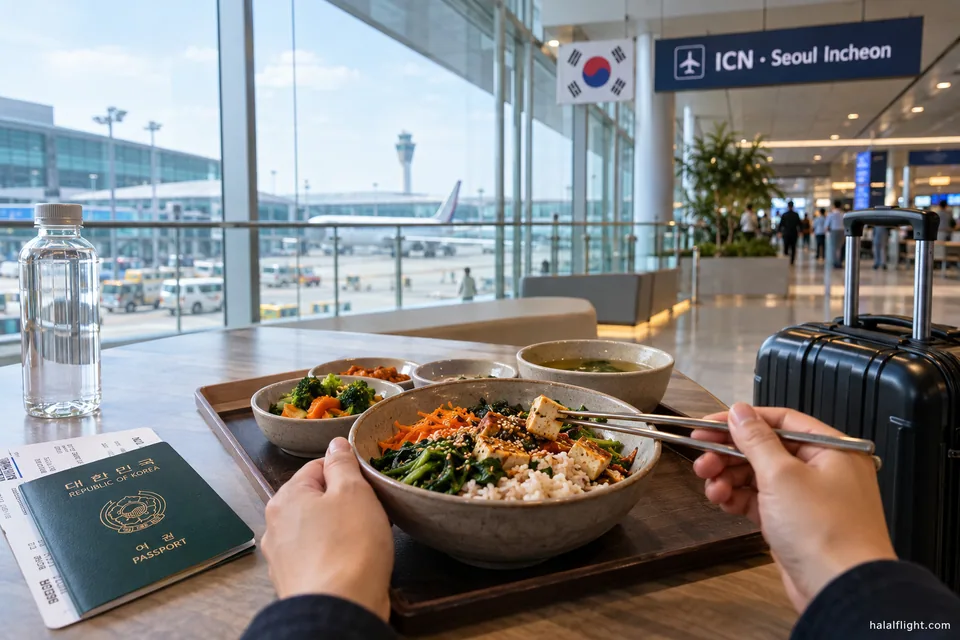
Rice bowls and their side dishes
A Korean meal often arrives as rice or noodles with several small dishes. Each part has its own ingredients, so a bowl that looks vegetable-based can sit beside a plate that is not.
Points to raise
- Broth and stock. Soups and noodle dishes may use meat or seafood stock even when the visible toppings are vegetables.
- Meat garnishes. Small amounts of minced meat or meat flakes can be added at the end.
- Sauces and seasonings. Ask about ingredients in sauces, including any that are fermented or contain rice wine.
- Cooking fat and shared surfaces. Ask whether grilled or fried items share equipment with pork dishes.
A request in writing can help when language is a barrier. Short notes such as "no pork, no alcohol, no meat stock" are easier to act on than a long explanation. Staff may answer a clear yes or no more reliably than an open question.
Prayer arrangements and food are separate questions
A Korea Tourism entry for Incheon mentions airport prayer facilities, including a location near Gate 24. That page could not be opened when this guide was prepared, so treat the detail as something to verify. Ask at an information desk or check the airport's current map for the room, its access conditions and which terminal it serves.
The presence of a prayer room tells you nothing about nearby restaurants. Do not assume a restaurant is suitable because it is close to a facility designed for Muslim travellers. Walk to the prayer room if you wish, but judge food on its own category and ingredients.
For timing of prayers during a long journey, a separate page on this site explains prayer on board and during transit, so it is not repeated here.
Late-night and early-morning choices
Many outlets in the directory are listed as open 24 hours, including fast-food and bakery-style chains, while a good share of Korean restaurants close in the evening and reopen around 06:00. If your connection falls in the small hours, filter for 24-hour outlets and then ask what is available.
Opening hours and ingredient assurance answer different questions. A restaurant that is open does not become suitable because it is the only one open. If the one place available cannot tell you what is in a dish, buy something sealed with a readable label, or eat from your own supplies.
Hours can change by season and by operator, so confirm them on the directory or by telephone near your travel date. The phone number shown for each entry is the quickest way to ask.
Packing a labelled reserve
A reserve costs little and removes pressure. Choose items you have checked at home: nuts, dried fruit, plain crackers, sealed snack bars and similar goods whose labels you have read.
Check the entry rules of South Korea and of your onward destination before packing. Rules on bringing meat, dairy and some fresh products into a country can be strict, and a snack that is fine at departure may not be allowed on arrival. Keep products in original packaging so labels remain readable and so officers can identify them.
If you need a pre-ordered halal meal on your next flight, remember that this is arranged with the airline, not with the airport. The airline's special-meal request, and its deadline, apply regardless of where you eat on the ground.
Checklist and what to do if it goes wrong
- Open the airport food directory and select your terminal.
- Choose two or three outlets near your gate and note floor, hours and phone number.
- Ask which Korea Tourism category the outlet falls into and who certified it.
- Ask about broth, sauces, meat garnishes and cooking oil for the exact dish.
- Keep a sealed reserve in your bag.
If you cannot get a clear answer
Choose plain rice with an item you can verify, a sealed product or fruit, and move on. If you later learn that a dish contained something you avoid, discuss the position with a qualified scholar; views differ and the answer may depend on your circumstances.
For help finding an outlet or checking its hours, use the airport's customer line or an information desk instead of guessing.
Frequently asked questions
Is there halal food at Incheon Airport?
The airport's English food directory does not mention halal, so it cannot confirm that any outlet is halal. You can use it to find outlets, then ask each one about its status using Korea Tourism's categories. Where the answer is vague, choose sealed food or a packed reserve.
What is the difference between halal certified and Muslim friendly in Korea?
Korea Tourism describes halal certified restaurants as verified by an accredited body, such as the Korea Muslim Federation. Muslim friendly restaurants offer some halal dishes and may sell alcohol. Self certified means the Muslim owners vouch for the food, and pork free means no halal menu but no pork.
Can I trust a pork-free restaurant at Incheon?
Pork free only means pork is not used. Korea Tourism notes that such restaurants have no halal menu and may sell alcohol. Meat could still be non-halal, and stock or sauces could contain unwanted ingredients. Ask about the exact dish and decide according to your own requirements.
Are there 24-hour food options at Incheon?
Yes, the directory marks a number of outlets as open 24 hours and offers a filter for them, alongside many Korean restaurants that close in the evening. Being open does not make a place suitable, so still ask about ingredients and check the hours near your travel date.
Is there a prayer room at Incheon Airport?
A Korea Tourism entry lists airport prayer facilities, including one near Gate 24, but that page could not be opened when this guide was written. Confirm the location and access with an information desk or the current airport map before walking there.
How do I find which terminal my restaurant is in?
Use the terminal filter on the airport's food directory, which separates Terminal 1, Terminal 2 and the Concourse, and note the floor and gate area shown in each entry. The entries reviewed covered Terminal 1, so check Terminal 2 separately if you depart from there.