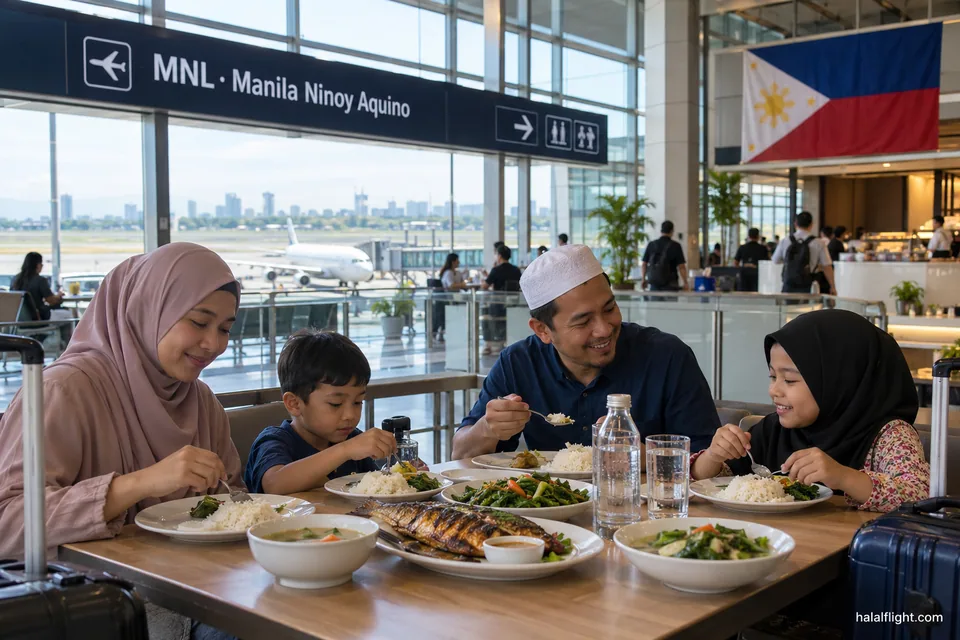
Starting point: the operator's own pages
Ninoy Aquino International Airport, usually shortened to NAIA, now has a passenger website run by its current operator, New NAIA. Its dining directory describes restaurants, cafes, fast food and food halls across the NAIA terminals and says it shows what is open landside and airside before you fly. The directory is the right place to begin, because older travel articles may describe outlets that have moved or closed.
What the directory does not do is tell you which dishes are halal. The pages reviewed for this guide did not name a halal programme or list certified outlets, so the responsibility for checking rests with you. This guide therefore concentrates on how to ask, what to look out for and how to fit a meal into a Manila transfer.
Philippine cooking is generous with pork, so a careful approach is sensible even in simple-looking dishes.
Landside or airside: decide before you queue
The distinction in the operator's wording matters. Landside means before check-in and security, and airside means after. If you have already cleared security, going back out to eat is rarely sensible, because you will need to pass checks again.
- If you are arriving to depart, eat landside only when you have comfortable time before check-in closes.
- If you are already through, restrict yourself to airside outlets near your gate.
- If you are transferring, check whether your airline expects you to collect bags and change terminals, because that changes the amount of time you really have.
Set a personal deadline, such as thirty minutes before boarding, after which you stop exploring and settle for whatever you have already confirmed or packed.
Rice meals: what can hide in a plain plate
Rice with a main dish is a standard airport meal in Manila and a popular choice for families. It looks simple, yet several components need a question.
The main dish
Pork is common in Filipino dishes, including adobo, sisig, lechon and sausages. Chicken and beef dishes may be cooked in the same pan or sauce as pork, or finished with bacon. Ask which meat is used and whether it is sourced as halal.
Sauces, gravy and sides
- Gravy and sauces may be built on pork stock or contain lard.
- Fried rice may be cooked with bacon bits, sausage or pork fat.
- Fried sides such as spring rolls or lumpia often contain minced pork.
- Soy-based or sweet sauces can contain alcohol-based seasoning such as rice wine.
- Desserts and drinks may use gelatine or alcohol flavourings.
Ask by name: do you use pork, lard or pork stock in this dish, and what is the source of the other meat? Do not take plain white rice and a fried egg as proof that the rest of the plate is suitable; ask about the oil used and whether the egg is cooked on the same griddle as bacon.
International chains are not all the same
A familiar chain may run different menus and suppliers in different countries, and sometimes in different branches. A halal claim at a branch in another country does not extend to the NAIA outlet, and a well-known logo does not prove anything on its own.
At the counter, ask what current halal assurance applies to the exact dish you want. A good answer names a certifier, shows a certificate or label, or points to written ingredient information. A vague answer such as it is just chicken is not enough for a decision.
If the staff cannot answer, the safest course is to choose another outlet or a sealed product. If you rely on a particular certifier or school of thought, a scholar or your usual halal authority can help you decide what to accept; this guide cannot give personal rulings.
Avoid assuming that staff are being evasive; frontline employees often work from a menu card and may not know supplier details, so a polite request to check with a supervisor is reasonable.
Prayer rooms and family facilities
The operator's services and amenities page lists prayer rooms among passenger services, together with free Wi-Fi, ATMs and currency exchange, baggage wrapping and clinics, and it covers Terminals 1, 2, 3 and 4. The text reviewed for this guide did not say which terminal has a prayer room, where it is or when it opens, so open the page on the day and confirm the details for your terminal.
For a family, treat prayer, rest and food as separate stops. Settle the meal first if children are hungry, then pray if time remains. Note that a prayer room is only a worship space, and its presence does not make the surrounding concessions halal.
If your terminal has no obvious prayer room, ask information staff before walking between buildings, because the distance between terminals can be considerable in Manila traffic.
Let the transfer plan decide when you eat
The operator's passenger guide covers check-in, security, eTravel registration, arrival procedures and frequently asked questions. It is the right place to confirm what you must do before departure and after landing. The pages reviewed did not give details of transfers between terminals, so ask your airline how your connection works and whether you must move between buildings.
- If you must change terminals, allow for transport, check-in and security as they apply to your ticket.
- If you are on one ticket with a checked bag to the final destination, your airline can tell you whether you need to touch the bag.
- If you are on separate tickets, expect to clear immigration and check in again, which leaves much less time for a sit-down meal.
When time is short, eat before leaving the first airport or buy a labelled reserve for the next departure area.
Bringing your own food
Many families carry food from home, which is the most reliable way to know what you are eating. Dry items such as nuts, dates, biscuits and plain bread travel easily. Check your airline's baggage rules and the rules of the country you are entering, because many countries restrict meat, dairy and fresh produce. Eat perishable items before you land or dispose of them as required.
Keep labels on packaged items so that you can read the ingredient list again, and so that officers can see what the item is. Do not carry cooked meat across a border without checking the entry rules first.
Checklist: when nobody can confirm the food
- Open the New NAIA dining directory on the day and note the terminal and landside or airside status.
- Pick two outlets near your gate or check-in area.
- Ask about pork, lard, stock, sausage, bacon and alcohol in sauces.
- Ask what halal assurance applies at this branch, and whether any written information exists.
- Check whether fried items share oil with pork.
- If you cannot confirm, choose sealed items with a readable ingredient list.
- Confirm the prayer room location on the amenities page.
- Keep a reserve for children: dry snacks, fruit, plain biscuits.
- Stop browsing at your personal deadline before boarding.
If a meal turns out different from what you were told, ask a qualified scholar about your circumstances instead of guessing.
Frequently asked questions
Is there a halal food list for Manila NAIA?
The operator's dining directory lists restaurants, cafes, fast food and food halls, but the pages reviewed did not label outlets as halal. Use it to find places, then ask each counter about pork, lard, stock and certification. Keep sealed snacks as a backup if no answer can be confirmed.
Is a rice meal at the airport safe to eat?
Not automatically. The main dish, gravy, fried rice and sides may contain pork, lard or pork stock, and meat dishes may share pans with pork. Ask about each part of the plate and the cooking oil. If you cannot get clear answers, choose another option.
Does a well-known chain in NAIA follow halal rules?
Not necessarily. Suppliers and menus can differ by country and branch, so a halal claim elsewhere does not prove the NAIA outlet. Ask what assurance applies to your dish at that branch, and ask to see a certificate or ingredient information.
Where are the prayer rooms at NAIA?
The operator's services and amenities page lists prayer rooms among passenger services for Terminals 1 to 4, but the text reviewed did not give locations or hours. Check the page on the day of travel, and ask airport staff if you cannot find the room.
Should I eat before changing terminals in Manila?
Often yes, if your ticket requires a terminal change or new check-in. Confirm the process with your airline, allow time for transport and security, and eat or buy a labelled reserve before you leave if the connection looks tight.