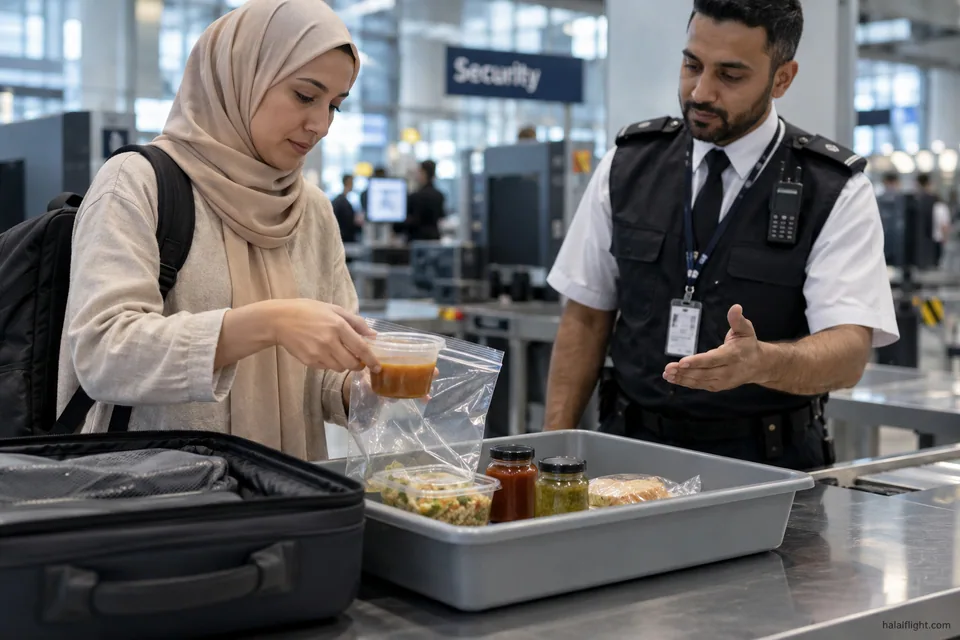
Food that screening treats as a liquid
Travellers who bring their own halal food to avoid doubtful catering often find that the most awkward items are the wet ones. Soup is clearly a liquid. Less obvious are sauces, dips, yoghurt, jam, spreads and pastes, which many security authorities class as liquids or gels because they are not solid at room temperature.
The Canadian Air Transport Security Authority (CATSA) says plainly that non-solid foods such as yogurt, pudding, peanut butter and jam follow the same limit as other liquids, and that a food counts as solid only if it is solid at room temperature. Calling something food, or showing that it is homemade, does not take it out of the liquid rules.
This page concentrates on the checkpoint. For the wider question of which halal foods may go into hand luggage, see the page on halal food in carry-on baggage. For meat and dairy at the border, see the page on customs restrictions.
The standard container rule
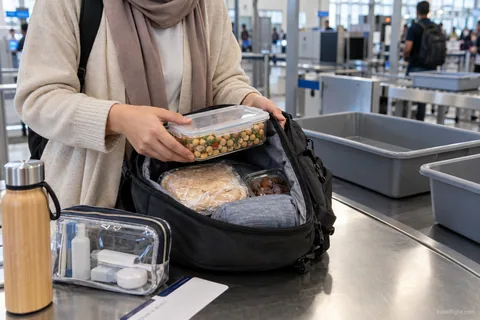
The most widely used rule is the container-size limit. CATSA states that containers must hold 100 ml or 100 g (3.4 oz) or less, and that all of them must fit in one clear, resealable bag of up to one litre, one bag per passenger. Containers above 100 ml can go in checked baggage. The same logic underlies the familiar US quart-bag rule.
Singapore's Changi Airport describes the same principle in more detail: containers above 100 ml are not accepted even if partly filled, and the containers must be presented in one transparent, resealable plastic bag of one litre in total, kept fully closed and shown separately at screening.
The half-empty jar trap
A large jar with only a spoonful left inside is still a large container. Officers look at what the container is rated to hold, not what it contains. Transfer the amount you need into small compliant pots, or choose a dry alternative. Check the pots are leak-proof, because a burst bag of sauce over your electronics creates a different problem.
Frozen soup, canned food and other edge cases
Several situations catch travellers out.
Frozen liquids
CATSA says that food that is normally a liquid or gel but is frozen solid is not allowed in carry-on baggage. A block of frozen soup is therefore not a loophole where that rule applies. Other authorities may word the rule differently, so check the one that governs your airport.
Canned or jarred solids
CATSA allows canned or jarred solid food that clearly holds less than 100 ml of liquid, such as tuna. A jar of lentil soup is not in that category. Tinned chickpeas with a splash of brine may be judged differently from a tin of chickpea stew, and the officer's decision on the day is final.
Souvenir tins
CATSA advises that canned condensed soup bought as a gift or souvenir should go in checked baggage. When a tin or jar is simply too large, checked baggage is the right place if your itinerary allows it.
Exemptions have conditions
Some authorities allow larger quantities of specific items. CATSA lists baby food, milk, formula, water and juice for infants under two, breast milk, prescription medicines, essential non-prescription medicines and certain gel or ice packs for medical or infant-food use. Passengers must declare these to the screening officer. Changi allows baby food and breast milk if the infant is travelling with the passenger, and says other items may be exempted with a bona fide doctor's letter, though additional checks may apply.
A preference for halal food, or a religious reason for carrying a particular sauce, is not on those lists. Do not expect a larger container of homemade gravy or soup to be waved through because it is halal. If a medical dietary need applies to you, ask your doctor for a letter and check with the airport or the authority in advance whether it will be accepted.
Infant feeding is covered in detail on the page about baby food and formula through airport security.
Rules differ by country and airport
The 100 ml rule is common but not universal, and it is not static. Some airports have introduced newer scanners and may apply different limits, and the position can change by terminal or by date. Travellers who read news of a relaxed limit at one airport should not assume it applies at the next. The European Commission's aviation-security pages, for example, have long described the general 100 ml rule alongside exemptions for liquid medicines and special dietary needs, including baby food, but also say that you should check current guidance for the latest rules.
For any journey, check three things: the official security page of the departure airport, the page of each transfer airport, and the airline's baggage page. Where two sets of rules differ, follow the stricter. If you are departing from the UK, the United States, Canada, the EU or an Asian hub, each publishes its own guidance, and the page for your own airport should be your final reference.
The next security check and the duty-free trap
A drink or sauce bought after security may be fine for the first flight and still be stopped at a later checkpoint. Changi's page, for example, warns passengers to check the rules at their transfer airport and says that on some itineraries only duty-free liquids sealed in tamper-evident bags, bought in the restricted area, may be carried.
If you connect through another airport and must pass screening again, anything you bought airside may be treated as a liquid at the second checkpoint. Keep receipts and any sealed tamper-evident bags unopened until you reach your final destination.
For a complicated connection, consider the following alternatives:
- Take solid food, such as bread and a dry filling, instead of sauces.
- Buy liquids after the last screening you will pass.
- Put sauces in your checked bag if your journey allows it.
- Ask the airline whether it can provide a meal that avoids the issue.
Dry alternatives that avoid the problem
The easiest way to avoid the rules is to change the food. Most liquid items have a solid substitute that gives a similar meal without screening risk.
- Instead of a dip, carry a firm spread in a dry sandwich filling, or make the sandwich at home and wrap it.
- Instead of soup, carry instant soup powder or dry noodles and ask for hot water on board if the airline offers it.
- Instead of a sauce in a jar, season the dish at home or pack a small dry spice mix.
- Instead of yoghurt, choose firm cheese or fruit, remembering the customs rules on dairy.
Hot water on a flight depends on the airline and crew, so ask rather than assume. Powders and dry seasonings can also draw attention at some checkpoints, so keep them in labelled, sealed containers and be ready to show them.
Checklist, and what to do if an item is stopped
- List every wet or soft item in your food bag: soup, sauces, dips, spreads, yoghurt, jam.
- Check each container is 100 ml or 100 g or smaller, and that all fit in one clear resealable bag.
- Decide which items go in checked baggage instead.
- Look up the official security page for the departure airport and every transfer airport.
- Carry a doctor's letter or other evidence if a medical exemption applies.
- Keep a dry halal backup snack in your main cabin bag.
If an officer stops an item
Stay calm and polite. You can usually choose between handing the item over, finishing it if practical, returning to check it in if time allows, or surrendering it. Do not argue about religious need; officers apply the written rule. Once through, buy a sealed alternative airside or use your dry backup. If you believe a rule was misapplied, ask the airport's customer service or the security authority for the written rule after your journey, not at the lane.
Frequently asked questions
Can I take homemade soup through airport security in hand luggage?
Usually only in containers of 100 ml or smaller that fit in one clear resealable bag, because soup counts as a liquid. Larger quantities generally have to go in checked baggage. Check the official security page for your departure and transfer airports, as limits and exemptions differ between countries.
Do dips, yoghurt and spreads count as liquids at security?
In many places, yes. CATSA, for example, applies the same limit to non-solid foods such as yogurt, pudding, peanut butter and jam, and treats a food as solid only if it is solid at room temperature. Treat sauces, dips and soft spreads as liquids unless the authority says otherwise.
Is a nearly empty large jar of sauce allowed through?
Not under the usual rule. Officers look at the size of the container, and a jar rated above 100 ml is oversized even if little is left inside. Changi's guidance says containers over 100 ml are not accepted even when partly filled. Decant what you need into small compliant pots.
Does halal food get an exemption from liquid limits?
No. The exemptions published by authorities such as CATSA cover items like infant food, breast milk and medicines, not religious preferences. If you have a medical dietary need, ask your doctor for a letter and check in advance with the airport or security authority whether it will be accepted.
Will liquids I bought airside be allowed on my connecting flight?
Not always. A second screening at a transfer airport may apply different rules, and Changi advises passengers to check the transfer airport's requirements. Keep purchases in their sealed tamper-evident bags with receipts, and check the rules for each airport on your route before buying.