What a special meal code is and where you see it
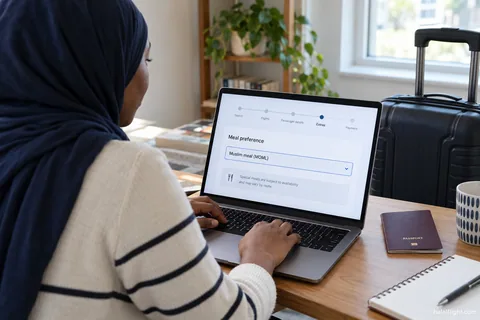
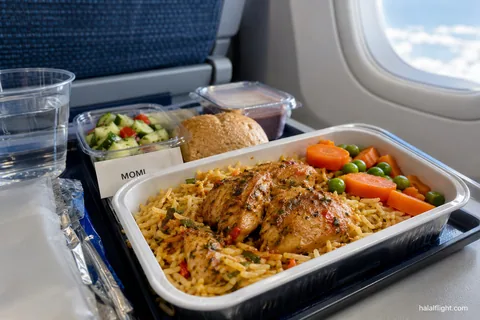
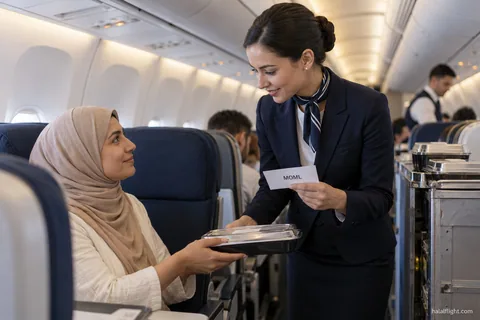
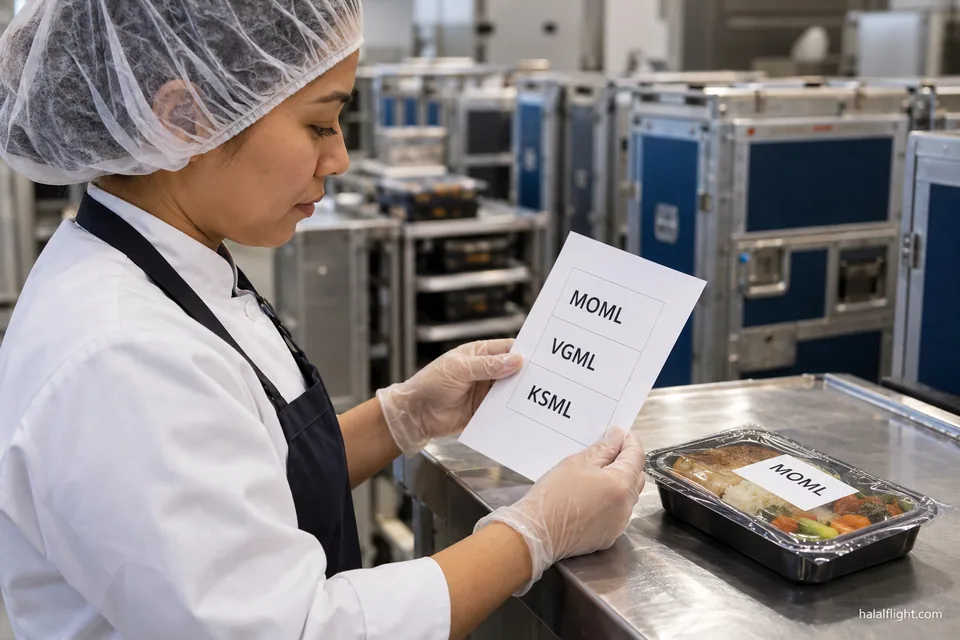
When a passenger asks for a non-standard meal, the request travels through the booking system as a short code attached to the reservation. Those codes end in ML (for meal) and are four letters long. You may see them next to the description on a booking page, in an itinerary email or on a label stuck to the tray.
The code is a routing tool. It tells the caterer which category of meal to load for which seat. It does not tell you who certified the kitchen, how the meat was slaughtered or what the dessert contains. For that, you read the airline's description of the meal, and you ask questions where the description is silent.
This guide concentrates on reading the codes, particularly those a Muslim traveller may meet. How to place the request, deadlines and certification are covered on separate pages.
MOML: the Muslim meal code
MOML stands for Muslim meal. Airlines that offer it describe it with similar but not identical words.
- Delta's guidance for travel agents says all its Muslim meals are halal certified and contain no pork, pork by-products or alcohol.
- Qantas describes its Muslim meal as suitable for people needing meals prepared according to Muslim dietary laws and customs, excluding pork, alcohol and doubtful (mushbooh) items.
- Singapore Airlines says a Muslim meal departing Singapore is prepared in a halal-certified kitchen from halal-certified suppliers, while meals departing elsewhere are made without pork, lard, pig by-products or alcohol, with halal meat and poultry not guaranteed.
- Lufthansa says its Muslim meal contains no pork or game and no alcohol, and that meat and poultry must be certified as slaughtered according to halal guidelines.
Four airlines, four wordings. The same four letters therefore carry different levels of assurance, which is why the airline's own description matters more than the code.
When there is no MOML to choose
Some airlines have no Muslim meal code because the whole menu is halal. Emirates states that all its meals are halal certified, and its page lists Indian vegetarian, Hindu non-vegetarian, Jain vegetarian and Kosher meals as the religious choices but no Muslim meal. Qatar Airways says all meals are halal. The selector you expected is not missing; it is unnecessary.
Other airlines use MOML but only on certain routes. Qantas notes that Muslim meals are not available on flights between Sydney and Sapporo, and that its Muslim meals are no longer nut-free. A request for MOML on a route that excludes it may be refused or replaced by another meal, so read the exceptions. For flights without a Muslim option, see the page on finding halal food when MOML is not listed.
Vegetarian and Hindu codes that are often confused
Several codes sit close together on the list, and the same letters do not always mean the same dish.
AVML
Usually an Indian-style vegetarian meal. Delta calls it the Asian Vegetarian Meal, Qantas labels it Hindu vegetarian, and Singapore Airlines calls it Indian. Lufthansa describes its Asian vegetarian meal as being without meat and prepared and spiced in the Indian style. Dairy may be included.
VGML
The vegan meal. Lufthansa lists no meat, fish, alcohol, dairy products or eggs, and Delta describes it as Western style with no meat, seafood, eggs or dairy.
HNML
The Hindu non-vegetarian meal, and the one that most often surprises people. Lufthansa warns that it may contain fish, shellfish, poultry, meat or eggs. Delta, however, describes its HNML as a meat-free vegetarian meal with limited dairy, and Qantas lists it as non-vegetarian Hindu. Two airlines, two meanings: check before choosing.
None of these is automatically halal. A vegetarian dish can still contain alcohol-based flavourings or ingredients of uncertain origin, so a halal-conscious traveller should check the description, not the code.
Medical, child and baby codes
The rest of the list covers medical needs and ages. Qantas and Singapore Airlines publish codes such as DBML (diabetic), GFML (gluten-free), NLML (low lactose or lactose intolerant), LSML (low salt, listed by Singapore Airlines), KSML (Kosher), VJML (Jain vegetarian) and FPML (fruit platter). Baby and child codes include BBML and CHML, and their age bands differ: Singapore Airlines uses BBML for infants of 12 months and under, while Qantas lists its baby meal for 6 months to 2 years.
Delta's agent page contains a small inconsistency of its own: its FAQ mentions CHML for the child meal while its table lists TDML, and the page does not settle the point. That is a useful reminder that even airline documents can disagree with themselves. Where a code matters, confirm it with the airline.
Medical codes are for real medical or dietary needs. Do not add one to a halal request merely to see what appears, because it may replace the meal you actually want.
One meal per passenger: combining needs
Delta's guidance says only one special meal can be requested per person. Many booking systems work the same way, so a traveller who needs a halal meal that is also gluten-free or low in lactose cannot normally attach two codes.
A Muslim meal code does not automatically include gluten-free or low-lactose features, and a gluten-free code does not guarantee halal meat. Whatever the booking page permits, explain the combination to the airline in writing and ask for a clear answer on what it can provide. Some airlines can do it only on certain routes; some cannot. If neither option fully covers you, ask which one the airline recommends and prepare your own safe food as a backup.
Requesting the code correctly
On most airline sites you never type the code: you pick the description from a list and the system applies the code. The code appears only when an agent enters the request. Airlines publish their deadlines separately, and 24 hours before departure is common; Air Mauritius, for example, says standard special meals must be ordered at booking and at least 24 hours before departure, and its Muslim meal (MOML) is the one it names for halal needs. Kosher meals often need longer notice, such as 36 hours at Qantas, 48 hours at Air Mauritius and 56 hours at Singapore Airlines.
Singapore Airlines also lists longer limits for flights from certain cities, so a standard deadline is not safe to assume. On itineraries with more than one airline, the request made with one carrier may not apply to the other, so repeat it where needed.
Checklist: make the code work for you
- Find the operating airline's special meals page and read the written description beside the code.
- If it says all meals are halal, you may not need MOML at all.
- Check whether the airline states certification, or only that pork and alcohol are excluded.
- Compare the description of AVML, VGML or HNML carefully if you are choosing a vegetarian alternative.
- Note the deadline for your route and cabin.
- Save the meal's full name and the code with your confirmation, the flight number and the date.
- If the tray label does not match, show the confirmation to the crew and ask what the meal contains.
Questions about whether a particular category meets your own religious standard belong with a qualified scholar.
Frequently asked questions
What does MOML mean on a flight booking?
MOML is the industry code for a Muslim meal. It tells the caterer to load a meal for that passenger. What the meal contains depends on the airline: some describe it as halal certified, others say only that it contains no pork or alcohol. Read the airline's own description alongside the code.
Is a Hindu meal vegetarian?
Not always. Lufthansa says its Hindu non-vegetarian meal may contain fish, shellfish, poultry, meat or eggs, while Delta describes its HNML as meat-free. The vegetarian Indian-style choice is usually coded AVML. Check the description on your airline's page before selecting.
Is AVML the same as VGML?
No. AVML is an Indian-style vegetarian meal that may include dairy, while VGML is vegan and excludes meat, fish, eggs and dairy according to Lufthansa and Delta. The recipes and exclusions differ, so do not treat them as interchangeable, and read the airline's definition.
Can I order a halal meal that is also gluten-free?
Often only one special meal can be requested per passenger, as Delta's guidance states. A Muslim meal code does not automatically cover gluten-free needs. Write to the airline, explain both requirements and ask what it can provide on your flight. Keep the reply and carry safe food as a backup.
Why does my airline not offer a Muslim meal code?
Some airlines serve only halal food. Emirates and Qatar Airways state that all their meals are halal, so they list no separate Muslim meal. Check the airline's special meals page; if it says all meals are halal, you can usually travel without requesting MOML.