Two models: halal for everyone or halal on request
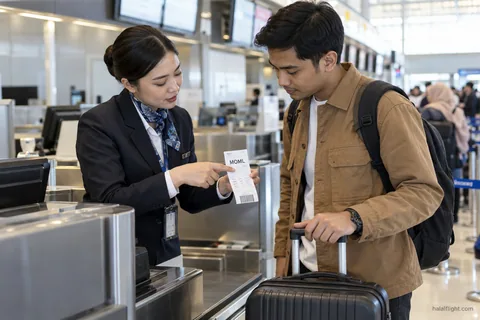
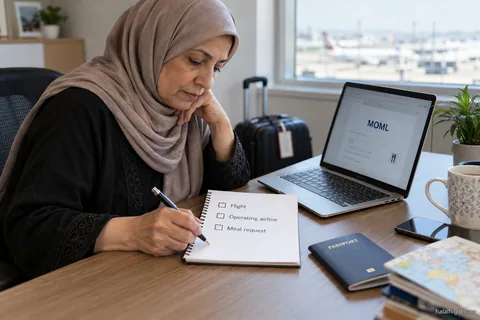
Airlines handle Muslim passengers in one of two broad ways. In the first, the standard catering follows a halal policy, so every tray is meant to be suitable and a separate order is unnecessary. In the second, the ordinary menu makes no such promise, and a Muslim meal (code MOML) is one of several special meals you add to the booking.
Knowing which model applies tells you whether to spend your effort on a request or on questions about ingredients and allergies. It also tells you what a missing request would mean: on a standard-halal airline, nothing; on a request-based airline, possibly a tray that was never prepared for you.
This page explains how to tell the models apart and how to check the result. Booking codes, fuller deadlines and cabin-specific menus have their own guides, listed with this page.
Airlines that describe their standard food as halal
Some carriers publish this directly. Etihad's special-meals page says there is no need to request a halal meal in advance and that all food served on board is prepared to halal standards. Turkish Airlines says the meals on its flights are prepared in accordance with Islamic dietary laws, while noting that menus may differ between Economy and Business Class. Emirates has stated on its dietary-requirements page that its meals are halal-certified; check the current wording there before travelling.
What standard-halal does not tell you
- It does not remove the need to request other dietary meals, such as low-lactose or gluten-free, if you need them. Etihad asks for most special meals at least 24 hours before departure.
- It does not guarantee allergen safety. Turkish Airlines states that it cannot guarantee meals are free of allergens.
- It may apply only to flights the airline operates, not to partner flights on the same itinerary.
If your question is a medical or allergy one, the airline's special-assistance team is the right contact rather than a general halal statement.
Airlines where halal is a special meal
Elsewhere the Muslim meal is an add-on. Singapore Airlines requires special meals to be selected at least 24 hours before departure, through Manage Booking, with longer notice from some cities. Lufthansa describes its Muslim meal as containing no pork, game or alcohol, with meat and poultry certified as slaughtered according to halal guidelines, and allows ordering up to 24 hours before departure through a travel agency or its website. Korean Air describes its Muslim meal as made without alcohol, pork, ham, bacon, gelatin or foods containing pork by-products, with requests due at least 24 hours before departure.
What the request does and does not prove
The request selects a particular catering item. It does not mean every dish on the ordinary menu follows the same specification, and it does not prove that all the other passengers' meals are halal. If you are offered an extra item, such as a bread roll or dessert from the main service, ask whether it falls under the same specification as your tray.
Some airlines also vary the standard by departure point. Singapore Airlines says its Muslim meals from Singapore come from a halal-certified kitchen, while those from other airports are prepared without pork, lard, pig by-products or alcohol, with halal-certified meat and poultry sourced where operationally feasible.
Do not confuse menu pre-selection with a special meal
Many premium cabins let you choose a main course in advance. That booking tool is not the same as the special-meal system, even when both appear on the same manage-booking page. Singapore Airlines, for instance, explains its meal-selection services separately from its special meals.
- Pre-selecting a dish records a menu preference, usually for a specific cabin and flight.
- Requesting a Muslim meal records a dietary requirement that the caterer prepares as a separate item.
If a screen offers both, complete the special-meal one. If the pre-selected dish looks suitable, mention it too, but do not treat a main-course choice as proof that the requirement has been recorded. When unsure, ask the airline which control creates the MOML code on your reservation.
Check each flight on a through ticket
One ticket may combine airlines with different models. A standard-halal carrier on the way out and a request-based one on the way back is entirely possible, and the return flight is where requests are most often forgotten.
- Identify the operating airline for each flight, not only the one that sold the ticket.
- Read that airline's policy for your cabin and route.
- Make the request on each flight that needs one.
- Look for the meal code on the booking after you have made it.
Etihad advises contacting the partner airline directly for any part of the journey it does not operate. Korean Air states that, if a special meal is requested, all meals for the entire itinerary are provided as special meals, which is useful on long multi-sector trips with one carrier.
Checking the tray when it arrives
Even a well-organised request can go wrong. Operational problems, aircraft changes and catering shortfalls all happen.
What to look at
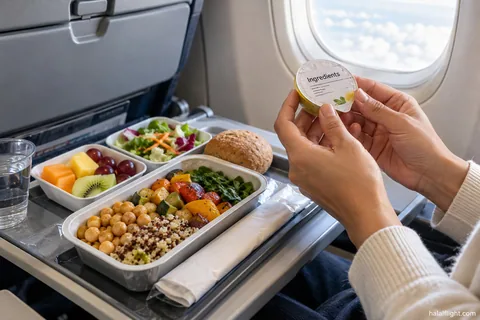
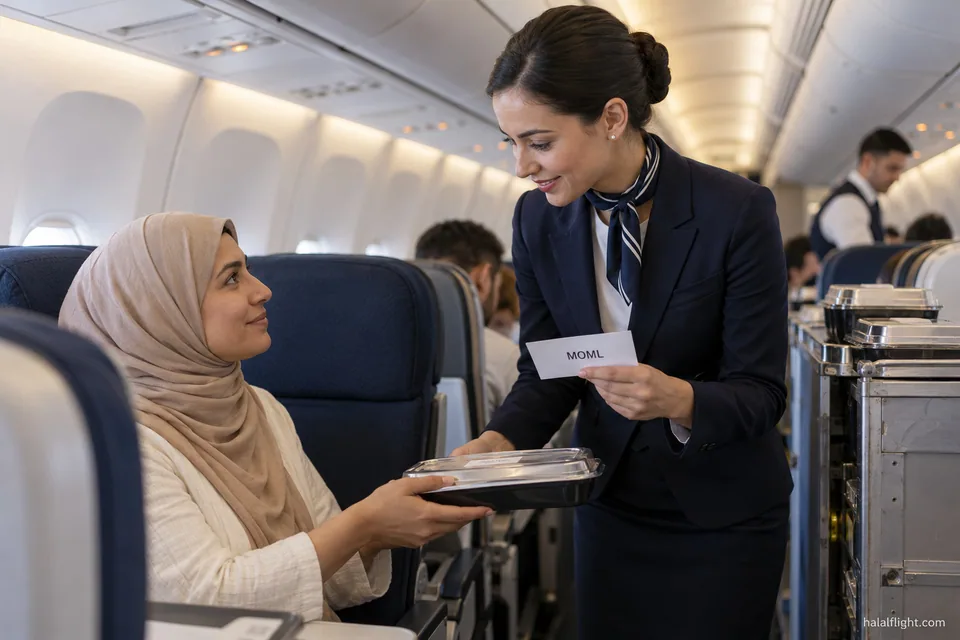
- The tray label or foil lid, which normally shows the passenger name, seat or meal code.
- The crew's confirmation, ideally from a manifest that lists your meal.
- The wrapped items, for ingredient lists where printed.
If it does not match
Say so before eating. Korean Air notes that you cannot change an in-flight meal request on board, so the crew may have little to offer except what is already loaded. Ask what items are verifiably suitable, read ingredient labels, and fall back on food you brought. Whether a substitute is acceptable to you is a personal religious matter for you and a qualified scholar.
Questions to ask the airline
If the website is vague, send a short written query. These four questions usually reveal which model you are dealing with.
- Is all food on this flight prepared to a halal standard, or only the meal ordered as a Muslim meal?
- Does the answer depend on the departure airport or the cabin?
- Is the halal certification applied to the meat only, or to the full meal?
- What is the deadline, and will you confirm in writing once the request is on my booking?
Keep the reply with your booking, and base your plans on the airline current wording rather than a version remembered from a previous trip. Policies change.
Checklist before you fly
- Find the operating airline for every flight.
- Decide, from its own page, whether the standard menu is halal or whether a request is needed.
- If a request is needed, submit it with a comfortable margin over the published deadline.
- If the standard menu is halal, still request any additional dietary meal you need.
- Screenshot the meal status on the booking.
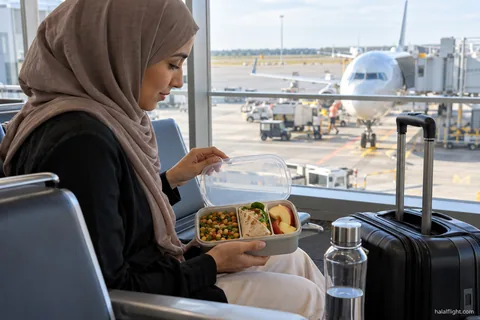
- Bring a sealed reserve snack in case of a shortfall.
If anything on the day contradicts the airline's published policy, record the flight details and write to the airline afterwards.
Frequently asked questions
Do I need to order a Muslim meal if the airline says all its food is halal?
Usually not for the halal requirement itself. Etihad, for example, says there is no need to request a halal meal in advance. You may still need a separate request for other dietary needs, and the statement may apply only to flights that airline operates.
Is choosing my main course in advance the same as requesting a Muslim meal?
No. Pre-selecting a dish records a menu preference, while a Muslim meal request records a dietary requirement and is prepared as a special meal. Singapore Airlines describes the two services separately. Make sure the special-meal control shows your request.
Does a Muslim meal request make everything else on the tray halal too?
No. The request selects one prepared meal. Ask the crew about any extras served from the general service, such as bread or desserts, and read labels. Airline definitions differ, so rely on the carrier's own wording rather than assumptions.
Is the Muslim meal the same on every departure airport?
Not always. Singapore Airlines says Muslim meals from Singapore come from a halal-certified kitchen, while meals from other airports are prepared without pork, lard, pig by-products or alcohol. Korean Air says overseas departures may be limited or substituted depending on local suppliers.
What if my meal does not match what I booked?
Tell the crew before eating, show your confirmation, and ask what they can verify. Do not expect a change to the request on board. Keep a snack with you, and complain to the operating airline afterwards if the tray was not loaded.