Why chicken on the menu is not an answer
Chicken is the dish many Muslim travellers choose first, because it avoids pork and usually looks straightforward. The difficulty is that the word on the menu describes an animal, not a method. It says nothing about how the bird was slaughtered, whether the supplier holds a halal certificate, or what the dish was cooked in.
Three separate questions sit behind one plate of chicken:
- The meat. Was the bird slaughtered according to halal requirements, and is there evidence?
- The preparation. Was it marinated, glazed or cooked with ingredients such as wine, alcohol-based flavourings or animal-derived stock?
- The booking. Did the airline treat your request as a Muslim meal, or are you eating a standard dish that happens to contain chicken?
Answering the first question in the airline's published policy is usually possible. The other two need a little more effort, and this page explains how to go about it.
Start with the airline's own wording
Airlines describe their position very differently, and the wording decides whether you need to do anything beyond ordering.
- Emirates states that all its meals are halal certified.
- Turkish Airlines says that, under normal circumstances, all meals on its flights are halal.
- Lufthansa describes a separate Muslim meal without pork, game or alcohol, and states that all meat and poultry used are certified as slaughtered according to halal guidelines. It asks for special meals up to 24 hours before departure on a confirmed booking.
- Singapore Airlines says Muslim meals on Singapore departures come from a halal-certified kitchen and certified suppliers. Elsewhere it works with local caterers to obtain halal-certified meat and poultry where that is operationally feasible, without claiming that overseas meals are certified.
These statements come from the airlines' pages and can change, so read the current text for your flight. If the airline you are flying does not publish a clear statement, treat that as an open question and ask in writing.
Departure airport and operating carrier
Because meals are loaded at the departure airport, a policy that applies in one city does not automatically apply in another. The Singapore Airlines page is a clear example: the home kitchen is described differently from overseas arrangements.
On a connecting itinerary
Look up each segment. A journey on one ticket may involve a partner airline for the second leg, and the partner's catering rules apply on board. Ask the operating carrier, not only the airline that sold the ticket, what it serves to a passenger who has requested a Muslim meal.
On the return sector
Do not assume the outbound experience repeats. Catering stations differ, so apply the same checks on the way back.
The stunning question
Whether a bird was stunned before slaughter is one of the points on which halal certifiers do not all agree. Some bodies accept certain forms of pre-slaughter stunning under conditions; others do not. The Halal Monitoring Committee (HMC) in the UK, for instance, states plainly that part of its criteria is that animals are not stunned, and it does not certify stunned meat or poultry.
Why this matters on a flight: an airline that says its chicken is "halal" is relying on some certifier's standard, and different certifiers may set different standards. The airline's wording rarely spells out which approach applies.
- If stunning is important to you, ask the airline which standard its supplier follows.
- If the answer is unclear, you can still decide on the basis of your own understanding. Differences exist between schools and scholars, and a qualified scholar is the right person to advise on your own position.
Sauces, marinades and sides
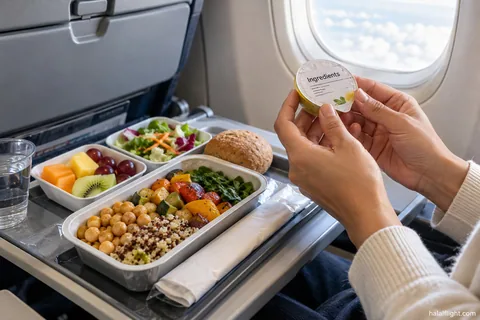
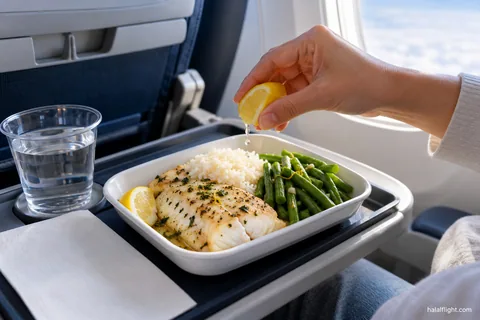
Chicken rarely travels alone. The sauce, gravy, stuffing or glaze can contain ingredients that raise separate questions, and removing a visible topping does not remove what has cooked into the dish.
Ingredients worth asking about
- Wine, beer or spirits in sauces, and alcohol-based flavourings.
- Stock or fat of uncertain origin, such as animal-derived stock where the species is not named.
- Gelatin in glazes or coatings.
- Cheese or other dairy products where the airline does not describe them.
You do not need to treat every dish with suspicion. Ask the airline whether its Muslim meal definition covers the full recipe, including sauces, or only the main protein. If a published list is not available, a short written question gets a better response than a conversation at the gate.
Muslim meal request versus a chicken preference
A Muslim meal request does not normally mean chicken. It means the meal is prepared to the airline's Muslim-meal definition, and the main protein may be chicken, lamb, fish or a vegetarian dish, depending on the airline and route. You cannot assume you will be given the specific protein you want.
If you also avoid beef, seafood or particular ingredients, say so when you book and ask which combination the operating carrier can accommodate. Some airlines offer overlapping categories; others require you to choose one. Do not assume a second category adds to the first.
Where the airline treats all meals as halal, you may simply choose between the standard dishes offered, and a separate request may be unnecessary. Check the airline's page to be sure.
Spotting the right tray and handling doubts
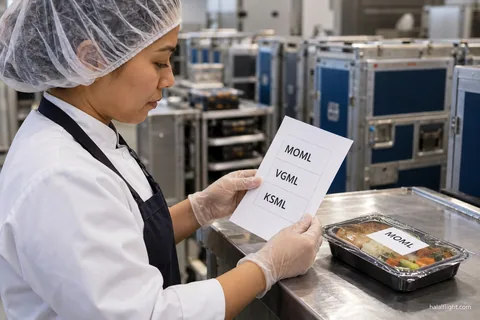
Special meals are usually loaded with a label showing the passenger's name or seat and the meal code. Before you open the main dish, match the label to your request. Appearance proves nothing about sourcing, so rely on the label and the airline's policy rather than on how the dish looks.
If you are served something that does not match:
- Tell the cabin crew politely and ask what else is on board.
- Do not guess about an unlabelled dish; ask the crew to check the catering sheet.
- Keep the label and note the flight number, date and seat so you can write to the airline afterwards.
The certification world is also visible in shops. HMC, for example, explains that its certified fresh chicken carries a colour-coded label with a serial number on the bird. That kind of label is not something you will see on an airline tray, which is why the airline's written policy matters so much.
A checklist before you fly
- Read the airline's special-meal or dietary page for its exact halal wording.
- Note whether it says all meals are halal or offers a separate Muslim meal.
- Book the meal within the airline's deadline, and confirm it on the booking-management page.
- Check each segment and the operating carrier.
- If sourcing or stunning matters to you, ask the airline in writing which standard its supplier follows.
- Ask whether sauces and marinades are covered by the meal definition.
- Carry a sealed snack for delays or a wrong meal.
- On board, match the tray label to your request before eating.
If the airline cannot answer, you can choose a vegetarian or fish option that avoids the meat question, if that suits you. That is a personal decision.
Frequently asked questions
Is chicken on an airline menu always halal?
No. The menu name identifies the meat, not how it was slaughtered or certified. Some airlines, such as Emirates, state that all meals are halal certified, while others require a separate Muslim meal request. Read the airline's own policy for your departure airport rather than relying on the dish name.
Does ordering a Muslim meal guarantee I get chicken?
No. A Muslim meal request sets the preparation rules, not the protein. The main dish may be chicken, lamb, fish or vegetarian depending on the airline and route. If you also avoid certain foods, state all requirements at booking and ask which combination the operating airline can provide.
Does stunned chicken count as halal on a flight?
Certifiers differ. The Halal Monitoring Committee, for example, does not certify stunned meat or poultry, while other bodies take different positions. Airlines seldom state which standard they follow, so ask. Your own position on stunning is a religious matter best discussed with a qualified scholar.
Can I eat the chicken if the sauce is unclear?
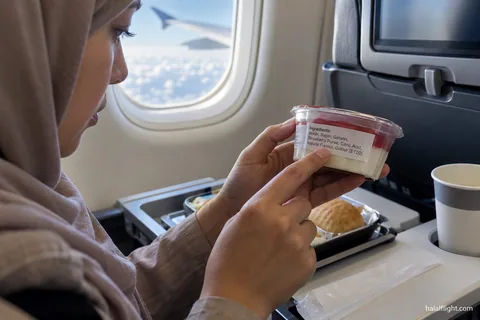
Ask the cabin crew whether they have ingredient information, and consider the airline's published definition of the meal. If the sauce may contain alcohol or animal-derived ingredients and nobody can confirm it, many travellers eat the plain components or a sealed snack instead. A scholar can advise on your own approach.
How early should I request a halal chicken meal?
Deadlines vary by airline. Lufthansa asks for special meals up to 24 hours before departure on a confirmed booking, and Turkish Airlines gives a similar window. Request as soon as you book, then check the confirmation on the airline's booking page before travelling.