Work out why the option is missing
When MOML does not appear on a booking screen, there are at least four separate explanations, and each leads to a different next step. Treat the empty menu as a question, not as a verdict on the airline's food policy.
- The airline serves halal food as standard. Some carriers have no need for a separate request because every meal already follows halal rules.
- The option uses other wording. The same meal may be listed as Muslim meal, halal meal or a religious meal rather than by its code.
- The route or cabin is excluded. Special meals can be limited to certain flights, classes or departure airports.
- The window has closed. Requests normally need to be made some hours before departure, and the tool simply hides the choice after that.
The sections below take these in turn. The aim is to reach a clear answer from the airline in writing, and failing that, a plan that does not depend on the airline at all.
When every meal is already halal
On some airlines the absence of a Muslim meal is explained by the fact that none is needed. Turkish Airlines states on its special meals page that all meals served on its flights are prepared in accordance with Islamic dietary laws, and lists kosher, Jain and Hindu non-vegetarian meals as the religious options still available to order. Malaysia Airlines likewise says that all meals served on its own operated flights are halal.
The lesson is to read the airline's own food page before assuming a gap. Do not extrapolate from the airline's name, home country or typical routes, because the policy has to be written down by the carrier itself. Look for a sentence that says all meals are halal or halal certified, and note its scope: it may apply to flights the airline operates but not to partner flights sold under its code.
Where you find such a statement, save a copy of the page or a screenshot. It is the document to show if the crew serve something that conflicts with it.
When a Muslim meal exists but is worded differently
Airlines do not use one vocabulary. Delta describes its Muslim meal as halal certified and free of pork, pork by-products and alcohol. Uzbekistan Airways lists a meal under the MOML code but describes it only as containing no pork, gelatin and alcoholic drinks, without using the word halal. ANA's page describes a Muslim meal prepared in accordance with the regulations and customs of Islam, excluding pork products, gelatin and alcohol-derived flavourings, and it too avoids the word halal.
The difference between these descriptions is real. One says the food is halal certified; the others say what is left out. Both are useful, but only the first makes a claim about certification. If the distinction matters to you, ask the airline whether the meat is halal certified and by whom.
Where to look
- The special meals page, usually under help, before you fly or onboard sections.
- The religious meals list inside the manage-booking tool.
- The airline's phone line for special services, if the page is silent.
Route, cabin and departure-airport limits
Even a carrier that sells a Muslim meal may not offer it everywhere. Lufthansa says on its special meals page that special meals are usually offered in Economy Class on flights of more than 185 minutes and in Business Class on flights of more than 60 minutes. Delta states that special meals are not available on flights originating from three named US airports, ELP, ABQ and TUS, and that offerings vary with regional catering. British Airways has published a restriction that excludes special meals from its Euro Traveller cabin, so cabin matters too; confirm the current wording on the airline's own page before relying on it.
Short flights are a common gap, since a service with no meal at all has nothing to adapt. If your flight is short and has no meal service, the missing option is not a refusal: there may be no food to request.
These limits change, so use them only as a guide to the kinds of exception that exist. Check the page for your own flight, cabin and departure airport, and ask customer service if the wording is unclear.
Operating airline, codeshares and partner bookings
A flight sold by one airline may be flown by another. The meal tools of the selling airline do not necessarily reach the operating carrier's catering. ANA states that only special meal requests for ANA-operated flights can be made through its website and that codeshare passengers should contact ANA instead. Uzbekistan Airways advises checking the operating carrier's website for codeshare flights. Delta warns that if you booked with another airline, your request will not apply to the Delta segment and you should call Delta instead.
When you ask for help, give the operating flight number and date, not just the flight number printed on your ticket. A technical booking problem and a genuine catering limit look similar on screen, but only the operating airline can tell them apart.
- Find the operating carrier on your itinerary.
- Open that carrier's special meals page.
- Request the meal through that carrier, not the selling airline.
- Keep the confirmation.
Deadlines and changes that make the choice vanish
The most ordinary reason for a missing option is timing. Delta asks for at least 24 hours before departure and Uzbekistan Airways asks for at least 48 hours. Uzbekistan Airways adds that if you change your booking you should order the special meal again, a trap that catches travellers who rebook and assume the earlier request carries over. Delta similarly says it does not store the request or add it automatically from a loyalty account, so it must be made for each new reservation.
Once the window has closed, ask the airline by phone whether a late request is possible or whether any halal-suitable item remains on board. Do not count on the gate agent to arrange it, since the meals are loaded by the caterer hours earlier.
If you travel often, a calendar reminder set for three days before each flight is cheap insurance.
Choosing a fallback when nothing fits
If the airline has no halal option and cannot confirm its regular meals, you need a fallback that you control.
Options, from safest to weakest
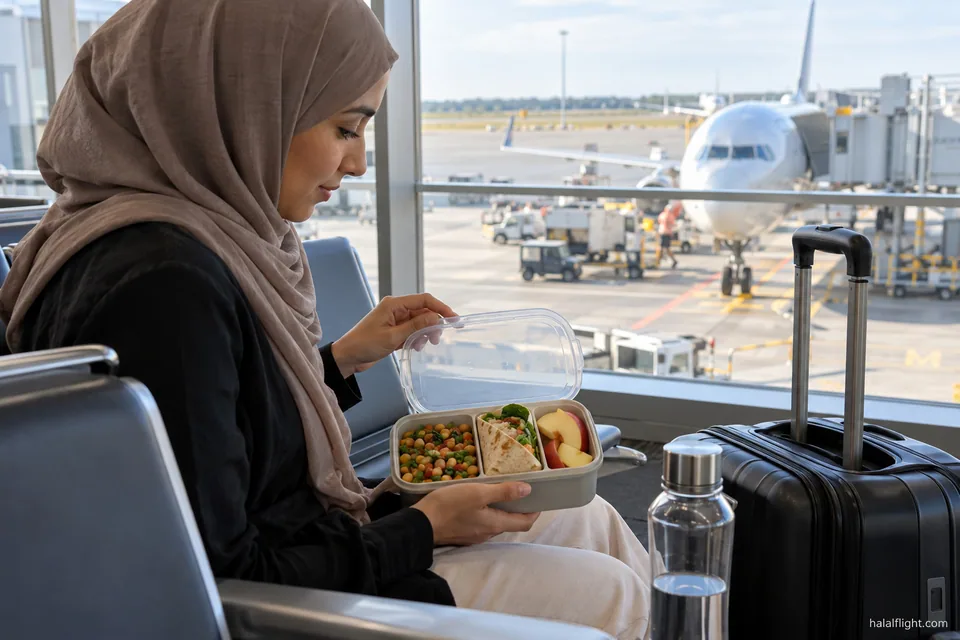
- Packed food you prepared or bought sealed, within security and customs limits for your route.
- A vegetarian meal, only after checking its ingredients and preparation, since vegetarian dishes can still contain alcohol-based flavourings or gelatine.
- A seafood meal where the airline lists one, again subject to ingredient checks.
- Packaged items from the trolley with a readable ingredient list.
Look at the rules for liquids and for fresh food at both ends of the trip, since some destinations restrict meat, dairy and produce. Aircraft cannot be relied on to chill or heat your meal. Dry, sealed foods travel best.
Whether a given alternative is acceptable to you is a matter for your own practice and, where unsure, a qualified scholar.
A checklist, and what to do if it goes wrong
Use this list when no Muslim meal is offered.
- Read the airline's food or special meals page for an all-halal statement.
- Check route, cabin and departure-airport limits.
- Identify the operating airline and contact it for codeshare flights.
- Note the request deadline and whether a change cancels the request.
- Ask in writing what is in the regular meal and who certifies the meat.
- Pack a sealed backup meal and snacks.
If it goes wrong in the air
Tell the crew early that you need halal food, ask what remains aboard, and read any label offered. If nothing is suitable, eat your own food and say politely that you will write to the airline. Afterwards send a short complaint with the booking reference, flight number and a copy of any page or email that stated the airline's policy. A written record is what usually moves a request to the catering team.
Frequently asked questions
Why can't I see a Muslim meal when I book my flight?
The airline may serve only halal meals, use different wording, limit special meals on your route or cabin, or have closed the request window. Open the airline's special meals page first, then contact it with your flight number and date if the page does not explain the gap.
Does no Muslim meal option mean the food is not halal?
Not necessarily. Turkish Airlines says all its meals follow Islamic dietary laws and Malaysia Airlines says all meals on its operated flights are halal, so no separate request exists. Other airlines simply have no option. The only reliable answer is the carrier's own written policy for your flight.
What if I booked through one airline but another operates the flight?
Request the meal through the operating airline, using the operating flight number and date. ANA says its website handles requests only for ANA-operated flights, and Delta says a request made with another airline does not apply to the Delta segment. Contact the operator by phone if its page is unclear.
Is a vegetarian meal a safe replacement for a Muslim meal?
It can be a reasonable fallback but is not automatically halal. Vegetarian dishes may contain alcohol-based flavourings, gelatine or other ingredients you avoid. Ask the airline for the ingredients and preparation details, and decide according to your own practice or the advice of a qualified scholar.
Do I have to reorder my special meal if I change my flight?
Check the airline's rule. Uzbekistan Airways says you should order the special meal again if your booking changes, and Delta says it does not carry a request across to new reservations automatically. After any change, look at the booking page and repeat the request if the meal no longer shows.