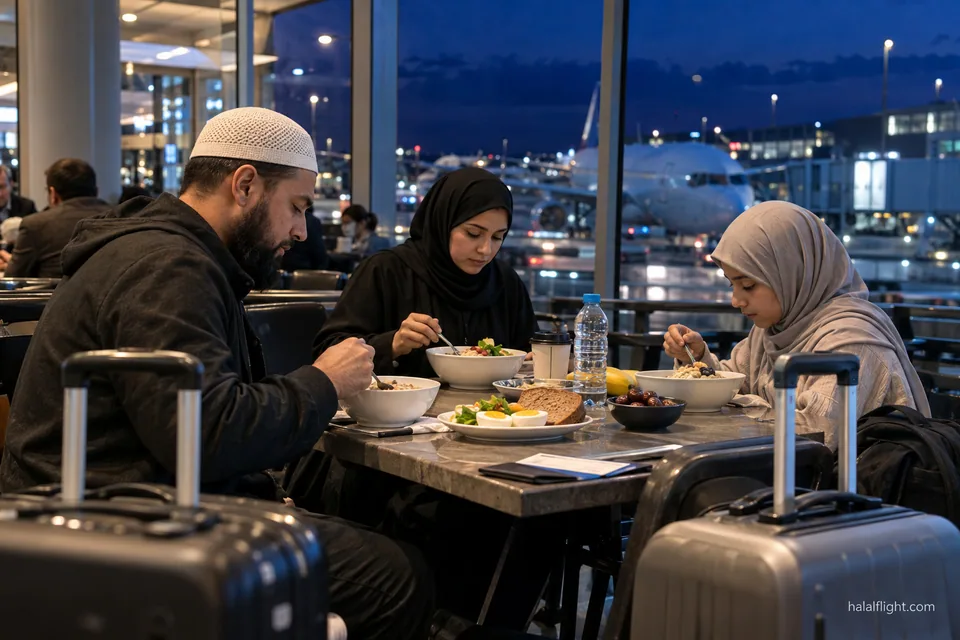
Start from dawn, not from the departure time
The pre-dawn meal belongs to the clock of the place where you are, and the flight number on your ticket has no bearing on it. A departure listed as early morning may in fact leave after dawn, yet you will have been in the terminal for hours before then. The sensible method is to find the fasting start time for your departure city, mark it as the hard limit, and then plan every other step so that the meal is finished before it.
Egypt's Dar al-Ifta, in a fatwa on the beginning of the fasting hours, states that the fast begins at dawn, when the dawn prayer becomes due. It describes a separate cut-off set a few minutes earlier, often called imsak, as unnecessary. Practice differs between communities and between timetables, so use the calendar your own mosque or scholar follows, and note whether it already includes a margin.
Write down three times before you travel: the time dawn begins, the time you need to leave for the airport, and the latest time you can start eating. The gap between the first and the third is your suhoor window, and it is often shorter than people expect.
Build the timeline backwards
A backwards timeline removes most of the stress. Begin with the dawn time and subtract the things that cannot be moved.
- Latest moment to finish eating, ideally with a few minutes in hand.
- Time to eat and drink without rushing, which for a proper meal is usually longer than people estimate.
- Time to wash, make wudu if you wish and, where it applies, pray before dawn.
- Time to reach the airport by the check-in deadline your airline gives for your fare and route.
Adding these up shows quickly whether suhoor fits at home or at a hotel, or whether it will have to happen in the terminal. If the airport journey itself runs through the pre-dawn hours, eating before you leave is usually calmer than eating at a departure gate.
When the arithmetic does not work
If you would have to wake at an hour that makes the whole trip miserable, consider a lighter meal eaten earlier and a second small portion later, rather than skipping the meal altogether. Some travellers also move to a different flight; the sibling guide on overnight sleep planning covers how to weigh sleep against timing.
Do not assume terminal food is available overnight
Cafés and restaurants in departure halls do not necessarily trade through the night. Some outlets open only when the first banks of flights begin, some are airside only, and some close during quiet periods. Staffing at night is often thin, and a counter that exists on the airport map may be shuttered.
Before you rely on any outlet, check the opening hours for the specific terminal and side of security, using the airport operator's own information or by contacting the operator. Treat any hours you find as something to confirm again close to the date, because they change with season and schedule.
The order of the airport journey matters
Most food is on the far side of security, while the dawn deadline may arrive while you are still queuing for bag drop or screening. Work out where you will be when dawn comes, and make sure the meal happens before you enter any queue you cannot easily leave. This is another reason to eat before arriving whenever the schedule allows.
Pack a portable suhoor
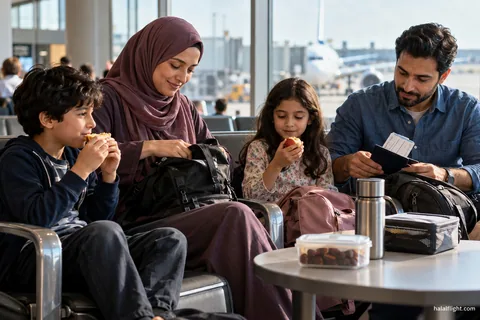
A portable meal removes the dependence on opening hours. The best choices are foods that need no heating, keep without refrigeration for a few hours and are easy to eat in a seat or on a bench.
- Dates, which are traditional and compact.
- Sandwiches, wraps or flatbreads with a filling you already know to be halal.
- Boiled eggs, nuts and dried fruit for slower-release energy.
- Oats or cereal bars, or a bread roll with a spread.
- A refillable bottle for water, kept empty until you are past security.
Keep the food where you can reach it without opening the main cabin bag, as an unpacked bag at a security belt wastes minutes you may not have. Food that is wet, creamy or sticky can be harder to eat tidily, so choose clean, solid items.
Remember the aim is a meal that sustains you through a travel day, so include something with protein and something with fibre alongside the dates, and drink water steadily before dawn.
Liquids, soups and security screening
Many suhoor staples count as liquids or gels for the purposes of security. The European Commission explains that liquids, aerosols and gels past EU screening points are limited to containers of no more than 100 ml, held together in one transparent resealable bag of about one litre. Yoghurt, soup, jam, honey, spreads and drinks can all fall under that kind of rule depending on the airport.
The same page lists exemptions, including liquids needed for special dietary requirements, medicine and baby food. Do not assume an exemption will be accepted without question: screening staff decide on the day, and rules differ in other countries and sometimes between airports. Check the rules for every airport on your route, including connections, with the operator or the security authority.
- Prefer solid foods in cabin baggage.
- Pack larger liquids in checked baggage where possible.
- Be ready to open containers and show what is inside.
- Finish or discard drinks before screening, then fill a bottle on the other side.
Suhoor during a transfer or on the aircraft
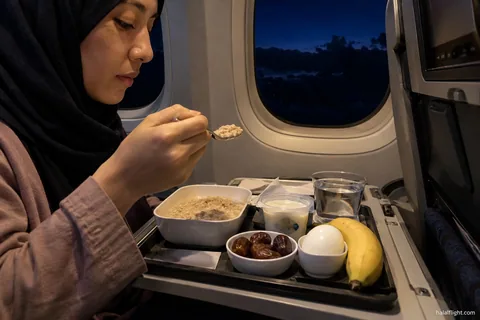
If dawn falls while you are in transit, the same logic applies: know the time at your current location, and have the food within reach. A long layover can make the meal easy, but a short connection can leave no time at all, so keep dates and a bottle of water available in a pocket or small pouch.
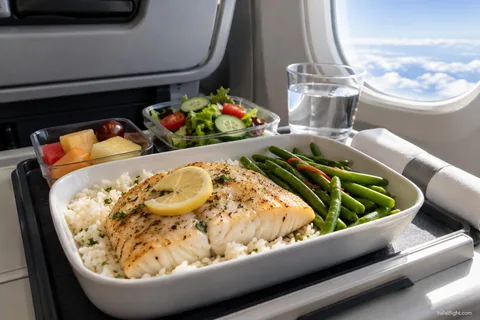
On an overnight sector, a cabin meal may be served well away from your intended meal time. You can ask the cabin crew what is on offer and when, politely and well before the lights are dimmed, but crew duties and food-handling rules limit how flexible they can be. Do not rely on a special service that has not been confirmed in writing by the airline. If you want a meal timed to suit fasting, read the airline's own information on this and contact it before the day.
The separate guide on suhoor meals onboard covers airline arrangements in more detail; this page concerns the airport and the schedule around it.
What a missed suhoor does and does not change
Missing the pre-dawn meal is not, by itself, a reason to stop fasting. Egypt's Dar al-Ifta draws a distinction between simply having missed suhoor and having a valid reason not to fast, and treats them as separate questions. Travel concessions and health circumstances are assessed on their own terms.
If disruption has left you with no chance to eat, and you are unsure how to proceed, the sensible step is to ask a qualified scholar who knows your situation. Rulings on fasting while travelling vary between schools and depend on the details, such as the distance and length of the journey, how hard the fast is for you and your health. This page does not give individual rulings.
Practical comfort if you fast without suhoor
Drink water carefully if you are able to, avoid heavy salty snacks at the start and let the cabin crew know if you start to feel unwell. Anyone with a medical condition or who takes medication should discuss fasting with a doctor before travel.
Checklist for a pre-dawn departure
- Find the dawn time for your departure city on the calendar you follow, and write it down.
- Work backwards: finish time, eating time, wudu and prayer, journey to the airport.
- Eat at home or at your hotel if the timeline allows it.
- Check opening hours for any terminal outlet you might rely on, and treat them as unconfirmed until you have seen them yourself.
- Pack dates, a solid meal and an empty bottle in an easy-to-reach pocket.
- Check liquid rules for every airport on the route, including exemptions for dietary needs.
- Do not count on a cabin meal being served at your preferred hour.
- Keep a note of the contact for a scholar or institution you trust in case you need advice during the trip.
If something goes wrong, such as a delayed flight that moves your departure past dawn, return to the first principle: dawn at your location sets the limit, and whatever you have in your bag is your backup.
Frequently asked questions
When does suhoor end if my flight leaves very early?
Suhoor ends at dawn at your location, not at the flight time. Find the dawn time for your departure city on the timetable you follow, subtract the time you need to eat, and treat the result as your deadline. Egypt's Dar al-Ifta states that fasting begins at dawn, so check which calendar your own scholar or mosque uses.
Can I eat suhoor in the airport after security?
Only if the food is open and you are through screening before dawn, which is not guaranteed. Many outlets do not trade through the night, and queues can take longer than expected. Check the opening hours with the airport operator, and carry portable food as a backup so the meal does not depend on a counter being open.
Can I take yoghurt, soup or honey through security for suhoor?
These are usually treated as liquids or gels. The European Commission describes a limit of 100 ml per container within one litre-sized transparent bag at EU airports, with exemptions for special dietary needs. Other countries differ, so check each airport on your route, and pack solid food where you can.
Is it acceptable to fast if I missed suhoor because of travel?
Egypt's Dar al-Ifta treats a missed pre-dawn meal as separate from a valid reason not to fast. Whether travel or health allows you to break the fast is a question for a qualified scholar who understands your circumstances, so ask before you travel if you can.
Should I ask the airline for a pre-dawn meal on the aircraft?
You can ask, but do not count on it. Meal timing on an overnight flight follows the airline's catering schedule, and crew duties limit flexibility. Contact the airline well before departure, ask in writing what it can provide and when, and keep your own food ready in case the answer is that it cannot.