The short answer for halal diners at Hong Kong Airport
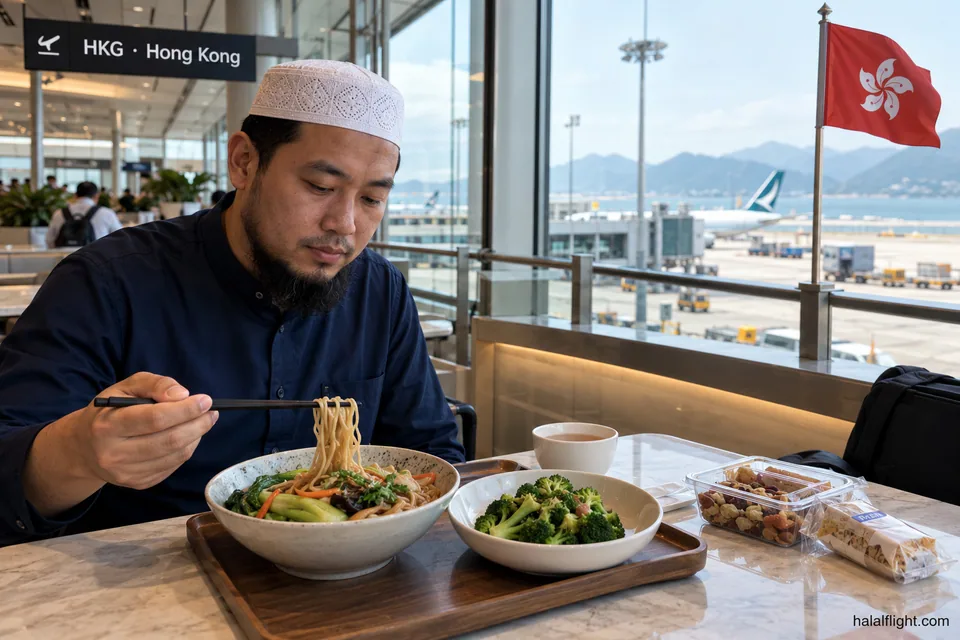
Hong Kong International Airport (HKIA) does not leave halal travellers to guess. The airport publishes a page headed "Discover Halal Options" which says that restaurants and shops across the airport offer halal entrées, quick bites, pre-packaged goods and drinks. That page is the right starting point, because it is written by the airport operator and not by a third-party review site.
The best-known named restaurant is Saffron, a Persian restaurant. Its listing on the airport website says it is fully halal certified and uses 100% halal meats, with lamb koobideh and chicken koobideh kebabs among its signature dishes. The airport's own description of Saffron places it in a non-restricted area, which is the detail that decides whether it is useful to you.
In practice, the decision comes down to three questions, answered in this order:
- Where will I be, and can I reach the outlet from there?
- Is the claim I am relying on current and specific to this outlet?
- Where can I pray before or after eating, and how long does that leave me?
The sections below take each question in turn. This page covers the food and prayer-room side of Hong Kong airport only; it does not replace the airline's own instructions about onboard meals.
Departing, arriving or transiting: which area are you in?
Airports divide passengers into groups, and a restaurant that is perfect for one group may be out of reach for another. Before you plan a meal around any named outlet, identify which of these you are.
Passengers starting or ending a journey in Hong Kong
If you have cleared immigration on arrival, or have not yet gone through departure security, you are in the public part of the building. Outlets described as non-restricted are open to you, to people meeting you and to staff. This is the easiest situation for a sit-down halal meal.
Passengers staying in international transit
Transit passengers who remain in the restricted area need to find out whether re-entering the public area is permitted on their ticket and visa position, and whether they would then have to pass security again. That can consume the time you meant to spend eating. If the answer is unclear, ask your airline or the transfer desk before leaving the restricted zone, and do not assume that a restaurant listed on the airport website is on your side of the line.
A simple rule of thumb
Work out your layover length first. A short connection rarely justifies leaving the transit area for a meal; a long one may. If you are unsure, buy something sealed and labelled in the area where you already are and keep the sit-down meal for another trip.
Reading Saffron's halal claim sensibly
Saffron's listing is a statement by the airport and the restaurant. It is useful, but a careful traveller still looks at what it covers.
What the listing says
The listing describes a Persian menu and states that the restaurant is fully halal certified and uses 100% halal meats. It names lamb and chicken koobideh, minced-meat kebabs usually served with rice. It also describes the restaurant as the first Persian restaurant in Hong Kong.
What the listing does not tell you
The text does not name the certifying body, the certificate number or its expiry date, and it does not give opening hours. A certificate shown in an old review or photograph may have lapsed even if the restaurant is still trading, so treat such images as history and not as proof of the present position.
Questions worth asking at the counter
- Which body issued the current halal certificate, and does it cover this airport branch as well as the main business?
- Are sauces, marinades and drinks included in the scope, or only the meat?
- Is anything on the menu prepared with alcohol, for example in dressings or desserts?
- Do staff use separate equipment for any non-halal items sold elsewhere in the same group?
A confident outlet answers these quickly. If the answer is vague, choose another option. Individual standards differ between communities, and a qualified scholar is the right person for a personal ruling on anything borderline.
Other halal options on the airport's page
The airport's halal page speaks of entrées, quick bites, packaged goods and drinks, but the page itself is a summary and does not name every outlet. A link on it leads to further detail, so open that before you travel and note two or three outlets in your terminal area as well as Saffron.
Distinguish between two kinds of listing, because they carry different weight:
- Fully halal operation: the whole kitchen is certified or run to a halal standard, so you choose from the entire menu.
- Selected suitable dishes: an outlet that sells some items suitable for halal diners within a mixed menu. Ask about the meat source, the shared grills and fryers, and any sauces.
Vegetarian and seafood dishes are a common fallback in the second case, but check for alcohol in sauces and for shared oil, because "no meat" does not mean "no concern" for every traveller. For packaged snacks, read the ingredient list for gelatine, alcohol-based flavourings and animal-derived emulsifiers, and look for a halal mark you recognise.
Prayer rooms at Hong Kong Airport
The airport's prayer-room page describes rooms that passengers may use at any time to pray or meditate. The rooms are non-denominational and shared by everyone, so expect simple furnishings and consider the other users.
What to expect inside
- A directional sign marking the qibla (the direction of prayer).
- A foot-cleaning basin in some rooms only, not in all of them.
- No assumption of a dedicated men's or women's space; check on arrival.
The page does not state the locations in the text available to this guide, so use the airport's own directory or terminal map to find the room closest to your gate. Because facilities vary by room, do not plan on washing at a particular spot without checking. If you need to perform wudu (ablution) before prayer, the practical option may be a restroom sink, and many travellers allow extra time for this.
If your prayer time falls during the flight, the page on praying seated on a plane covers the options; the page on prayer timing and qibla in the air covers direction.
Buying a backup meal for the flight
Even a well-planned airport stop can fail: a queue is longer than expected, a gate changes, or the restaurant is on the wrong side of security. A sealed backup removes the pressure.
- Choose items with a full ingredient list in a language you can read, or ask staff to help while you are still at the counter.
- Prefer foods that survive a few hours at cabin temperature: nuts, crackers, fruit bars, sealed sandwiches that you will eat soon.
- Keep the receipt and the wrapper until you have finished the item.
- Do not carry leftover meat, dairy or fresh produce across a border. Import rules differ by country, and the destination's customs authority is the place to check.
If you have ordered a special meal from the airline, the backup is insurance and not a replacement. A separate page covers what to do when a pre-ordered halal meal is not loaded on board.
Timing the meal around security and boarding
A meal is only a good idea if it fits. Work backwards from the boarding time printed on your pass, not the departure time.
- Note the boarding time and the gate, and recheck the gate on the airport screens before you sit down to eat.
- Allow time for security or other checks if you are leaving or re-entering a restricted area.
- Allow walking time from the restaurant to the gate, particularly if the gate is in a different part of the building.
- Keep your passport, boarding pass and phone in one place, so that you are not searching for them at the till.
If you are travelling with children or an older relative, add margin. Order first, pay promptly and ask for the meal to be packed to take away if the queue is moving slowly.
Checklist: before you arrive and if something goes wrong
Before you travel
- Open the airport's halal page and the Saffron listing; note the outlets that suit your passenger area.
- Decide whether you will be in the public area or in transit, and how long you have.
- Find the nearest prayer room on the airport directory and screenshot it.
- Pack a sealed snack for the cabin.
If it goes wrong
- Saffron is out of reach: look for a halal-suitable option on your side of security, or buy a packaged item with a visible halal mark.
- The certificate answer is unclear: choose a vegetarian or sealed alternative and do not rely on the name alone.
- No time to eat: a sealed snack and water is enough for a short flight.
- No suitable meal on board: ask the cabin crew politely and show your booking; the airline's own page explains how special meals are requested.
Frequently asked questions
Is Saffron at Hong Kong Airport halal?
The airport's Saffron listing says the restaurant is fully halal certified and uses 100% halal meats. It does not name the certifier or give an expiry date, so if the exact certificate matters to you, ask the restaurant which body issued it and whether it covers the airport branch.
Can I eat at Saffron if I am only transiting through Hong Kong?
The airport describes Saffron as being in a non-restricted area, which is the public part of the airport. A transit passenger would need to leave the restricted area, which may involve further checks. Ask your airline or the transfer desk whether re-entry is possible on your ticket before you go.
Are there prayer rooms at Hong Kong International Airport?
Yes. The airport's prayer-room page describes non-denominational rooms open to passengers at any time, with a sign showing the qibla. Only some rooms have a foot-cleaning basin, so do not assume every room offers washing facilities. Use the airport directory to find the room nearest your gate.
How do I find halal food at Hong Kong Airport besides Saffron?
Start with the airport's halal page, which says airport restaurants and shops offer halal entrées, quick bites, packaged goods and drinks. Open the further-detail link from that page, then check each outlet's location and whether it is fully halal or only sells some suitable dishes.
Can I take halal food from Hong Kong Airport on to my next flight?
Sealed, labelled snacks are usually the safest choice. Cooked meat, dairy and fresh produce can be restricted by the destination country's customs rules, so check the destination authority's website before you pack leftovers. Keep wrappers and receipts until you have finished eating.