Why fish is simpler, and why it is not automatic
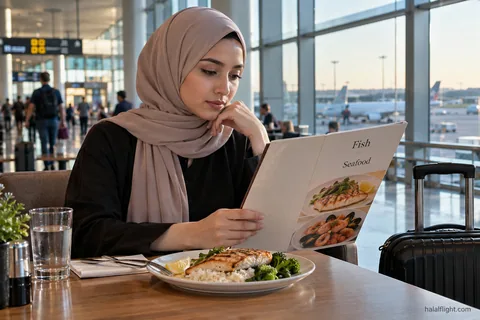
Many Muslim travellers choose fish because it avoids the usual doubts about how meat animals were slaughtered. That reasoning is sensible, but it covers only one part of the tray. A cooked fish dish is still a recipe: it may contain a sauce, a stock, a marinade, a flavoured butter or a garnish, and any of these can bring in an ingredient you would not choose.
The practical approach is to treat the fish itself as the easy part and spend your attention on everything around it. The sections below follow that order: what the booking code means, how views on shellfish differ, which components deserve a closer look, and how allergy concerns are handled separately from religious ones.
What the seafood meal code actually promises
Airlines that offer a seafood special meal usually book it under the code SFML. Royal Brunei Airlines, for example, describes its seafood meal as one containing only fish and/or seafood. That definition tells you the main protein; it does not tell you which fish or shellfish will be used, how it is cooked, or what it is served with.
A code is a category, not a recipe
Two airlines can both sell an SFML meal and serve quite different dishes. One may plate a white fish fillet with rice, another a prawn pasta. If your practice excludes some kinds of seafood, the code alone cannot protect you, so you need to ask the airline what is typically loaded on your route.
Halal status may already be built in
Some carriers state that every meal on board is halal. Royal Brunei says this on its special meals page, and it lists no separate Muslim meal for that reason. On such an airline the seafood choice does not need to be combined with a second religious request. On airlines that sell a distinct Muslim meal, the position is different, which is why the booking page of your own carrier matters more than general advice.
Fish, shellfish and where scholars differ
Scholarly opinion on aquatic animals is not uniform. Many scholars accept fish without difficulty. Views on crustaceans such as prawns and lobster, and on molluscs such as squid, mussels and oysters, vary between the traditional schools of Islamic law, and some scholars take a stricter position than others on particular groups. Anyone who follows a school or a teacher with a specific view should apply it when choosing.
This guide does not give personal rulings. If you are unsure which seafood you may eat, put the question to a qualified scholar before you travel, then use the airline's menu information to apply that answer. A written note of your own rule, such as fish with fins only, makes it easier to explain your needs to the booking agent or the cabin crew.
Mixed seafood dishes
Because the SFML category can include both fish and shellfish, a seafood salad or a mixed pasta may contain items you avoid. Ask whether the dish is fish only, and if the airline cannot say, consider a vegetarian or standard meal instead.
Sauces, stock and cooking liquids
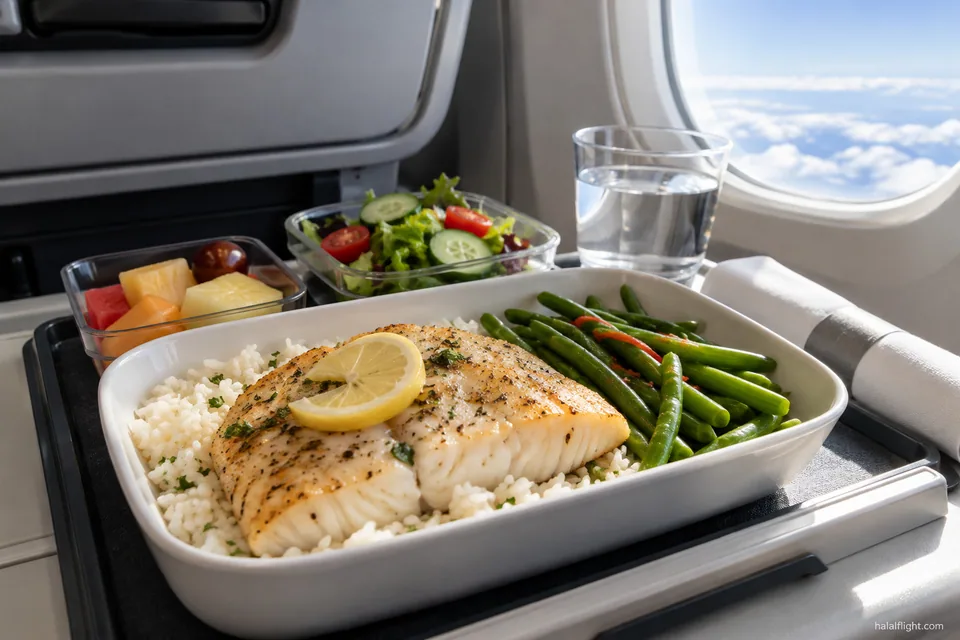
The most common hidden problem is not the fish but the sauce. Fish dishes are often finished with white wine reductions, cream sauces, flavoured butters or stocks, and these can contain alcohol or animal ingredients that the main ingredient list does not make obvious. A plainly grilled or steamed preparation is easier to assess than a dish in sauce.
Crew members serve food that was prepared and sealed in a catering kitchen. They can usually read the menu card or the label, but they cannot remove a sauce that was cooked into the dish, and they cannot confirm how it was made. If the sauce is the concern, the time to raise it is before departure, with the airline's special meals team, rather than at the seat.
- Ask whether the fish is served plain, grilled, fried or in a sauce.
- Ask whether wine, beer, spirits or alcohol-based flavourings are used in the dish.
- Ask whether fish stock or other animal-derived stock is part of the recipe if that matters to you.
The general subject of alcohol in airline cooking has its own page on this site, so this guide only flags the issue as it applies to fish.
Check the whole tray, not just the main
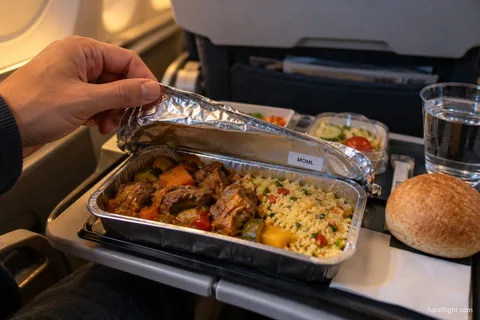
A familiar main ingredient creates a false sense of security. The bread roll, the salad dressing, the dessert and any spread on the tray each have their own ingredients, and some may contain gelatine, alcohol-based flavouring or similar items. Read the labels on sealed items and ask about anything unmarked.
This matters most when you pick a seafood option from the standard menu rather than ordering a special meal in advance. A standard menu choice has not been checked against your dietary rules by anyone, whereas a pre-ordered meal at least began as a documented request. If you are choosing on board, work through each component in turn rather than approving the tray as a whole.
Religious suitability is not allergy safety
Fish and shellfish are recognised major food allergens, and a meal that is acceptable on religious grounds can still be dangerous for someone with an allergy. Royal Brunei states plainly that it cannot guarantee allergen-free meals or an allergen-free environment, and that its meals may contain traces of allergens including fish. Other carriers publish similar statements.
If you have a seafood allergy, tell the airline through its medical or allergy process when you book, carry your prescribed medication in your hand luggage, and discuss the journey with your doctor. Do not treat a halal label as an allergy label. Equally, avoiding the seafood meal does not prove that fish is absent from the tray, since fish-based ingredients can appear in sauces and dressings.
The UK government publishes consumer advice on food allergy and intolerance, which is a useful general reference even if you are not flying from the UK.
How to request and confirm a seafood meal
Special meals are generally requested through the booking page or the airline's reservations team. Royal Brunei, for instance, accepts requests during online booking or through its offices, no later than 24 hours before departure. Other airlines set different deadlines, and deadlines can also differ by route or by booking class, so read the conditions that apply to your flight.
- Request the seafood meal when booking, not at the airport.
- Check the confirmation or manage-booking page to see that the request appears against each passenger.
- Repeat the request in writing if you change flights, since a change can drop the meal.
- On short flights, find out whether any meal service is offered at all. Royal Brunei lists several short domestic and regional routes where meals are not served.
For deadlines across airlines, use the dedicated booking-deadline guide on this site.
A checklist before you eat, and what to do if it goes wrong
Before you eat
- Confirm whether the dish is fish only or includes shellfish.
- Look at the sauce and ask about alcohol if you cannot tell.
- Read the label of the bread, dressing and dessert.
- Keep the packaging until you have decided.
If the meal is not what you ordered
Tell the cabin crew politely and early, and ask what else is available. Alternatives may be limited because most meals are loaded in fixed numbers. If nothing suitable is on board, fall back on the snacks you packed, fruit or plain bread items you can verify, and report the problem to the airline after the flight so that the request can be corrected.
If you are unsure
When doubt remains, leaving the item is a legitimate choice. Individual religious decisions belong to you and your scholar, and the airline's staff are not in a position to rule on them.
Frequently asked questions
Is a fish meal on a plane automatically halal?
Not automatically. Fish avoids the slaughter question, but sauces, stock, wine-based glazes and side items can contain ingredients you avoid. Some airlines state that all meals on board are halal, which settles part of the question, but you should still check how the dish is made and follow your own scholar's guidance on shellfish.
What does SFML mean on my booking?
SFML is the code airlines use for a seafood special meal. Royal Brunei defines it as a meal containing only fish and/or seafood. The code does not name the species or the sauce, so ask the airline what is usually served on your route if you avoid particular seafood.
Can I eat prawns or squid on a flight if I follow a strict school?
That depends on the school or scholar you follow, because views on crustaceans and molluscs differ. This site cannot give a personal ruling. Ask a qualified scholar in advance, then ask the airline whether the seafood meal is fish only or mixed.
Does a halal meal protect me from a fish allergy?
No. Halal status concerns religious suitability, not allergen control. Airlines such as Royal Brunei state that they cannot guarantee allergen-free meals and that meals may contain traces of fish. Report the allergy through the airline's medical process and keep your medication in your hand luggage.
Can the crew take the sauce off my fish?
Usually not if it was cooked into the dish in the catering kitchen. Crew serve meals prepared and sealed on the ground. Ask about the sauce before the flight through the special meals team, or choose a plainer meal if you cannot confirm what it contains.