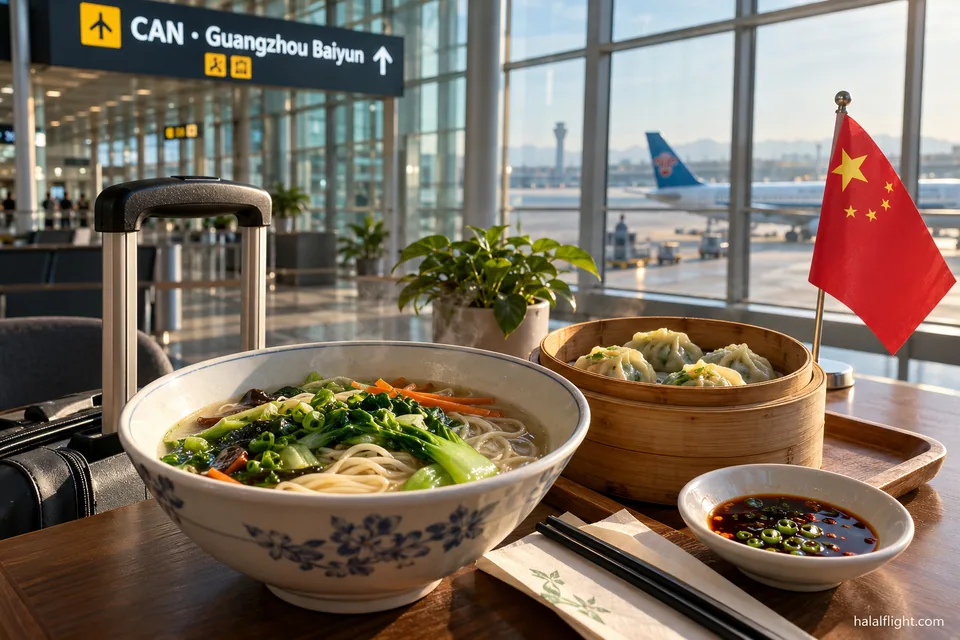
How to approach halal eating at Baiyun Airport
Guangzhou Baiyun International Airport is one of China's three major aviation hubs. Its official website offers a restaurant directory and a terminal map, and these are the most reliable places to find which outlets exist and where they are. What they do not offer, in the parts a traveller can check, is a halal guarantee for any particular restaurant. The website is a location tool, not a certificate.
In mainland China, halal food is usually identified by the Chinese word qingzhen (清真) on signs, menus or certificates, and it is common in Muslim-run noodle shops and restaurants in cities. Airport outlets are run by operators with their own suppliers, so seeing a familiar dish name, or a Muslim-style dish on the menu, does not replace asking.
The practical plan in this guide is simple: confirm your terminal, use the official list to find outlets near your route, record the Chinese details, ask clear questions, and keep a backup meal in case the answer is unclear.
Confirm your terminal before using any list
Baiyun's current dining and map tools cover more terminal choices than older articles describe, and many older guides still talk about only two terminals. Do not build a meal plan from an outdated description.
What to do first
- Check the terminal printed on your ticket or in your airline's latest message.
- Open the official terminal map and find your gate area.
- Open the official restaurant directory and filter for your terminal, then note which outlets are before and after security.
The directory is designed to show terminal, security area and outlet hours, so use those filters instead of relying on a blog post or a social media tip. If you are transferring between terminals, allow for the transfer time before you add a meal.
The official site is partly built to load content dynamically, so if a page looks empty on your phone, try refreshing, switching browser or using the airport's mobile service. If it still will not load, ask at an information desk.
Save the Chinese name, floor and nearby gate
Restaurant names often appear differently in English search results, on maps and on the signs above the door. A translated nickname can lead you to the wrong place or to nothing at all.
Take a screenshot with these details
- The outlet's Chinese name, exactly as shown in the listing.
- The floor and the nearest gate or area number.
- The terminal and whether it is before or after security.
- The hours shown on the listing.
Show the screenshot to information-desk staff or to a member of airport staff. This is much faster than trying to describe the outlet, and it works even when the staff member does not speak English. A translation app can read signs for you, but a screenshot of the original Chinese name is the safest reference.
If you want to ask about halal status, a short written phrase can help. You can ask whether the restaurant is qingzhen (清真), meaning halal, and whether there is a certificate on display. Many travellers prepare the phrase in advance and show it on their phone.
Broth, noodles and dumplings: what to ask
Noodle soups and dumplings are among the most common quick meals at an airport in southern China, and each can hide several unknowns.
Noodle soup
A bowl advertised as beef noodles may still be made with a stock or seasoning you need to assess. Ask what the broth is made from, whether pork bones or lard are used anywhere in the kitchen and whether the noodles are cooked in water shared with other dishes.
Dumplings
Ask about the filling, the cooking fat and the preparation surface. Pork is a very common dumpling filling in China, so a dumpling is not a safe default. Vegetable fillings may still be cooked in the same steamer or pan as meat.
Sauces and sides
Chilli oil, soy-based sauces and dipping sauces may include ingredients such as rice wine or meat-based seasoning. Ask before they are added.
Ask the outlet to state its current halal assurance, not to infer it from how a dish looks. If the answer is a shrug or a vague yes, treat it as unconfirmed and move to your fallback.
Accessibility and dietary assurance are separate questions
Guangzhou's official information describes efforts to improve accessible airport dining, including suitable seating arrangements. That is helpful for a traveller using a wheelchair or with limited mobility, because a table with space for a chair or a lower counter makes a meal much easier.
These features say nothing about halal status. An accessible restaurant can serve food that does not suit you, and a halal outlet may have narrow aisles. Treat the two topics as separate parts of your request.
- Ask airport assistance for help reaching an accessible outlet if you need it.
- Raise your dietary questions with the restaurant staff once you are seated or at the counter.
- If you travel with someone who needs assistance, tell the airline in advance so help is ready at the gate.
Combining the two requests in one sentence can lead to a confused answer, so keep them apart and take them one at a time.
Prayer and timing in a large airport
This guide does not list specific prayer rooms at Baiyun, because the pages checked did not state them. Ask at an information desk, check the terminal map and look at the airport's service information to find out whether a prayer room is available in your terminal and on which side of security it sits.
If the answer is no, many travellers pray in a quiet corner and follow their own scholar's guidance on what is permitted. Questions about the correct approach belong to a qualified scholar, not to an airport guide.
Time planning
Large Chinese airports can involve long walks, security checks and sometimes a train or shuttle between buildings. Add the prayer, the walk and the meal together and compare the total with your connection time. If prayer falls during the flight, see the separate guide on calculating prayer times across time zones.
Keep a fallback near your gate
If staff cannot verify a suitable hot meal, look for labelled packaged food and keep the ingredient panel. Ask airport assistance where to find a nearby shop, and allow time for the terminal route and any screening before you return to your boarding area.
What suits a fallback
- Fresh fruit, plain nuts and unflavoured bread.
- Packaged biscuits or snacks with a clear ingredient list.
- Water and unsweetened tea or soft drinks in sealed bottles.
Reading Chinese labels
If you cannot read the label, a translation app can help. Look for animal ingredients, gelatine and alcohol, and check whether the pack carries a qingzhen mark. A mark on the pack is a statement by the producer and is not the same as a verification by you, so apply your own standard.
Carrying a few items from home, within the rules for your route, is often the most dependable fallback of all.
Checklist, and what to do if the answer is unclear
Before you go to the outlet
- Confirm your terminal and security area.
- Screenshot the Chinese name, floor and nearby gate.
- Prepare a short phrase asking about qingzhen status and a certificate.
At the counter
- Ask about broth, filling, cooking fat and shared equipment.
- State allergies first.
- Ask for the current halal assurance, not an assumption.
If the answer is unclear
Choose your fallback instead of guessing. If you have already ordered and have doubts, say so and ask for the dish to be changed or cancelled before it is served. Airport information desks can point you towards another outlet, and the airline's special meal request remains the route for the meal on the aircraft.
Frequently asked questions
Does Guangzhou Baiyun Airport have halal food?
Possibly, but the official dining list and terminal map are location tools and do not certify any outlet as halal. Confirm your terminal, find outlets near your gate, then ask the restaurant about its halal assurance, broth, fillings and cooking fat. If the answer is unclear, use a labelled packaged item.
What does qingzhen mean on a Chinese menu?
Qingzhen (清真) is the Chinese term used for halal on signs, menus and certificates. It is common in Muslim-run restaurants in China. Seeing it is helpful, but it is the operator's own statement, so ask what it covers, such as the meat source and the kitchen, and apply the standard you follow.
Why should I save the Chinese name of an airport restaurant?
English spellings and nicknames differ between websites, maps and shop signs. A screenshot of the Chinese name, floor and nearby gate from the official listing lets staff identify the exact outlet quickly, even if they do not speak English, and reduces the risk of going to the wrong place.
Are dumplings and noodle soup safe options at Baiyun?
Not automatically. Dumpling fillings are often pork, and noodle broth may use stock or lard you want to avoid. Ask about the filling, stock, cooking fat and shared preparation surfaces, and ask for the outlet's current halal assurance. If it cannot be confirmed, choose another meal.
Does accessible dining at Baiyun mean the food is halal?
No. Official information describes efforts to improve accessible dining, such as suitable seating arrangements, but that is about access, not ingredients. Discuss your mobility needs and your halal questions as two separate requests so that neither is lost in the conversation.