A certificate always has a scope
Halal certification is not a general stamp of approval on a company. A certifier examines something specific and writes down what it covers. That subject might be a single product, a production plant, a storage facility, a food preparation area or an eating establishment. The Singapore authority MUIS, for example, lists separate schemes for eating establishments, food preparation areas, storage facilities, poultry abattoirs and whole-plant or product certification.
For airline food, that means a logo on a brochure tells you little until you know what sits behind it. One certificate may cover the main caterer's kitchen at a home base but not a second kitchen at an outstation. Another may cover the meat supplier but not the assembly line. The practical lesson is to read the scope, not the badge.
This page explains the certification process and how to read it. Which airlines serve halal food, how to order a Muslim meal and the meal codes are covered on other pages.
What the auditors look at first: ingredients
Certifiers begin with inputs. The Halal Foundation's guidance on airline caterers says every ingredient, including meat, poultry, additives and enzymes, must come from suppliers that are halal certified or otherwise judged suitable, and that pork, alcohol and non-halal derivatives are prohibited, including hidden traces in flavourings or processed foods. MUIS's business page for its own scheme says that all raw materials must be halal and backed by supporting documents.
Why the paper trail matters
A tray is a final assembly of many parts: meat, sauce, bread, dessert, a gelatine-set item, a flavouring. Assurance depends on records linking each part to an accepted supplier. If one item cannot be traced, an auditor cannot confirm it. Ingredients that look harmless, such as gelatine, emulsifiers or cooking wine, are the usual areas of attention, and they have their own page on this site.
Kitchen controls: keeping halal and non-halal apart
Removing pork from a recipe is not the same as running a halal operation. The Halal Foundation page for airline catering describes requirements that include separate storage, preparation areas and utensils for halal food, cleaning and sanitising equipment to halal standards before use, and facility design that prevents cross-contamination between halal and non-halal food.
- Critical control points: steps identified as critical to compliance, such as receiving, storage, preparation, cooking and packaging.
- Staff training: people who prepare or handle halal meals are trained in halal principles.
- Records: ingredients, suppliers and processing steps are documented so any failure can be traced and corrected.
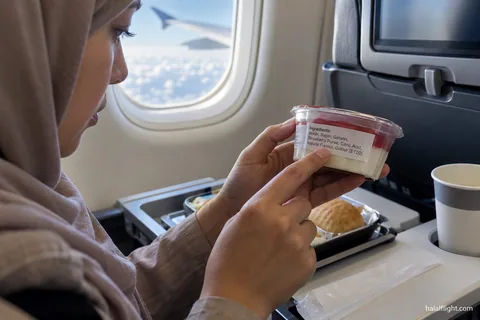
- Labelling: finished packs carry details such as plant name, product name, ingredients, production and expiry dates.
The exact requirements depend on the certifier and the scheme. Not every certifier uses the same standard, and the details above come from one certifier's published description.
How the process runs from application to renewal
Published descriptions differ, but the path is broadly similar.
- Application: the caterer applies and supplies documents about its menu, suppliers and procedures.
- Initial audit: the Halal Foundation page describes document verification, a walk-through of the facility and staff training.
- Corrective action: if the audit finds non-compliance, the caterer receives a report, fixes the problems and must pass a follow-up audit before a certificate is granted.
- Certificate: the certifier issues the certificate and states its scope.
- Ongoing checks: regular audits and inspections cover the full process from ingredient sourcing to final packaging. The Halal Approval Global, a certifier based in Abu Dhabi, describes supervisors observing production and a multi-year partnership with repeated audits and renewals.
The Halal Foundation page gives a range of roughly four to twelve weeks for the whole certification. That is one certifier's estimate for one kind of business, not a universal figure.
Why airlines rarely have one global certificate
An airline buys meals from caterers at each departure airport, and each caterer works under local law, local suppliers and often a local certifier. A single flight network can therefore depend on dozens of certificates, none held by the airline itself.
Singapore Airlines shows how this works. Its special-meals page says a Muslim meal departing Singapore is prepared in a halal-certified kitchen using ingredients from halal-certified suppliers. For departures elsewhere it says the meal is prepared without pork, lard, pig by-products or alcohol, but that halal meat and poultry are not guaranteed; the airline works with overseas caterers to source halal-certified meat and poultry where operationally feasible. By contrast, Delta's agent guidance says all its Muslim meals are halal certified, and Emirates states that all its meals are halal certified without naming a certifier on the page checked.
Policies like these change, so read the airline's current wording for your own departure airport.
Foreign certifiers and national recognition
Halal certificates do not automatically travel across borders. Some countries accept only certifiers they have approved. MUIS explains that it does not certify food products made overseas, so imported products depend on foreign halal certification bodies that MUIS recognises. Recognition depends on whether a body can apply halal standards aligned with the Singapore standard, and an approved body receives a recognition certificate valid for a set period, with annual reporting.
This shows how layered the system is. The mutual recognition between jurisdictions does not mean one authority certifies every foreign factory, nor that a certificate accepted in one market is accepted in all. Halal Approval Global says its aim is a unified system that consolidates requirements of several countries, and it states that its logos carry a traceable reference number checkable on a government site, unlike self-declared logos. For a traveller, the lesson is to check that the certifier is one you or your community recognise.
Questions a passenger can fairly ask
An airline may not send a supplier file, but it can usually answer a short, specific query. Useful questions are:
- Who certifies the meal on my flight, and for which departure kitchen?
- Does the certificate cover the meat, the whole meal or only the kitchen?
- Is the meal on my connecting flight from the same caterer?
- Is halal meat guaranteed at my departure airport, or sourced where feasible?
Compare the answer with your own requirements. Different schools and communities place emphasis on different points, such as the method of slaughter or the status of certain additives, and a qualified scholar is the right person for a personal ruling. Where an airline explains only that a meal has no pork or alcohol, treat that as the stated limit of the assurance rather than as proof of more.
Checklist: judging an airline's halal claim
- Find the airline's current meal page for your actual departure airport.
- Note whether the wording says halal certified, prepared to halal guidelines, or only free of pork and alcohol.
- Look for a named certifier and the covered kitchen or supplier.
- Check whether the claim applies to every sector of your itinerary, including the return and connections.
- Book the Muslim meal, or confirm all meals are halal, before the deadline.
- Keep the airline's written reply with your booking.
- If the assurance is weaker than you need, pack your own sealed food and ask the crew about alternatives onboard.
A weaker assurance on one sector is not a reason to avoid the airline altogether, but it is a reason to plan ahead.
Frequently asked questions
Does halal certified mean the whole airline is halal?
No. A certificate covers a stated scope, such as a product, a kitchen or an activity. An airline may depend on several caterers at different airports, each with its own certificate or none. Read the airline's own wording for your departure airport and ask what exactly is certified.
Who certifies halal meals on flights?
It varies. Certification is usually held by the caterer or supplier, and the certifier may be a national authority or a private body. Some airlines name theirs and many do not. Ask the airline which certifier covers the kitchen at your departure airport, and check that you accept that body.
What do halal auditors check in a catering kitchen?
Published descriptions mention ingredient sources, supplier certificates, separation of halal and non-halal food, dedicated utensils, cleaning, trained staff, records and labelling. An initial audit is followed by regular inspections. The exact checklist depends on the certifier, so the same kitchen may be assessed differently by different bodies.
Is a Muslim meal always certified halal?
Not always. Delta's agent guidance says its Muslim meals are halal certified, while Singapore Airlines says its Muslim meal departing outside Singapore is made without pork, lard, pig by-products or alcohol and that halal meat and poultry are not guaranteed. Always read the policy for your own departure point.
Can I check whether a foreign halal certifier is recognised?
Yes, in some countries. MUIS in Singapore, for example, publishes a framework for recognising foreign halal certification bodies. Other authorities have their own lists. Ask the relevant national halal authority, or your own community's scholars, which certifiers they accept, since recognition differs between countries and between schools of thought.