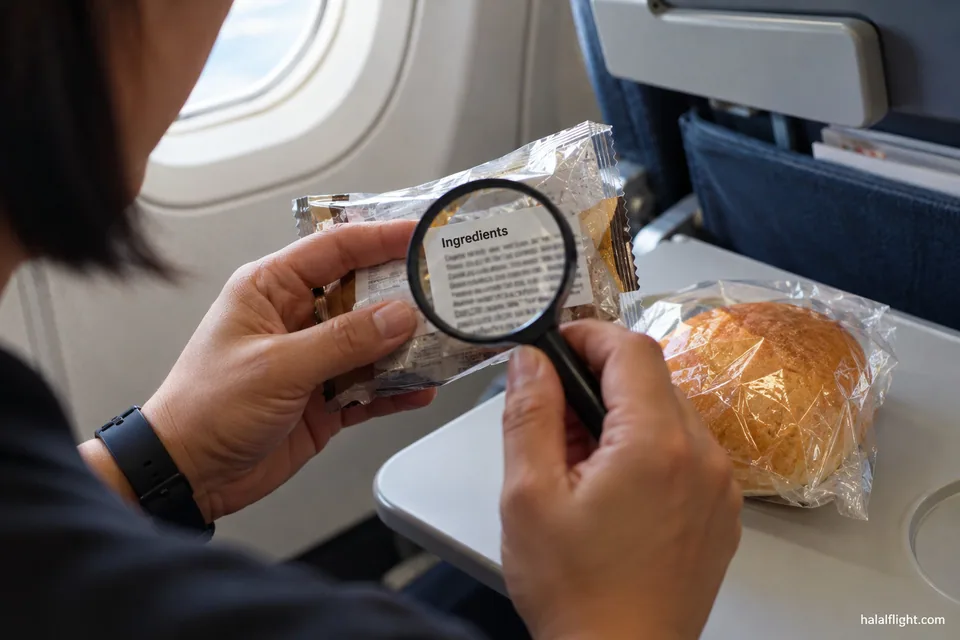
Where pork hides on an airline tray
The obvious cases are easy: a ham sandwich, bacon on a breakfast roll, pork sausage in a hot dish. The harder cases are the ones that look innocent. A flaky pastry, a pie crust, refried beans, a gravy base or a biscuit can all be made with lard or with an animal fat of unstated origin.
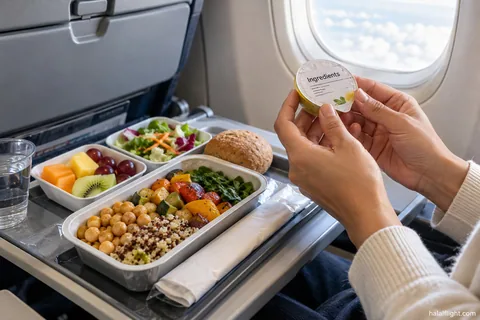
On a tray where halal status is not confirmed, check these in turn:
- The protein, including any garnish such as crumbled bacon or ham shavings.
- Fillings and toppings in sandwiches, wraps and salads.
- Pastry, bread, buns and crackers, where fat is part of the dough.
- Sauces, dressings, stock-based soups and gravies.
- Processed snacks, desserts and sweets, where animal-derived additives may appear.
If you have ordered a Muslim meal, this check is lighter, but it does not disappear: the extras handed out from the general service may follow a different specification.
What Muslim meal wording promises
Airlines define their Muslim meals in their own words, and the differences matter. Four examples from airline pages:
- Korean Air says its Muslim meal does not contain alcohol, pork, ham, bacon, gelatin or any foods containing pork by-products.
- Delta says its Muslim meals are halal certified and contain no pork, by-products of pork or alcohol.
- Lufthansa says its Muslim meal contains no pork, game or alcohol, and that meat and poultry are certified as slaughtered according to halal guidelines.
- Singapore Airlines says that on departures outside Singapore, Muslim meals are prepared without pork, lard, pig by-products or alcohol.
Reading between the lines
A list of exclusions tells you what is kept out. It does not necessarily say how the meat was slaughtered or who certified it. Singapore Airlines separates the cases: meals departing Singapore come from a halal-certified kitchen, while overseas departures rely on the pork, lard and alcohol exclusions, with halal-certified meat and poultry sourced where operationally feasible. Air France also discusses pork-derived ingredients in its special-meal definitions. Read the whole policy for your departure airport, not just the headline sentence.
Lard and other fats
Lard is rendered pig fat. It can appear in pastry, fried products, biscuits and some spreads. Because it is a cooking fat rather than a visible cut of meat, it only shows up on the ingredient list, if there is one.
Other fats are less clear. The Council of Islamic Organizations of Greater Chicago, in its list of ingredients, describes lard as totally haram and treats animal-origin shortenings as haram, while shortening labelled pure or 100 per cent vegetable is listed as plant-based. It also states that fats and lipids from animal sources are considered suspect when the source is unknown. Schools of thought and certifiers can treat borderline cases differently, so the list is a starting point rather than a ruling.
Practical wording on labels
- Lard, pork fat, bacon fat: pork-derived, with no ambiguity.
- Animal fat, tallow, shortening, dripping: species and slaughter method are not stated.
- Vegetable oil, sunflower oil, rapeseed oil: plant-based, though a mixed product can still contain other ingredients.
Additives with an unclear source
A few ingredient names can come from either plants or animals. The same list mentions mono- and diglycerides, glycerol, gelatin and some enzymes as items whose source needs checking; for example, it says animal-derived mono- and diglycerides should be suspected until the source is known, and that gelatin is usually animal-derived and most often from pigs. Cheese made with unlabelled rennet is another common question.
An unfamiliar name is not automatically pork. Many such ingredients are plant-based or synthetic. The honest position is that the label alone often cannot settle the matter, so ask the supplier or choose a different item. Gelatin in desserts and snacks has its own page on this site, and certification questions have another.
Do not rely on a photograph of the food or on the country the airline is based in. The same source warns against assuming that an imported product is halal just because it comes from a Muslim country.
Removing a topping does not fix the dish
Taking the bacon off a sandwich or the ham out of a salad leaves several problems unresolved. Juices, fat and crumbs may have touched other ingredients, a dressing or spread may contain pork-derived components, and the item may have been prepared on shared surfaces.
If you are unsure, ask the crew for a different item that is independently suitable instead of picking things out. Individual views on how strictly cross-contact applies differ, and the right answer for you belongs to your own scholar, but the safest starting point is to avoid relying on removal of the visible part.
Questions that get useful answers
General questions such as is this halal get general answers. Specific questions get specific ones.
To the airline before you fly
- Does the Muslim meal exclude lard and pig by-products, and does that apply on my departure airport?
- Is the meat certified, and by whom, or is the statement only that pork is excluded?
- Do bread, desserts and snacks served with the meal follow the same specification?
To the crew on board
- Can you check the ingredient label or catering sheet for this item?
- Is this the Muslim meal or a standard tray?
Keep questions short and polite; crew often have only the printed label to work from.
Keeping a record when you need to follow up
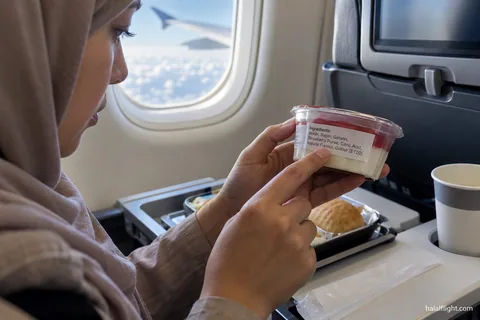
If a product raises doubts, record enough detail for the supplier to answer precisely: the brand name, the full ingredient list, any batch or best-before code, the flight number and date, and the seat. A question about a named product can be answered; a question about airline bread in general cannot, because many recipes and manufacturers exist behind that phrase.
Photograph the label before you leave your seat, and send the airline the image with a clear question afterwards. Most airlines have a feedback form or customer-relations address on their website for this purpose.
Checklist and what to do if you find pork
Before the flight
- Request the Muslim meal by the published deadline, and read the airline's definition.
- Note any exclusions and whether the policy depends on the departure airport.
- Pack a sealed snack in case nothing can be verified.
On board
- Check the tray label and the visible components.
- Read ingredient lists on packaged items.
- Ask about anything with animal fat, gelatin or an unclear additive.
If you find pork or lard in your meal
- Stop eating and tell the crew calmly.
- Ask for a verified alternative or use your reserve.
- Note the details and write to the airline afterwards.
- If you have already eaten something you did not know about, ask a qualified scholar about your situation; this page cannot give that ruling.
Frequently asked questions
Does a Muslim meal always exclude lard?
Not every airline words it the same way. Singapore Airlines and Korean Air name lard or pork by-products among their exclusions, and Delta excludes pork by-products. Read your airline's own definition and ask if lard is not mentioned.
Is animal fat or shortening on a label always pork?
No. The term does not identify the species. It could come from beef, poultry or pork, and the slaughter method is not given either. Ask the supplier or the airline for the source or a certificate, or choose a different item.
Can I just remove the bacon or ham and eat the rest?
Removing the visible piece does not resolve contact with juices, sauces or shared preparation. Many travellers ask for a separate suitable item instead. How strictly you apply the rule is a question for a qualified scholar.
Are airline bread rolls and pastries safe if I ordered a Muslim meal?
Not automatically. The Muslim meal is a specific catering item, and extras from the general service may be made to a different specification. Ask the crew whether the bread belongs to your meal and check the label if one is printed.
What should I do if I think I ate pork by mistake?
Tell the crew, note the item and flight details, and report it to the airline later. Whether any further step is needed is a religious question for a qualified scholar, not something an airline or a travel guide can decide.