Why one halal label cannot settle the stunning question
Many travellers assume that the word halal on a meal answers every question about how the meat was produced. In practice it does not. Halal is certified by a number of different bodies, each publishing its own standard, and those standards treat stunning (rendering an animal unconscious before the cut) in different ways. Some prohibit it, some permit it only for certain species or methods, and some accept it under conditions.
For a passenger whose practice distinguishes stunned from unstunned meat, a broad statement such as halal chicken is therefore incomplete. The useful question is: which certifier and which standard apply to this meat? The sections below explain what two published standards say, so that the question is easier to ask.
What one UK certifier requires: HMC
The Halal Monitoring Committee (HMC) states publicly that it does not accept or certify stunned meat or poultry. Its published criteria describe hand slaughter with a swift and humane incision, a Tasmiyah recited by a Muslim slaughterman over each animal, and a check that the required vessels are cut. HMC also states that it works only in EU-approved licensed abattoirs under veterinary supervision, adding its own halal compliance checks on top.
This is a clear position, and it shows what an explicit standard looks like. It does not mean every halal body uses the same criteria, and it does not mean an airline caterer buys from an HMC-certified supplier. HMC's statements describe HMC-certified meat only.
A contrasting standard: HMA
The Halal Monitoring Authority (HMA), which publishes guidelines of its own, draws the lines differently. Its guidelines prohibit pre-slaughter stunning of red meat, including captive bolt stunning, while allowing post-cut stunning with the approval of the halal authority. For poultry, it permits water-bath stunning only where the voltage leaves birds motionless without injury or death, and it allows controlled-atmosphere stunning with carbon dioxide only with approval and under stated conditions, including that birds remain alive until slaughter.
Two reputable certifiers, then, can reach different rules for poultry. Neither summary here is a ruling on which approach is correct. That question is one for a qualified scholar, and individual practice varies.
What the comparison teaches
- Terminology such as stunned, pre-stunned and post-cut stunned is used precisely by certifiers and loosely on social media.
- Poultry and red meat are often treated differently inside the same standard.
- A certificate shows compliance with the certifier's own rules, not with a universal one.
Reading the certifier's own conditions
When a supplier or airline names a certifier, go to that certifier's published standard rather than a summary written by someone else. Official slaughter requirements are usually short documents, and the relevant clauses cover stunning, the qualifications of the slaughterman, the method of cutting and the supervision regime.
Compare the clauses with the standard you personally follow. The practical question is whether the actual meat supplier satisfies the particular standard you accept, rather than which slogan appears on the packaging or in an online post.
- Look for the word stunning, or captive bolt, water bath and gas, in the document.
- Check whether the standard separates poultry from red meat.
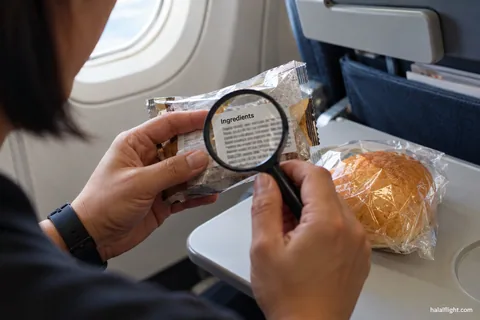
- Check whether it covers further processing (sausages, minced meat, sauces).
Species, kitchen and slaughter are separate links
An airline menu may tell you the animal (lamb, beef, chicken) and the place the meal was assembled (the departure kitchen). Neither of those facts documents slaughter. Lamb identifies a species; a catering unit identifies a preparation site. The method of slaughter is a third link, and it sits with the abattoir and the certifier.
Reliable assurance connects all three: the supplier of the meat, the certificate covering it, and the kitchen that prepared the meal. If an airline gives you only one of them, treat the chain as incomplete and ask for the rest instead of filling the gap with an assumption. Another page on this site covers who certifies airline catering in general; this one stays with the stunning question.
Why processed items need the same scrutiny
Minced meat, meatballs, sausages and pre-cooked slices pass through additional processing after slaughter. The certificate for the carcass does not automatically extend to a product made in a different factory, so ask whether the finished component, not just the raw meat, carries the certification. This matters most for cold plates, sandwiches and ready-made hot dishes bought in from a third-party producer.
What cabin crew can and cannot tell you
Crew members serve meals that were loaded before departure, and they cannot trace a product back to an abattoir during service. They can read the label or catering tag on the meal, tell you the special-meal code and check whether your meal was loaded. They cannot normally answer a question about how a chicken was stunned.
That is why the question needs to go to the airline in writing, ahead of the flight, and ideally before the catering cut-off for your departure. Cut-off times differ by airline and station, so ask the airline for the one that applies to you.
How to ask the airline about slaughter standards
A short, specific message works best. Name the flight, the meal code and the departure airport, and ask these questions:
- Is the meat in the Muslim or halal meal certified, and by which body?
- Does the certifier's standard permit stunning, and does that apply to poultry and red meat?
- Does the certificate cover the kitchen that will cater my flight?
- Is the same standard used on all sectors of my journey?
Keep the reply. If the airline cannot answer, that is information too, and you can decide whether the evidence is enough for you.
Checklist and what to do if the evidence is not enough
- Decide in advance whether stunning matters to your practice, and ask a qualified scholar if you are unsure.
- Request the meal at booking and ask for the certifier's name.
- Read the certifier's own published standard.
- Confirm the operating carrier, departure airport and date.
- Keep written replies with you.
If the available evidence does not meet your requirements for a particular meal, choose another option for that sector, such as a seafood or vegetarian meal after checking its ingredients, a sealed meal you have brought yourself where the rules allow, or food bought from a halal-certified outlet at the airport. Plan this before the flight, not at the trolley.
Frequently asked questions
Is stunned meat halal on airline flights?
It depends on the certifier. HMC states that it does not certify stunned meat or poultry, while the Halal Monitoring Authority permits limited poultry stunning under stated conditions. Ask the airline which certifier applies, then follow a qualified scholar on what is acceptable for you.
How can I find out if airline chicken was stunned before slaughter?
Cabin crew usually cannot tell you. Write to the airline before the catering cut-off, give your flight and meal code, and ask which certifier and standard cover the poultry. If no clear answer comes back, choose a different meal for that flight.
Do all halal certifiers have the same slaughter rules?
No. Published standards differ on stunning, on poultry versus red meat, and on supervision. A halal label shows compliance with that certifier's rules only, so read the standard of the body named by the supplier.
Does a lamb or beef halal meal guarantee hand slaughter?
No. The species tells you the animal, and the kitchen tells you where the meal was prepared, but neither documents the slaughter method. Only a certificate and a certifier's standard can, so ask for both.
What if the airline will not name its halal certifier?
Treat the assurance as incomplete. Ask again in writing, check whether the airline publishes a certification statement for your departure airport, and decide whether a meal you can verify is a better choice for that flight.