The short answer: certainty versus convenience
For a traveller who eats only halal food, the two ways of getting a paid meal on a flight are not equal. Ordering in advance gives you time to read the menu, ask what is in a dish and keep a record of what you bought. Buying from the trolley is easy when it works, but it rests on what the crew happened to load, what is left by the time they reach your row, and whether anyone in the aisle can answer an ingredient question.
This page is about paid food on airlines that sell it, usually low-cost and short-haul carriers, and about paid pre-order menus. It is not about the free religious special meal that full-service airlines offer, which has its own request process and is covered in other guides on this site. The two can run side by side on one journey, and they follow different rules for confirmation and change.
The comparison below looks at stock, information, payment, proof of purchase and fallback plans. In each case the airline's own page for your flight has the final say on prices, menus and deadlines.
Stock: what is left when the trolley reaches you
A trolley is loaded for an average flight, not for you. Popular items sell out, and a halal-suitable dish may be among them. Air Arabia explains on its meal pages that pre-ordering gives a wider choice than the onboard sales menu, and the same logic applies to most carriers that run both systems.
FlyArystan, a low-cost carrier, makes the point more directly in its own article about pre-ordered meals. It says that pre-orders are reserved, since some onboard items may sell out, and that meals can be pre-ordered no later than 24 hours before the flight on its website or in the mobile app. The airline presents the saving as up to 30 per cent compared with buying during the flight.
What this means for a halal diet
If only one or two dishes on a menu are suitable for you, the chance that those exact items are still available at your row is lower than it looks. A reserved meal removes that uncertainty. Crew generally cannot prepare a missing product from scratch in the galley, so an empty shelf is the end of the matter.
Information: time to ask before you pay
A pre-order menu is a document. You can read it at home, compare it with the airline's food policy and send a question to customer service before committing money. At the trolley you have a few seconds and a flight attendant who is serving a full aisle.
Some airlines state a halal position that covers every meal they serve. Malaysia Airlines, for example, says on its dining page that all meals served on Malaysia Airlines-operated flights are halal, and it lists pre-ordered Economy meals among them. That kind of statement is worth looking for: if it exists, pre-ordering becomes a convenience choice. If it does not exist, the pre-order menu is where you can find out which dishes contain pork, alcohol or other items you avoid.
Not every airline says anything about halal. The FlyArystan article on pre-ordered meals, for instance, does not mention halal at all, listing children's, diabetic, vegetarian and gluten-free menus. Where a page is silent, silence is not assurance. Write to the airline and ask.
Payment: practical points that cause real problems
A suitable meal is no use if you cannot pay for it. Pre-orders are normally paid in advance through the booking, so the money question is settled before you board. Onboard payment is a separate matter and varies by carrier.
FlyArystan says onboard purchases can be paid by bank card, cash or contactless methods such as Apple Pay, Samsung Pay or Google Pay, and warns that card payments may be delayed because there is no internet connection during the flight. For pre-orders it lists bank card or an airline voucher, and says the order is confirmed by the boarding pass.
- Carry more than one payment method.
- Check which currencies the airline accepts onboard.
- If you rely on a mobile wallet, make sure it works without a connection.
- Keep a small amount of cash in a currency the airline lists.
Cabin crew cannot fix a declined card in mid-air, so a problem at that point usually means going without.
Receipts and records for paid food
A paid menu product is a different purchase from a religious special meal. It may be handled by a separate system, with its own confirmation email, its own change window and its own refund route. Keep both.
Malaysia Airlines shows how the two can sit side by side. Its Economy pre-order can be placed from 30 days to 24 hours before departure and changed in Manage Booking up to 24 hours before departure, while special dietary meals have their own request route and, for changes, a separate email procedure with a longer notice period. The two sets of rules are published on the same page but are not the same rules.
What to keep
- The confirmation email or booking-page screenshot naming the food and the flight.
- The receipt for any card payment.
- The name of any agent you spoke to and the date.
These records turn a missing meal from a dispute into a claim with evidence.
Timing: when a pre-order is served and when it closes
Two details trip travellers up. The first is the closing time. Many airlines stop pre-orders about 24 hours before departure, as both Malaysia Airlines and FlyArystan state for their own services. The second is when on the flight the meal is delivered. Malaysia Airlines says pre-ordered Economy meals are served at the first main meal service of the flight, so a pre-order does not change when you eat.
On a long journey with several services, that matters for anyone who needs to eat at a set time, for medical reasons or because of fasting. If your flight falls in Ramadan, ask how the airline handles meals for passengers who will break their fast in the air, and book accordingly. A separate guide covers fasting across time zones.
Do not assume that a closed pre-order window means no food at all. It usually means the trolley menu is your only option, which brings you back to stock and information.
When onboard buying is still reasonable
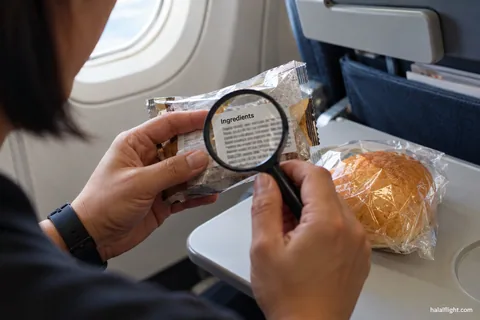
There are cases where buying on the aircraft makes sense. A short flight with sealed, clearly labelled packaged items is one. If the product has an ingredient list and a recognisable halal symbol, you can judge it yourself without needing the crew's help. Drinks and packaged snacks fall in this group more often than hot dishes.
It also suits a traveller who is flexible and happy to skip the meal if nothing fits. Trolley sales cost nothing until you buy, and an unsuitable menu simply goes unused.
Where it is a poor choice is a long flight, a tight medical schedule, or a strict diet in which hot dishes are the only suitable option. On those trips the pre-order or the religious special meal is the better plan, with onboard purchase as the last resort.
A checklist, and what to do if your order is missing
Before you fly, work through this list.
- Find the airline's food page and read whether it says all meals are halal.
- Check the pre-order deadline and place the order before it closes.
- Ask by email about any dish with unclear ingredients.
- Save the confirmation and the receipt.
- Pack a sealed backup snack that you can identify yourself.
If the ordered item does not arrive
Show the confirmation or receipt to the crew and ask what the airline offers in place of the missing item: a substitute, a refund or a voucher. Ask to read the ingredient list of any replacement, because a product at the same price may not meet the same religious or medical needs. If nothing is suitable, eat your own food and make a written claim after the flight, quoting the booking reference, flight number and the evidence you kept.
Frequently asked questions
Is it better to pre-order a halal meal or buy one on the plane?
Pre-ordering is usually the safer choice. It reserves the item, gives you time to check ingredients and leaves a record. FlyArystan notes that onboard items can sell out, and Air Arabia explains that pre-ordering gives a wider choice. Buying onboard can work for sealed, labelled packaged items.
How late can I pre-order food for my flight?
It depends on the airline. Malaysia Airlines accepts Economy pre-orders from 30 days to 24 hours before departure, and FlyArystan asks for orders no later than 24 hours before the flight. Check your own airline's page, because routes and services can have different cut-off times.
Does a pre-ordered meal count as a halal special meal?
Not automatically. A paid pre-order menu and a religious special meal are usually separate services with separate rules. Some airlines state that all meals are halal, which settles the question. Where no such statement exists, ask the airline in writing before you rely on the pre-order.
What if the airline runs out of the meal I paid for?
Show your confirmation or receipt to the crew and ask what replacement, refund or voucher the airline offers. Read the ingredients of any replacement before accepting it, and eat your own backup food if it is not suitable. Afterwards, write to the airline with your booking reference and flight number.
Can I pay for onboard food by card on every airline?
No. Accepted methods differ and some carriers sell only certain payment types. FlyArystan, for example, lists bank card, cash and contactless wallets and warns that card payments can be delayed without an internet connection. Check your airline's rules and carry a second payment option.