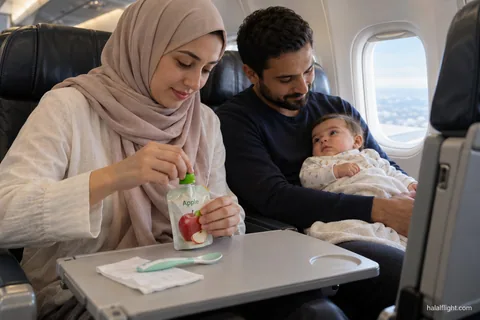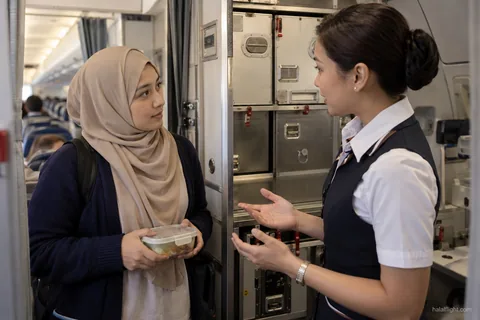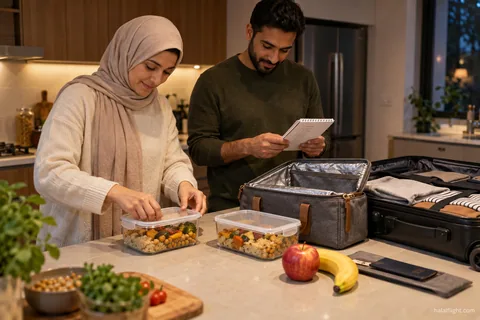
The short answer: infant supplies have their own rules
Ordinary cabin rules limit liquids to small containers, but most security authorities carve out exceptions for infant feeding. The exceptions are not identical everywhere. What is allowed, in what quantity and with or without the child present depends on the country where you are screened, and on each airport where you connect.
This page compares the United States and the United Kingdom because both publish clear public guidance. If your journey involves other countries, the same method applies: find the security authority or airport page for each departure point and read the infant section before packing. Questions about halal suitability of formula and baby food belong to a separate guide; here the focus is the checkpoint itself and the practical planning around it.
United States: what TSA guidance says
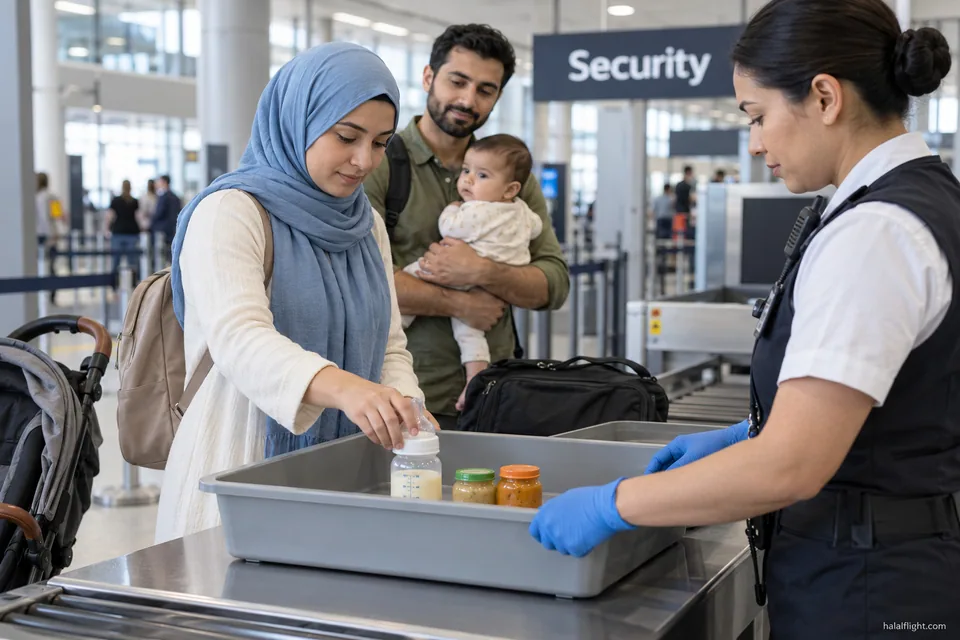
The Transportation Security Administration (TSA) states that formula, breast milk, toddler drinks and baby or toddler food, including puree pouches, may exceed 3.4 ounces (100 millilitres) in carry-on bags and do not have to fit in the quart-size bag. TSA also says the child or infant does not need to be present or travelling with you.
How to present the items
- Tell the officer at the start of screening that you are carrying these items over 3.4 ounces.
- Take them out of your carry-on so they can be screened separately.
- Expect that officers may test the liquids for explosives or concealed prohibited items.
- Clear, translucent bottles are easier to screen than plastic bags or pouches. Pouches may need to be opened if feasible.
If you prefer no X-ray or opening
TSA states that X-ray machines do not harm food or medicine, and that nothing is put into the liquids during screening. If you would rather your items were not X-rayed or opened, tell the officer. Additional screening follows, including Advanced Imaging Technology and enhanced screening of your other carry-on items.
Cooling accessories in US carry-on
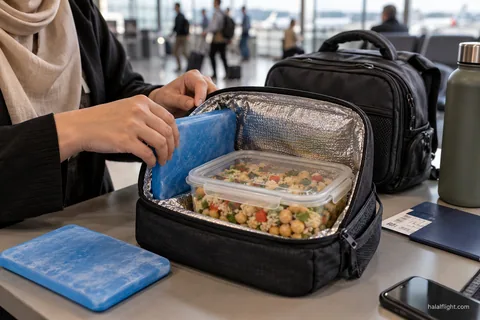
TSA allows ice packs, freezer packs and gel packs used to cool infant items in carry-on bags, whether or not breast milk is inside. Liquid-filled teethers are also allowed. A pack that is only partly frozen or slushy is screened in the same way as a liquid, so freeze packs fully before you leave for the airport.
This helps with the practical problem that formula bottles and milk need to stay cool, but it does not make an aircraft galley a refrigerator. The next sections cover that point.
United Kingdom: product matters, and so does the baby
Government guidance for UK airports is more specific about product types. It lists baby food, formula, cow’s milk, soya milk for babies and sterilised water as allowed in both hand and hold luggage, but in hand luggage only when the baby is travelling with you. It adds that there is no legal limit on how much you can take, while advising you to check with your airport before travelling.
Breast milk
Breast milk is treated differently. It is allowed in hand luggage even if you are not travelling with a baby, with each container holding no more than 2,000 ml. Containers are screened at security and staff may need to open them. Breast milk is also allowed in hold luggage.
Frozen items
The guidance says you cannot carry frozen breast milk in hand luggage, though it is allowed in hold luggage. Gel packs and ice packs are allowed in both hand and hold luggage.
The practical consequence is a mismatch with the US rule: a parent travelling without the baby may carry formula in a US carry-on, but the UK guidance ties formula and baby food in hand luggage to the baby being present.
Connecting flights and mixed itineraries
The hardest part of infant supplies is rarely the first checkpoint. If you connect through another country you may be screened again, under that country’s rules, and items accepted at departure can be questioned at transfer.
- List every airport on your route and find the security authority guidance for each.
- If a rule is unclear, contact the airport or the airline in writing and keep the reply.
- Carry slightly less than you think you need in hand luggage and allow for purchases at the destination.
Where guidance says only “check with your airport”, as the UK guidance does regarding quantity, a short enquiry before travel avoids an argument at the tray.
Halal and feeding questions are separate from screening
Being allowed through security says nothing about whether a product is halal or suitable for your child. Check the ingredient list and any certification for the formula or food you normally use, and keep familiar products for the journey. Fats, flavourings, gelatine and enzymes in some infant products are the usual points to check; the sibling page on halal baby food on flights deals with that in detail.
If a flight tempts you to change your baby’s usual feed, seek advice from a doctor, health visitor or paediatric dietitian first. Neither a security authority nor a travel guide can advise on what is right for an individual infant, and individual religious questions about a product belong with a qualified scholar.
Storage, heating and delays
Clearing the checkpoint does not change the manufacturer’s preparation and storage instructions. Prepared formula and expressed milk do not keep indefinitely, and a delay on the runway or at a connection can use up time you had planned for. Whether crew can warm a bottle or store milk differs by airline and by cabin, and is not something to assume. The sibling page on crew heating and refrigeration covers what to ask.
- Carry powdered formula and sterile water separately if the product allows, and prepare feeds as needed.
- Keep feeding equipment clean and within reach, not in the overhead locker.
- Keep a spare feed and a spare change of clothes in case of delay.
On arrival, remember that food and milk left over may be subject to import rules in the destination country. Check the destination country’s customs or agriculture authority before you land with products you did not finish.
Checklist and what to do if screening goes wrong
Packing
- Pack infant items in an easy-to-reach pocket of the carry-on.
- Use clear bottles where possible and label containers.
- Freeze gel packs solid and keep them separate from other liquids.
At the checkpoint
- Declare the items before the tray goes through.
- Ask for a private area or a manual check if you need one.
- Stay calm and politely ask to speak to a supervisor if an officer’s instruction seems to contradict published guidance.
If an item is refused or discarded
- Ask whether it can be checked in or handed to a companion outside the secure area.
- Buy a replacement after screening, or ask the airline or airport for assistance.
- Report the incident in writing to the airport or security authority afterwards, quoting the guidance you relied on.
Frequently asked questions
Can I take baby formula over 100 ml through US airport security?
Yes. TSA states that formula, breast milk, toddler drinks and baby food over 3.4 ounces may go in carry-on and need not fit the quart-size bag. Tell the officer at the start and remove them from the bag for separate screening. The child does not need to be travelling with you.
Do I need my baby with me to carry formula through UK security?
For formula, baby food, cow’s milk, soya milk for babies and sterilised water, UK guidance allows hand luggage only when the baby is travelling with you. Breast milk is the exception and can go in hand luggage even without the baby. Confirm quantities with your airport.
Can I carry frozen breast milk in hand luggage in the UK?
UK guidance says no: frozen breast milk cannot be carried in hand luggage, though it can go in hold luggage. Ice packs and gel packs are allowed in both. Plan to carry chilled rather than frozen milk if you need it in the cabin, and check your airline’s hold rules.
Are ice packs allowed for baby milk at airport security?
TSA allows ice, freezer and gel packs for cooling infant items in carry-on, and UK guidance allows gel and ice packs in hand and hold luggage. Packs that are slushy or part-frozen are screened like liquids in the US, so freeze them fully before leaving.
Does airport screening approval mean the formula is halal?
No. Screening rules address safety only. Whether a formula or baby food is halal depends on its ingredients and certification, and what suits your baby is a matter for a health professional. Check the label and certificate separately and keep to familiar products during the journey.