What a baby meal on a flight does and does not tell you
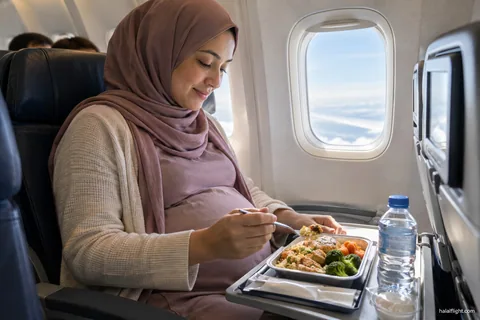
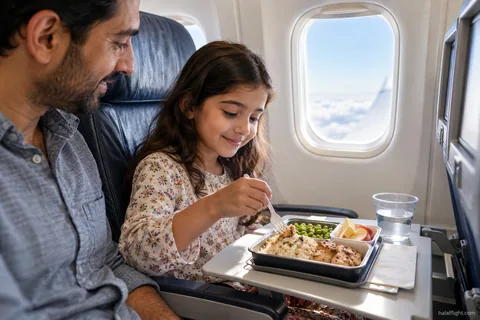
Airlines that offer baby or infant meals describe them by age: they are made for small children, usually in a soft or pureed form. That label tells you who the meal is for. It does not tell you whether the meat in it, or any other ingredient, meets your halal requirement.
Emirates, for example, states on its infant travel page that it offers a range of baby meals and that milk formula and bottles are available on board on request. That describes availability, not certification, so the traveller still needs to ask about ingredients if halal sourcing matters for the product.
The safest plan has three layers. Ask the airline what it can supply and whether ingredients can be checked before travel. Carry your own familiar food and milk as the main supply. Treat anything supplied on board as a backup that you check before it reaches your baby.
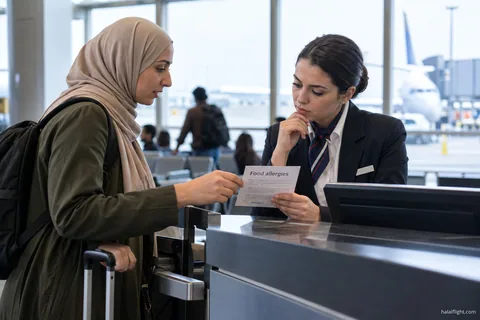
Asking the airline the right questions
Because policies differ, a short list of direct questions saves time. Put them in writing where you can, through the booking page or customer service, and keep the replies.
- Does the airline carry baby meals on this route and aircraft, and what are they called?
- Can ingredients be sent to you before travel?
- Is the halal status of the baby meal stated anywhere by the airline?
- Is formula supplied, which brand, and is it a type suitable for your baby's age?
- Will crew warm a bottle or a jar, and how is that done?
- What is the deadline for requesting a child or baby meal?
Emirates says that cabin crew will help with food and bottle warming, and that a special children's meal can be requested at booking or added through Manage a Booking at least 24 hours before the flight. Other airlines may have different rules, so confirm yours rather than assuming the same applies.
Keeping the baby's usual feeding plan
A flight is not the moment to change what a baby eats. Bring the milk, formula or food your baby normally has, in a quantity that covers the journey plus a margin for delay. A halal label on an unfamiliar product is not a reason to swap it in, especially for a young infant whose nutrition is age-specific or prescribed.
If you are breastfeeding, plan where and when you will feed, and whether you will express milk during the trip. If your baby takes a specialised formula, check that the same product is available at your destination as well, in case luggage is delayed.
Any change to feeding for medical or developmental reasons should be discussed with your health visitor, doctor or other child-health professional before you travel. This page gives general planning information only.
Preparing formula safely on the move
Timing
The CDC says prepared formula should be used within two hours of preparation and within one hour from the start of feeding. If it has not been used within two hours it should be refrigerated at once and used within 24 hours, and any formula left in the bottle after a feed should be thrown away. These limits matter on a flight, because an early-prepared bottle can easily exceed them.
Making it up in transit
The NHS Healthier Together guidance suggests measuring powder into a small, clean, dry container and carrying water that has just been boiled in a good vacuum flask. It says a sealed flask filled with at least 525 ml keeps water at 70 degrees Celsius for three hours. You then add water and powder to a sterilised bottle, cool it under cold water and test the temperature on your wrist.
That approach is more practical in an airport than on an aircraft, where hot water access is limited. Ask the airline how it handles hot water and what the crew can supply.
Ready-made liquid formula and breast milk
Ready-to-feed liquid formula can reduce the preparation steps. The NHS guidance says to transfer it to a sterilised bottle and warm it in a container of warm water, then test the temperature on your wrist. Once opened, it should be kept in a cool bag with an ice pack and used within four hours; with no ice pack or fridge, within two hours or it should be discarded.
For expressed breast milk, the same guidance says freshly expressed, unused milk can stay at room temperature for up to six hours and otherwise should be kept in a cool bag with ice packs. Warm milk that was not freshly expressed, and test it on your wrist.
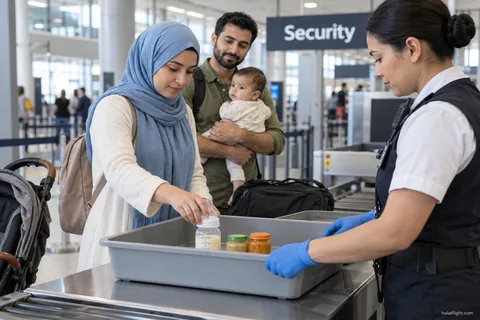
Do not assume that an aircraft has suitable refrigeration for your baby's feeds. Ask the airline in advance, and plan around a cool bag. The security rules for carrying such items are covered in the separate guide on baby food and formula through airport security.
Water, bottles and cleanliness
The CDC explains that tap water is generally fine for most babies, but that for babies under two months, those born prematurely and those with weakened immune systems, water should be boiled and left to stand for about five minutes before mixing, then cooled. If you are unsure about water at your destination, use bottled water or ready-to-feed formula and follow local public-health advice.
Bottles need to be clean. Carry spare sterilised bottles and teats, with a means to rinse and store used ones in a sealed bag. If you use sterilising tablets or wipes, check what the airport and airline allow.
- Take more clean bottles than you expect to use.
- Carry a sealed bag for used bottles.
- Store opened powder as the label directs, and note the opening date.
- Never use formula past the use-by date on the container.
Halal checks for solid baby food and snacks
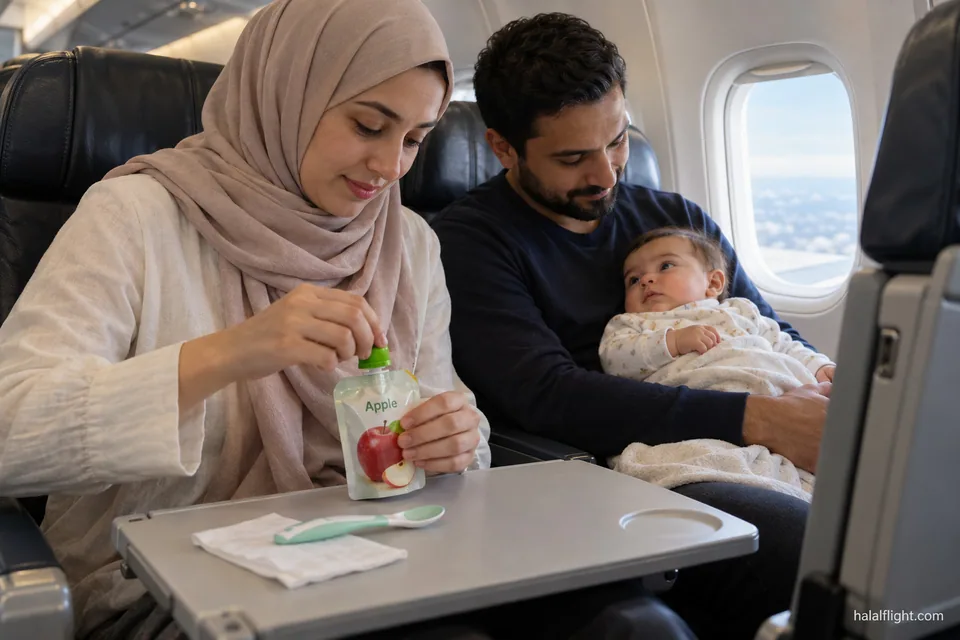
For babies on solids, the halal question is about ingredients. Savoury jars and pouches may contain meat, gelatine or flavourings, and fruit pouches can include animal-derived additives. Read the label of any product you plan to bring, and look for a halal certification mark from a certifier you trust where meat or gelatine is involved.
When the airline supplies a baby meal, ask for the ingredients or the jar. If the crew cannot show them, keep your own product as the first option. A vegetarian or fruit-based product is often simpler to verify than a meat dish, but a meal being vegetarian does not on its own tell you that every ingredient is acceptable to you.
Individual rulings on additives, gelatine or enzymes belong to a qualified scholar, and many scholars address these points differently.
Packing checklist and what to do if something goes wrong
Before you leave
- Ask the airline about baby meals, formula, bottle warming and deadlines.
- Pack more milk or food than the journey needs, in hand luggage.
- Take a vacuum flask, clean bottles, a cool bag and ice packs, and spare clothing.
- Check security rules for each airport on your route.
On board
- Prepare feeds as close to feeding time as you can.
- Discard leftover formula after each feed.
- Keep a note of the times a bottle was made.
If it goes wrong
If the airline's baby meal is missing or unsuitable, use your reserve and ask the crew for plain items such as water, bread or fruit. If a bottle has been out too long, throw it away and make a fresh one. If your baby seems unwell after a feed, seek medical advice as you would at home, and keep the product details to hand.
Frequently asked questions
Are airline baby meals halal?
Not automatically. A baby meal is defined by the age group it serves. Ask the airline whether it states the halal status of the product and whether ingredients can be checked before the flight. If it cannot confirm, bring your own product and treat the airline's meal as a backup.
How long can prepared baby formula stay out on a flight?
The CDC advises using prepared formula within two hours of making it and within one hour of starting to feed. Anything left in the bottle after a feed should be discarded. Prepare feeds close to feeding time, and do not rely on cabin refrigeration.
Can I ask the crew to warm a baby bottle or jar?
Some airlines do. Emirates states that its crew will help with food and bottle warming. Other airlines differ, so ask in advance what is offered. Test the temperature on your wrist before feeding, whatever method is used.
Should I bring formula or rely on what the airline provides?
Bring your baby's usual formula, plus extra for delays. Airline supply may be a different brand or type, and availability on request is not the same as suitability for your baby. Discuss any change in feeding with a child-health professional.
Is ready-made liquid formula easier to use on a plane?
It removes the mixing step, which can help. Once opened, the NHS guidance says to use it within four hours if kept in a cool bag with an ice pack, or within two hours without cooling. Check airport security rules for carrying liquids for your baby.