How to approach halal eating at MIA
Miami International Airport serves a large Latin American and Caribbean network, and its food reflects that: rice and beans, roast meats, empanadas, sandwiches and fresh juices sit beside the usual American fast food. The airport's pages and app help you find outlets, but none of the pages reviewed for this guide labelled outlets as halal.
The workable approach is simple. Anchor your plan to your concourse and gate, use the official maps to find outlets you can reach without leaving the secure area, and ask each outlet about ingredients and halal assurance in your own words. If the answer is unclear, choose a sealed product.
This page covers food at the airport. Airline meal requests, and what to do if your Muslim meal is missing, are on other pages of this site.
Beans, rice and the pot they were cooked in
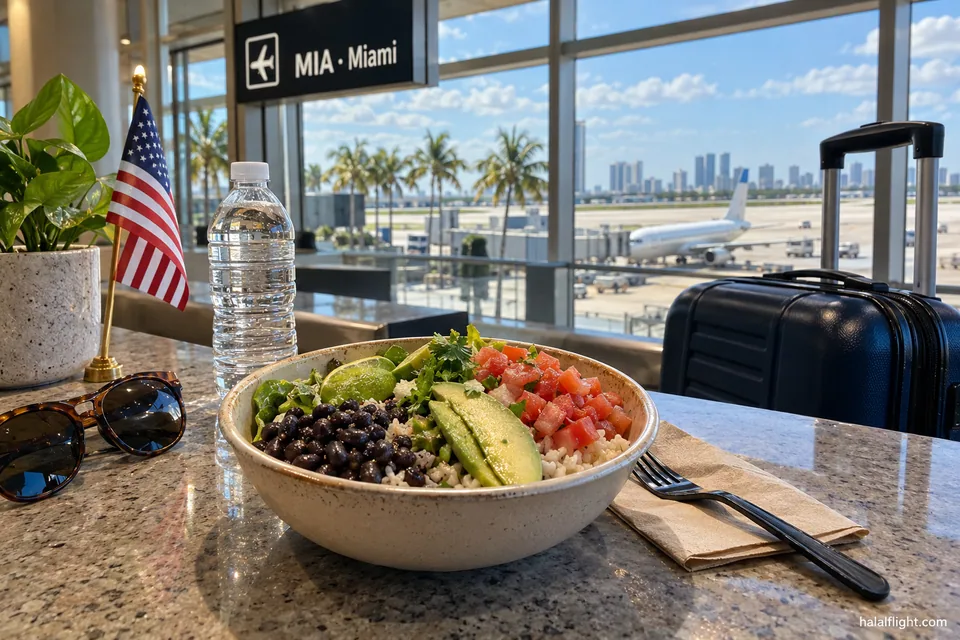
Latin-inspired bowls can look meat-free, which makes it easy to forget the base. Black beans are frequently cooked with bacon, ham hock or pork fat, or with a sofrito made on lard. Rice may be cooked in chicken or beef stock, or with chorizo. Plantains can be fried in oil shared with pork items such as croquettes or pork pastries.
Questions for the counter
- Are the beans cooked with any pork, bacon, ham or lard?
- Is the rice cooked in stock, and what kind?
- Does the sauce, mojo or dressing contain alcohol, wine or beer?
- Is the fryer shared with pork items?
- Is the chicken or beef halal, and can I see any certificate or label?
The topping is only part of the story. Check the base and the sauce separately before deciding whether the combination meets your own standard. Opinions on shared equipment differ, and a qualified scholar is the right person for a personal ruling.
Use your concourse as the anchor
The airport's pages offer maps of terminal gates and security checkpoints, and a separate restaurant-and-shop map listing. Keep your concourse letter and gate visible while you browse. A shop that looks close on a page can be on the other side of a checkpoint or on a different concourse.
One of the airport's older shopping map addresses now sends visitors on to a separate shop-and-dine website, which describes terminal maps and food for purchase and pre-order. The text available for review was limited, so open the live version on the day of travel and look for the concourse and security status of each outlet.
- Note whether the outlet is before or after security.
- Choose outlets in your own concourse first.
- Do not leave the secure area to eat unless you have a generous margin.
Concourse D and the Skytrain
The airport maps page states that the Skytrain is the fastest way to travel Concourse D, and it links to maps for checkpoints and terminal gates. It does not give stops or schedules in the text reviewed, so check the live pages for your route.
If your gate is in Concourse D, make a plan before you leave a restaurant elsewhere. Work out how long the train ride and walk are, add time for a gate change, and leave a margin for the return trip if you will go back. A meal that looks near on a map but needs a train ride, a security check or a long corridor may not be worth the risk.
If a gate change is announced while you are eating, stop and move; a half-finished meal is better than a missed flight.
The MIA app and MIA2GO ordering
The airport's official app uses location technology and more than 500 beacons, according to the airport's own app page. Its features include boarding-pass flight updates, interactive maps, current security checkpoint wait times, an interactive agent called Talk to Mia and MIA2GO, a mobile service for pre-ordering food for contactless pickup.
These tools are helpful for timing. Checkpoint wait times show whether you can afford a meal before security, and maps help you find the pickup point. They do not replace a conversation about ingredients. A menu tag or a confirmed order does not tell you what is in the dish, so ask the outlet when you collect, or message them first if the system allows it.
If you pre-order, check the order summary for substitutions, and keep the receipt in case you need to point to what you chose.
Entering the United States with food
If Miami is your port of entry, food in your bags is a separate matter from the airport meal. US Customs and Border Protection says travellers must declare meats, fruits, vegetables and plant and animal products, in checked bags, carry-on bags and vehicles. It states that undeclared prohibited items are confiscated and that civil penalties can apply. It also notes that many meats are prohibited because of animal disease, and that a product containing restricted meat, such as a beef broth, is usually prohibited too.
- Declare food when in doubt, even if you think it is allowed.
- Keep items in original packaging so officers can identify them.
- Eat or leave behind homemade meat dishes before arrival.
- Check CBP's rules before you pack food from abroad.
Rules change, so confirm them close to your travel date. Do not treat the need for halal food as a reason to carry meat into the country without checking.
Transit passengers and short connections
On a short connection, decide early whether you will eat at all. If your next flight is soon, buy a sealed snack or fruit near the gate rather than queueing for a hot meal. If the connection is long, you can afford to check an outlet properly, ask the questions and wait for answers.
Remember that connecting in the United States may require you to clear immigration and customs and re-check bags, depending on your itinerary. That uses time that you might have planned to spend eating, so ask your airline what applies to your ticket.
If you are fasting, find the local sunset time and keep dates and water in your bag so that you do not depend on an outlet being open or having a short queue.
Checklist if nothing can be confirmed
- Note your concourse, gate and whether you are before or after security.
- Look at the current checkpoint wait times in the app.
- Choose two outlets in your concourse and ask the bean, rice, sauce and fryer questions.
- Ask whether the meat is halal and request written information.
- If using MIA2GO, still ask about ingredients at pickup.
- Check the Skytrain route if your gate is in Concourse D.
- If answers are unclear, buy sealed items with a readable ingredient list.
- Do not carry meat or homemade food into the country without checking CBP rules.
- Leave a margin for gate changes.
If you are unsure about something you have eaten, speak to a qualified scholar rather than relying on general advice.
Frequently asked questions
Are beans and rice at Miami Airport halal?
Not automatically. Beans may be cooked with bacon, ham or lard, and rice may be cooked in meat stock or with chorizo. Ask how each is prepared and whether fryers are shared with pork. If staff cannot answer, choose a sealed alternative with a readable label.
Does the MIA app show halal food?
The airport's app page describes flight updates, maps, security wait times and MIA2GO food pre-ordering, not halal labelling. Use it to find outlets and save time, then ask the outlet about ingredients and assurance before you order.
What is MIA2GO?
The airport describes MIA2GO as the app's mobile food ordering feature, letting you order food ahead and collect it without contact. It helps with timing, but it does not confirm what is in a dish, so still ask the outlet.
How do I reach Concourse D quickly?
The airport maps page says the Skytrain is the fastest way to travel Concourse D. Check the live maps for your route, and leave extra time for the ride and any gate change if you eat in another concourse.
Can I bring halal meat into the United States through Miami?
Not without checking. US Customs and Border Protection requires declaration of meats and other animal products and says many meats are prohibited. Declare anything you carry, and read the CBP agricultural guidance before packing food from abroad.