Where to start at HND
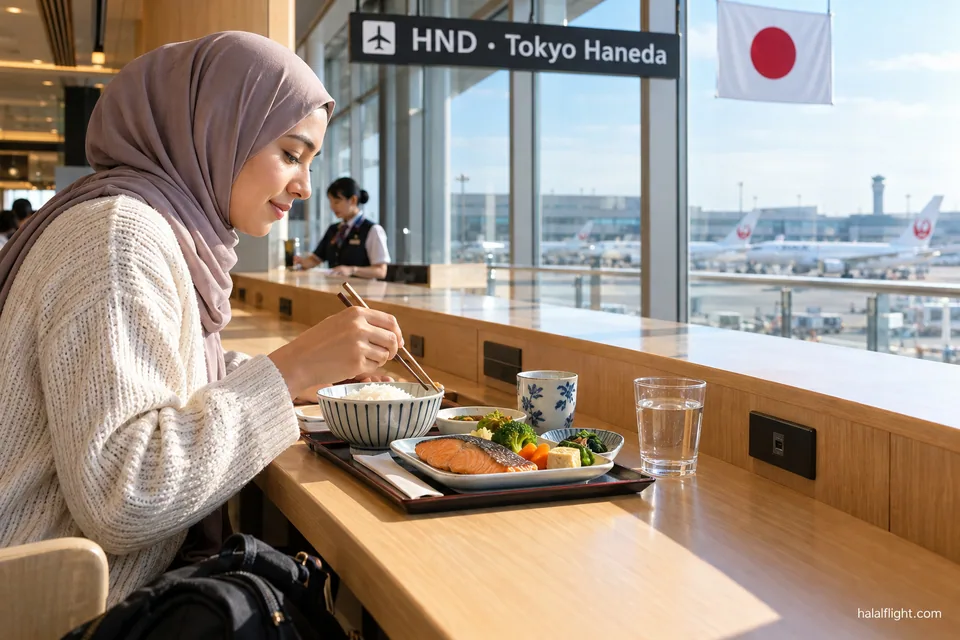
Japan is not the easiest country for halal food, and an airport meal is no exception. Haneda does, however, give travellers more tools than many airports: its online restaurant finder has a halal-related toggle, and at least one outlet states on its own listing that it holds halal certification. The sensible approach is to use the finder to build a short list, open each shop's page, and then settle remaining questions directly with the staff.
Three decisions shape the plan before any menu is considered:
- Which terminal your flight uses.
- Whether you will be before or after security when you want to eat.
- How much time you have once prayer and the walk to the gate are counted.
How the restaurant finder filters work
The official finder lets you narrow results in several ways. At the time of checking, the options included terminal tabs (all, Terminal 1, Terminal 2 domestic, Terminal 2 international and Terminal 3), an area choice of before or after the security check, and a quick toggle labelled for halal and vegetarian options. A refine panel also listed halal compatible and vegetarian support as separate specific conditions.
Read the combined toggle carefully
Because the quick toggle merges halal and vegetarian, a result may satisfy one group and not the other. A vegetarian dish is not automatically halal: it may contain alcohol-based mirin or sake, and vegetable dishes can be cooked in stock or sauces that contain meat. Use the separate halal compatible option in the refine panel where possible, then open the listing for the individual shop.
What halal compatible means
The wording suggests the shop can accommodate halal needs, which is not the same as holding a certificate. Treat it as a prompt to ask questions, not as a guarantee.
The Kebab Studio listing
The shop page the airport publishes for this outlet is titled Kebab Studio, marked as takeout only. According to the page, it sits in Terminal 3 on the fourth floor in the EDO KOJI area, before the security checkpoint on the north side. Listed hours were 9:00 to 20:00 on weekdays and 10:00 to 21:00 on Saturdays and Sundays. The shop serves doner kebab with a house-made sauce in its own bread, and the listing says the business also has halal certification so that Muslims can eat with peace of mind.
Two cautions apply. First, the page also contains a data field that marks halal as false, which conflicts with the written statement, so ask at the counter what the certification covers and ask to see the certificate. Second, hours and locations change, so check the live page and phone number shown on it before relying on the shop.
Being before security matters. If your flight leaves from Terminal 2, you would need to travel to Terminal 3 landside and return through security, so only choose this option with time in hand.
Terminals, domestic and international sides
Haneda separates Terminal 2 into domestic and international sections in the finder, and Terminal 3 is a distinct building used for international flights. A restaurant in the same building as your flight may still sit in an area you cannot reach, for example on the far side of security from where you are standing, or in a domestic zone when you hold an international ticket.
- Check your boarding pass or airline app for the terminal.
- Select that terminal tab in the finder and choose before or after security to match your position.
- If you change terminals, allow for transfers between buildings, which may involve leaving the secure area.
If you arrive at Haneda on an international flight and connect onward on a domestic one, the route and baggage process are different from an international transfer, so confirm the steps with your airline.
Asking about Japanese dishes
When there is no certified option, you may be tempted by noodles, rice bowls or fried dishes. Japanese cooking commonly uses ingredients that raise halal questions even in dishes that look plain.
- Broth: ramen, udon and soba soups are often built on pork or fish stock, and bonito-based dashi is common elsewhere.
- Seasonings: mirin, sake and some soy-based sauces can contain alcohol.
- Fats: lard is sometimes used in frying or in fillings.
- Meat: unless the shop states the meat is halal, the source cannot be assumed.
Short, specific questions work best, ideally written on a phone in Japanese using a translation app, such as asking whether the dish contains pork, alcohol or lard. If staff cannot answer, choose another dish. Whether a given standard is acceptable to you is a matter for your own scholar.
Prayer rooms at Haneda
The airport's facilities page says Terminal 2 and Terminal 3 have prayer rooms, and Terminal 1 has none. As listed at the time of checking:
- Terminal 2 (international): two rooms on the third floor before security and two rooms on the second floor after security.
- Terminal 3: two rooms on the third floor before security.
All are described as having purification facilities for washing before prayer, and the page links to floor guides that show the exact positions. Note that Terminal 3 rooms are before security only, so a departing passenger there will need to pray before passing through. Confirm the current arrangement on the airport page, because rooms can be relocated.
Packaged food and backup choices
If the shop is closed or too far away, sealed food from convenience stores can fill the gap. Read the ingredients label, and look for words relating to pork, gelatin, lard, alcohol, mirin or extracts. Labels may be in Japanese only, so use a camera translation tool and take a little extra time. Fruit, plain nuts, rice balls with simple fillings such as plum or kelp, and plain bread are common safer starting points, but always read the list, because fillings and coatings vary.
Remember that carrying food into another country may be restricted. Check your destination's rules on meat, dairy and fresh produce before you board.
Checklist for a halal meal at Haneda
- Note your terminal and whether you want to eat before or after security.
- Use the finder with the halal option, then open each listing.
- If you plan to visit Kebab Studio, check the live hours and call the number on its page if you need to ask about certification.
- Ask to see the certificate and ask what it covers.
- Locate the nearest prayer room and the walk back to security.
- Keep a sealed backup snack with an ingredient list you have read.
If it goes wrong
If the shop is closed or its answers are unclear, do not guess. Ask airport information to point you to the nearest alternative within your area, eat the backup food, and plan a proper meal at your destination. Use the airline meal on board if you ordered a Muslim meal in advance.
Frequently asked questions
Is there a halal restaurant at Tokyo Haneda Airport?
The airport's own listing for Kebab Studio, a takeout shop in Terminal 3 on the fourth floor before security, says the business holds halal certification. A data field on the same page conflicts with that, so ask the shop what the certificate covers and check the live listing before you rely on it.
What does the halal filter on the Haneda restaurant finder do?
The quick toggle covers halal and vegetarian options together, so results may suit only one group. The refine panel separately lists halal compatible and vegetarian support. Treat halal compatible as a reason to ask questions at the shop, not as proof of certification.
Are there prayer rooms at Haneda Airport?
Yes in Terminals 2 and 3, and none in Terminal 1, according to the airport page. Terminal 2 has rooms both before and after security; Terminal 3 has them before security. The rooms are described as having purification facilities. Check the airport's floor guides for exact positions before you travel.
Is vegetarian food at Haneda automatically halal?
No. Vegetarian dishes can contain mirin, sake or other alcohol-based seasoning, and vegetable toppings may sit in meat or fish stock. Ask about the broth, the sauce and the oil, and choose a different dish if the shop cannot answer clearly.