What a vegetarian meal does and does not settle
Vegetarian means the main dish contains no meat, and on most airlines no fish either. That answers one question, whether the flesh of an animal is present. It leaves open the questions a Muslim traveller usually cares about: whether the ingredients were made without alcohol, whether animal-derived additives such as gelatine are absent, and whether the kitchen is certified by a body you trust.
For that reason a vegetarian meal is best treated as a fallback with conditions, not as an automatic equivalent of a Muslim meal. Some travellers are comfortable with a carefully checked vegetarian tray when no halal option is available; others prefer to carry their own food. Which standard applies to you is a personal religious matter, and a qualified scholar is the right person to ask if you are unsure.
This page covers vegetarian meals only. The wider question of plant-based labels is dealt with on the page about vegetarian and vegan meals in general, and vegan meals have their own page.
Read the airline's definition, not just the code
Meal codes look standard, but each carrier writes its own description. TAP Air Portugal, for example, publishes three relevant definitions side by side. Its lacto-ovo vegetarian meal has no meat, fish or shellfish but allows dairy and eggs. Its vegetarian vegan meal excludes all animal products and by-products, including eggs, honey and dairy. Its Hindu vegetarian meal is described as Asian-style cooking with no animal products, by-products or eggs, with dairy allowed. Its Muslim (halal) meal is described as using halal-certified meat or poultry, or halal-approved fish and produce, with no pork, alcohol or doubtful (mushbooh) items.
Notice what the comparison shows. The vegetarian definitions say nothing about alcohol or doubtful ingredients, while the Muslim definition does. That gap is exactly why the label alone cannot be relied on. Another airline may word its vegetarian meal differently, so read the description for the carrier and the date you are flying.
Which vegetarian type suits a halal-conscious traveller
Lacto-ovo (western style)
This is the broadest type. It may contain cheese, yoghurt, butter, cream and eggs. The extra risk here is in how those items were made, particularly cheese, which can be set with animal rennet. If that matters to you, ask the airline or choose a type that excludes dairy.
Vegan or strict vegetarian
Removing dairy and eggs removes the rennet question and some gelatine-containing desserts. It does not remove alcohol-based flavourings, wine in a sauce or a dessert made with liqueur. Treat it as narrower, not as certified.
Indian or Asian vegetarian
These meals often rely on pulses, rice and spiced vegetables, so they are filling and usually free of obvious animal products. Some airlines allow dairy in them and others do not. Do not assume that every airline's version excludes the same things.
Hindu is a different request
A Hindu meal on many airlines can contain lamb, poultry or fish and exclude only beef and pork. It is not a vegetarian code. If you want to avoid meat, choose a genuine vegetarian type and state any halal requirement separately.
Hidden points on a vegetarian tray
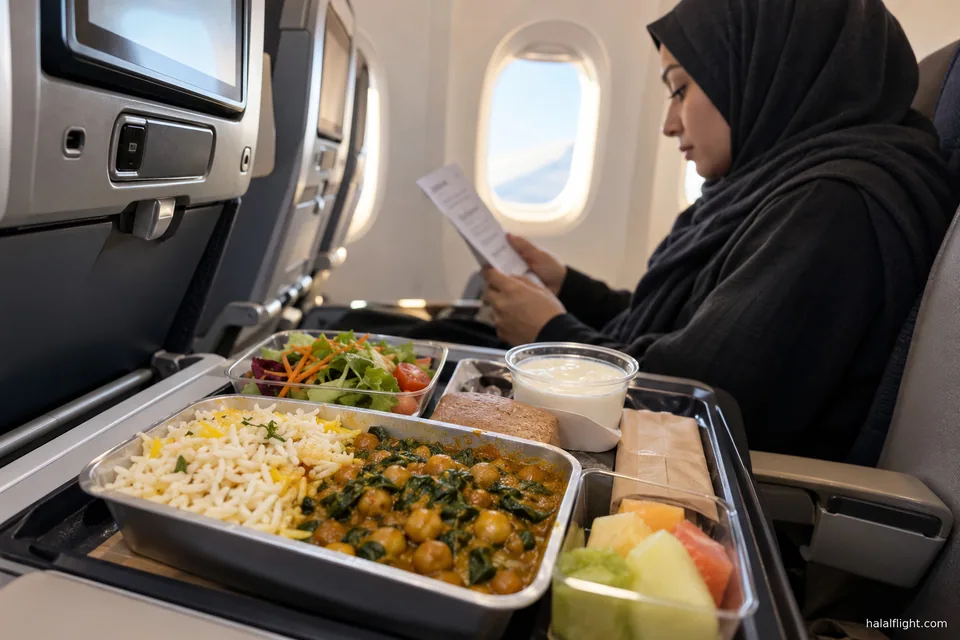
The main course is rarely the problem. Items around it deserve a second look.
- Cheese and yoghurt: may use animal rennet or enzymes that the label does not reveal.
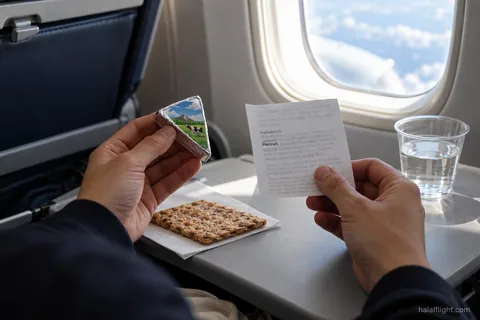
- Desserts and jellies: gelatine is common in set desserts and some sweets; vegetarian trays are not always gelatine-free unless the airline says so.
- Sauces and dressings: may contain wine, vinegar from wine, or alcohol-based flavouring.
- Bread and pastry: can include animal-derived fats or emulsifiers.
- Soups and stocks: a vegetable soup may still be built on a stock; ask.
Each of these has its own detailed page on this site, including animal rennet and dairy, gelatine and alcohol-based flavourings. Here the point is only that a vegetarian label does not clear them for you.
Ordering the meal and the timing
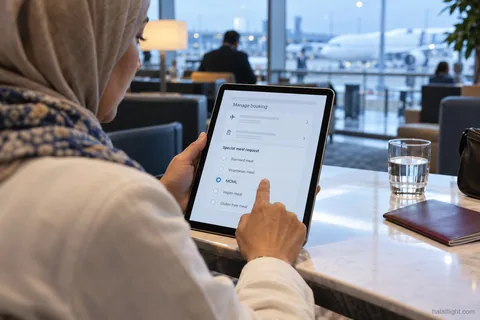
Special meals are normally requested in advance, through the booking or the airline's contact channels. On TAP, standard special-meal requests must be made up to 24 hours before departure and can be made online through Manage your Booking, through the contact centre, at the airport counter or through a travel agency. Other airlines set their own cut-offs, and some require more notice on certain routes or cabins, so look up the airline's current rule instead of assuming 24 hours.
If you book through a travel agent or a partner airline, check that the request has reached the operating carrier. A request recorded on a different airline's reservation does not always carry over to the flight you actually board. The page on adding a meal after ticket purchase explains the steps in detail.
Long journeys, connections and portion size
A vegetable-based tray can be lighter than a meat meal. On a long sector, or across a connection, that matters. Consider the whole journey rather than one tray.
- Check each flight separately, because vegetarian availability can differ between short and long sectors and between departure airports.
- On short flights, meals may be sold or limited, and special meals may not be offered at all in some cabins.
- Carry permitted, sealed backup food such as nuts, dried fruit or bars, subject to the customs rules of your destination.
- If you are fasting, plan the meal timing separately; the fasting pages cover suhoor and iftar on board.
Questions to ask the airline
When you contact the airline, short and specific questions get better answers than a general request to confirm the meal is halal. Useful ones include:
- Does your vegetarian meal contain alcohol, wine or alcohol-based flavouring in any component?
- Are the desserts and any jelly or mousse free of gelatine?
- Is the cheese made with animal rennet, or can you confirm a vegetarian cheese?
- Is the meal prepared in a certified halal kitchen, or is it from the standard catering line?
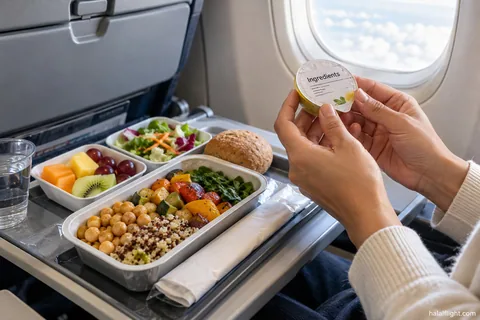
- Can you send the ingredient list or the meal description in writing?
If the airline cannot answer, you have learned something useful: the vegetarian tray is unverified, and you can decide whether to eat it, eat only the parts you are happy with, or rely on your own food.
If the meal arrives and you are unsure
Before you eat, run through a short checklist.
- Read the label on the tray and compare it with your booking.
- Ask the crew what the code means if it is not the one you ordered.
- Ask whether the dessert, sauce and bread have been checked.
- Set aside anything you cannot confirm and eat what you are satisfied with.
- Use your backup food if a main item is doubtful.
- Keep a note of what was ordered and what arrived in case you want to give feedback afterwards.
If the wrong tray was supplied altogether, the page on receiving the wrong special meal covers how to handle that at the seat.
Frequently asked questions
Is a vegetarian meal on a plane automatically halal?
No. Vegetarian only means the dish has no meat, and on many airlines no fish. It does not state that the ingredients were free of alcohol, that animal-derived additives are absent or that the kitchen is halal-certified. Check the airline's own meal definition and ask about specific components if they matter to you.
Is a Hindu meal the same as a vegetarian meal for halal purposes?
No. On many airlines a Hindu meal is a separate category that can include lamb, poultry or fish and excludes mainly beef and pork. If you want to avoid meat, order an actual vegetarian code. If halal matters, mention that separately and ask what the airline can confirm.
Should I choose lacto-ovo or vegan if no Muslim meal is available?
Vegan meals remove dairy and eggs, which avoids the rennet question, but they do not rule out alcohol-based flavourings or wine in sauces. Lacto-ovo trays are broader and include cheese. Neither is certified halal by its name. Choose the one whose written description you can accept, and ask about gaps.
Can I ask for a vegetarian meal and a halal meal together?
Usually only one special meal code can be attached to a passenger on a flight. Whether any option covers both needs depends on the airline and route. Ask the airline directly which single meal best matches both, and ask for the answer in writing before you travel.
What can I eat from a vegetarian tray if I am unsure about the dessert?
Eat only what you are satisfied with and set aside the rest. Fresh fruit, sealed rolls, plain rice and cooked vegetables are usually easier to assess than set desserts, sauces and cheese. Ask the crew to read the label for any item that contains gelatine, wine or alcohol-based flavouring.