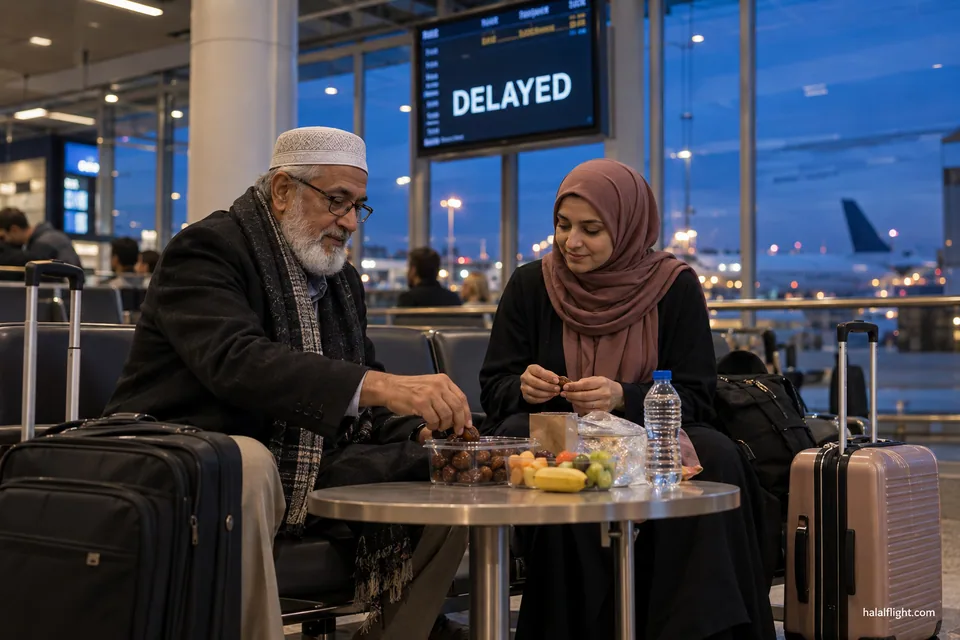
What a delay changes for a fasting traveller
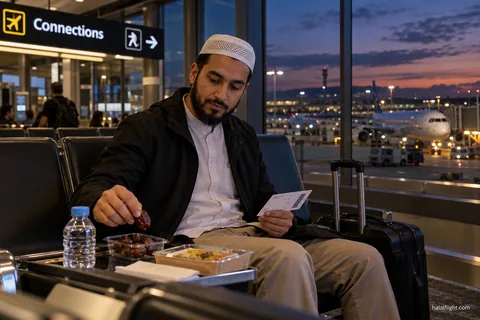
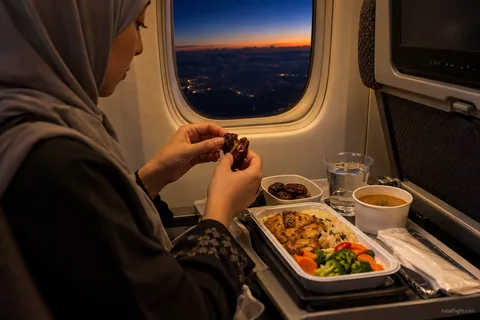
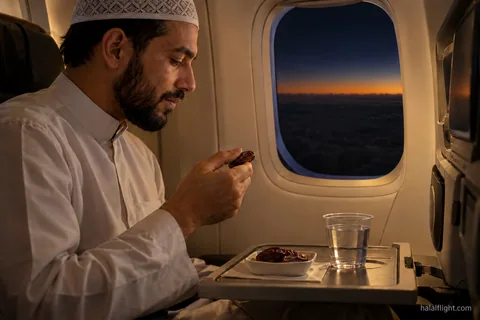
A fasting passenger plans a flight around two moments: the pre-dawn meal and the sunset meal. A delay of a few hours can shift either of them. A departure that was meant to give you iftar on board may now leave you in the terminal at sunset, and an early morning flight that pushed suhoor to the kitchen table at home may now start from a departure lounge with nothing open.
The practical answer is to treat every Ramadan journey as if one meal might land somewhere unplanned. That means carrying something small, knowing how to find the right time for wherever you actually are, and knowing who to ask when the airline has promised a meal that no longer matches the flight.
This page covers delays, cancellations and rebooking. Choosing departure times in advance, sleep on night flights and the rules for breaking the fast at altitude each have their own guides, so only the points that matter during disruption are repeated here.
Work out the timing from where you really are
Any timetable you made at home assumed a particular departure and a particular route. Once the flight is late, that timetable is out of date.
While you are still on the ground
If you are still at the departure airport at sunset, the original inflight estimate no longer describes your situation. The sunset that matters is the one at the airport where you are standing, and the local prayer timetable for that city is the usual reference. Check it on your phone before you rely on an announcement.
After take-off
Once the aircraft is airborne, ground timetables stop being useful. Some airlines publish how they calculate the time. Emirates, for example, has said that its crew use a tool based on the aircraft's position and altitude, and that the captain announces iftar when the sun sets. Other carriers may handle this differently, and some give no announcement at all. Ask the cabin crew early in the flight what the practice is, and look at the moving map if one is available.
When schools of thought differ
Scholars and institutions give different guidance on timing at altitude and on how long a delay changes the day's rules. For anything beyond practical logistics, ask the scholar or institution you normally follow. A dedicated guide on this site explains when to break the fast during a flight.
Pack a small meal that you can reach
The simplest protection against a delay is food in your own bag. Keep it in the cabin bag or a small pouch on top, not in checked luggage, because checked bags stay with the airline until you reach the destination.
- Dates and dried fruit. Light, shelf-stable and easy to eat quickly at the moment of iftar.
- Nuts and plain biscuits. Check the ingredient list for gelatine, alcohol-based flavourings and unclear emulsifiers if you avoid them.
- A sealed bottle of water. Buy it after security, or bring an empty bottle and fill it at a fountain if your airport allows this.
- A sandwich or rice box. Only if you have a plan to keep it cool and expect to eat it soon.
Food that is permitted but unlabelled is still a risk. Choose products whose ingredients you can read, and keep the packaging so that you can check later if needed.
Keep perishable food safe on a long wait
A backup meal that spoils is worse than no meal. The United States food safety portal FoodSafety.gov gives a simple rule: perishable food should not be left out of refrigeration for more than two hours, and if the temperature is above 32 degrees Celsius (90 degrees Fahrenheit), the limit falls to one hour. It also explains that bacteria multiply fastest between roughly 4 and 60 degrees Celsius.
For a delayed journey, this leads to a few sensible habits:
- Pick foods that do not need refrigeration for the first part of the trip, such as dates, nuts, bread and hard fruit.
- If you carry perishable items, use an insulated bag with ice packs and eat them early rather than saving them for the end of the delay.
- Do not carry cooked meat, rice or dairy for hours in a warm bag and then eat it at sunset.
- If you cannot say how long food has been unrefrigerated, throw it away.
Security rules vary between airports on liquids and gel packs, so check the screening rules for your departure point before packing frozen items.
Ask what help the airline or airport can give
Some airlines run Ramadan arrangements at selected airports. Emirates, for instance, has stated that some of its gates give out iftar boxes containing water, laban, a banana and dates, and that fasting customers on selected routes can receive a meal box on board. These are operator-specific and depend on the airport and flight, so they cannot be assumed for any other carrier or for a delayed flight.
Instead of guessing, go to the gate or the airline desk and ask three direct questions:
- Is there any Ramadan or iftar assistance for this flight or this airport tonight?
- Are meal vouchers or refreshments being given for this delay, and where can I use them?
- Which food outlets in this terminal will be open at sunset?
If your own airline cannot help, ask a neighbouring airline's desk or the airport information point whether a prayer room or quiet area is available, because that space is often where fasting passengers wait.
Know what you may be owed for the delay
Passenger rights depend on where the flight departs from, which airline operates it and why it is late. In the European Union, the passenger-rights rules say that once a departure delay passes a set threshold, the airline must offer meals and refreshments in proportion to the waiting time. The thresholds are two hours for flights of up to 1,500 kilometres, three hours for longer flights within the EU and for other flights of 1,500 to 3,000 kilometres, and four hours for all other flights. A hotel and transfers apply if the new departure is the next day or later.
The rules also say that if the airline does not provide help and you pay for reasonable expenses yourself, you may be able to claim them back, so keep receipts. The airline can limit assistance in exceptional circumstances.
Other countries, including the United States, have their own consumer rules and airline commitments, and these differ. Look at the regulator for your departure country or ask the airline for its customer commitments. A voucher given for a meal does not guarantee that a halal or Muslim meal is available at the outlet where it can be used, so check the ingredients before you buy.
Re-check your special meal after a rebooking
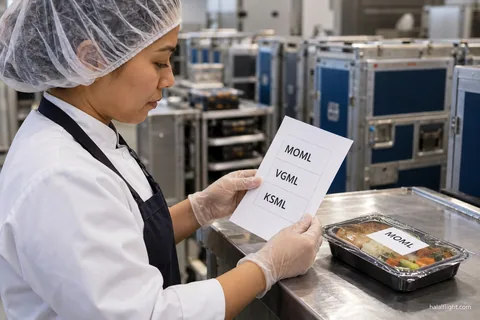
When a cancelled flight is replaced by a new booking, a special-meal request does not always move with you. A confirmation for the original flight proves nothing about the new one, particularly if the replacement is on another operating flight, another airline or a different kitchen.
Singapore Airlines explains that special meals can be chosen well ahead but that changes are only accepted until a set time before departure, and that if there is a disruption a selected meal may not be fulfilled for operational reasons. The general lesson applies to any carrier: the closer the new flight is, the less likely it is that the caterer can still add an order.
- Open the new booking and look for the meal request against each flight segment.
- If it is missing, request it again through the airline's usual channel and ask for a written confirmation.
- If the deadline has passed, ask whether the airline can still try and what the fallback is.
- Always carry your own backup, even when the booking shows a confirmed meal.
The meal codes and what they mean are explained in a separate guide.
Checklist if the flight is delayed or cancelled
Use this short list at the moment of disruption, in roughly this order.
- Note the time of the delay announcement and the expected new departure.
- Look up sunset for the city where you currently are, not your destination.
- Open your cabin bag and check that your backup food and water are reachable.
- Ask the airline desk about meal vouchers, Ramadan assistance and the new flight.
- If you have been rebooked, check the special-meal request on every new segment.
- Keep receipts for any food or transport you pay for yourself.
- Find the prayer room and a quiet seat, and tell the people travelling with you where you will be.
- If food has been out of refrigeration for more than a couple of hours, do not eat it.
If you are travelling with children or on a pilgrimage group booking, the same steps apply, but the organiser or parent also needs to plan for people who are not fasting.
Frequently asked questions
What should I do if my flight is delayed past sunset while I am fasting?
If you are still at the airport, the sunset that applies is the local one, so check the prayer timetable for that city and break your fast with the food you carry. Then ask the airline about vouchers, and keep your receipts if you buy food yourself. Ask your own scholar if you have a specific question about your situation.
Will the airline give me iftar if my flight is late?
Not automatically. Some airlines give iftar boxes at selected gates or on selected routes, but that depends on the carrier, airport and flight. Ask the gate staff directly. In the EU, passengers may be entitled to meals and refreshments once a delay passes a set number of hours, but that is not a halal guarantee.
Does my Muslim meal request carry over if I am rebooked on another flight?
Do not assume it does. A new booking may not copy the request, and a different operating airline or caterer needs its own order. Check each segment in the booking, request the meal again and ask for confirmation. If the deadline has passed, carry your own food as a backup.
How long can I keep packed food before it is unsafe?
FoodSafety.gov advises that perishable food should not be left out of refrigeration for more than two hours, or one hour if the temperature is above 32 degrees Celsius. Dry items like dates, nuts and plain bread are far less risky on a long wait than cooked meat, rice or dairy.
Can I claim the cost of food I bought during a delay?
Possibly. Under European Union rules, if the airline does not provide the care it should, you may be able to claim reasonable expenses, so keep receipts. Rules differ by country, so check the regulator for your departure point or ask the airline for its written customer commitments.