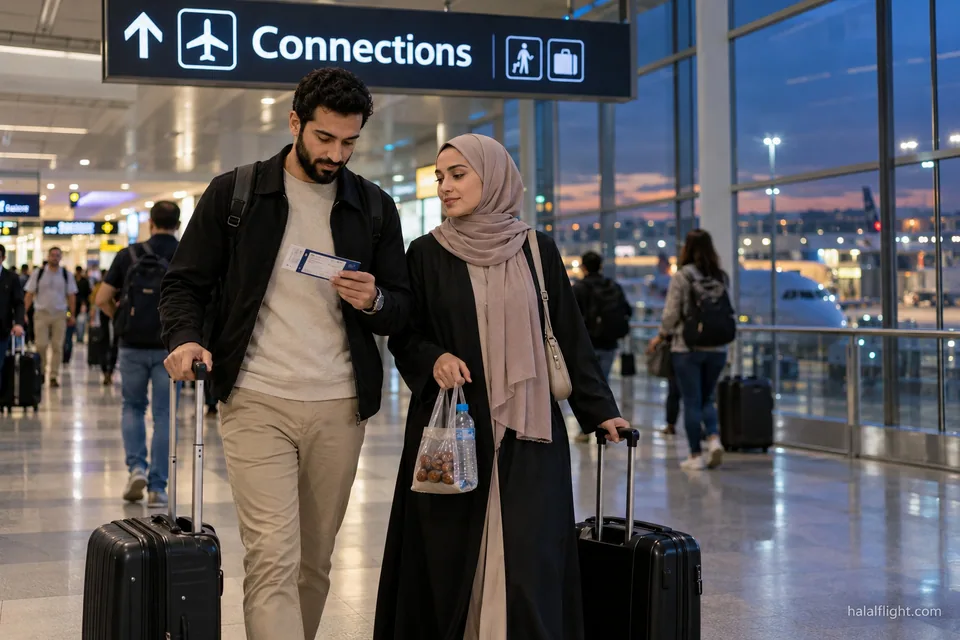
Work out the time you can really use
The printed layover is the gap between landing and departure, and almost none of it belongs to you. During Ramadan the margin matters more, because iftar, wudu and prayer all have to fit inside whatever is left. A reliable way to plan is to work backwards from the boarding deadline rather than forwards from the landing time.
A simple subtraction
- Start with the scheduled arrival time and add the time the aircraft normally takes to reach a stand and open its doors.
- Add the walk through the terminal to the connection or transfer area, which can be long in a large hub.
- Add transfer security, which is often the least predictable step.
- Add the journey to the next gate, including any shuttle or train between terminals.
- Subtract the boarding deadline, which falls before the departure time shown on the ticket.
What remains is your genuine window. If it is under about an hour, treat a sit-down meal as unrealistic and plan a quick opening of the fast with items you carry yourself.
Why a single ticket changes the picture
On one booking, the airline sells only itineraries that meet the airport’s minimum connection time, and your bags are normally checked through. On separate tickets, those protections do not apply, and you may need to collect luggage, clear immigration, check in again and pass security. That adds a great deal of time and leaves much less for a relaxed iftar or prayer.
Know which zone of the airport you will be in
Terminals are divided into areas that passengers may and may not enter. The part you stay in during a connection is usually the secure, departures-side area, and restaurants outside it can be unreachable without leaving and re-entering.
Public side versus passenger side
Some airport dining directories, including the one published by Zayed International Airport in Abu Dhabi, let you separate outlets in public areas from those in passenger areas. A restaurant that looks ideal on a map may sit before security or immigration. Check which side it is on before you set your heart on it.
Leaving the secure area is a decision, not a detour
Stepping out to eat means passing immigration and then repeating security on the way back, and it may require a visa or permission to enter the country. Heathrow’s connecting-flights guidance, for example, recommends staying airside during a connection and notes that you need the right to enter the UK if you leave. For most Ramadan layovers, the sensible default is to remain inside and use what is there.
Questions to answer before landing
- Is the next flight in the same terminal, or does it need a shuttle or train?
- Are the food outlets I want before or after security?
- Will gate information appear only after I pass the next security check?
Plan where to break the fast
If sunset falls during your layover, iftar becomes the central item to organise. Decide in advance whether you will eat at the airport, on the aircraft, or from food you carry.
Rely on what you carry first
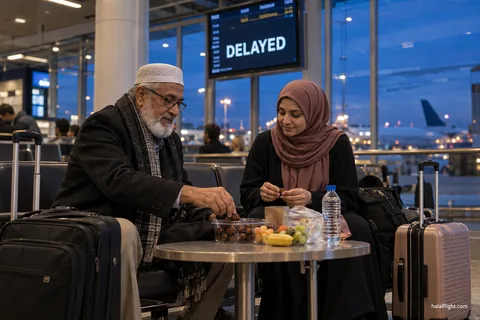
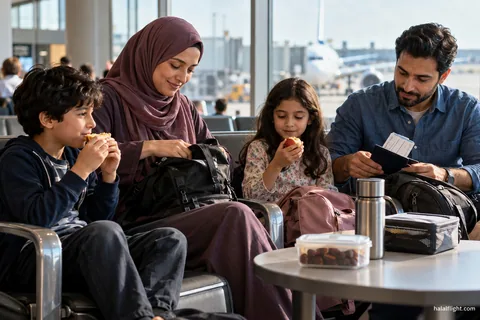
Dates, a small bottle of water bought after security, nuts or a sealed sandwich take seconds to eat and do not depend on queues. Airport outlets can be busy at dusk in a Ramadan period when many other passengers are doing the same. Carrying something means a delayed gate change does not turn into an uncomfortable wait.
Treat outlet menus with care
A shop in a transit area is not automatically suitable for you. Ask staff about ingredients and preparation, and look for certification or a clear statement rather than assuming. If you cannot confirm a dish, choose something simple such as fruit, plain bread, or a vegetarian option that you can check by reading the label.
Decide the order of events
A common sequence is to break the fast with a date and water, perform wudu, pray maghrib, and only then eat a larger meal if time permits. Some travellers prefer to eat a light item first and prioritise the prayer before boarding. The right order for your situation is a matter for your own practice and, where you are unsure, a qualified scholar.
Find prayer and ablution facilities in advance
Prayer arrangements differ from airport to airport, and the difference affects how you prepare. Zayed International Airport describes dedicated prayer spaces with ablution facilities, while Heathrow lists multi-faith prayer rooms in its terminals. These are different set-ups: a dedicated space may have separate washing areas, whereas a shared multi-faith room may require you to make wudu elsewhere.
What to look up before you travel
- Which terminal and which side of security the room is on.
- Whether ablution facilities are next to the room or in the general restrooms.
- Whether there are separate areas for men and women, or a single shared space.
- How far the room is from your arrival and departure gates.
Sharing the space respectfully
Multi-faith rooms are used by people of many beliefs, and at peak times several travellers may be waiting. Keep prayers efficient, avoid leaving belongings spread across the floor and follow any posted notices. If you need to make wudu in a restroom, be considerate of other users and keep the area dry.
For the rules of praying on the aircraft itself, including direction and posture, see the separate guide on prayer timing and qibla in flight rather than relying on this page.
Keep the next flight’s meal separate from the layover
What you eat during the connection says nothing about what will be loaded on the aircraft you board next. The onward flight may be operated by a different airline, with a different catering supplier and a different approach to Ramadan service.
Confirm three things for the onward sector
- The operating airline, which is not always the airline that sold the ticket.
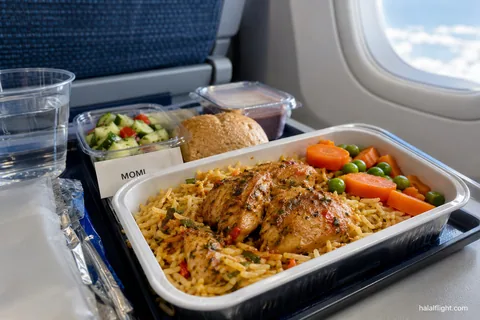
- Whether your special-meal request, such as a Muslim meal, was carried across to that flight.
- When the meal will be served, because service may fall well after sunset or very close to it.
Contact the airline that holds your booking and ask for confirmation in writing or through the booking record. If the connection joins two carriers, repeat the question for each. A request made for the first flight does not automatically transfer.
Have a fallback
If the meal does not appear, you still need to eat at the right time. Packing a second small portion for the onward flight is a simple safeguard that keeps your plans independent of catering errors.
Allow for gates, hours and crowds to change
Airports are fluid. Gates are reassigned, outlets close early, and security lines lengthen at certain hours. A plan based on a map saved weeks earlier can fail quickly.
Recheck as you go
Look at the departure display as soon as you can, because the gate may not be shown until after security. Heathrow, for instance, notes that gate details appear on its boards closer to boarding. Many airports have an app that gives live gate updates and a route to the next flight; use it if available.
Keep an alternative nearby
Identify a second option for food and a second prayer location. If the first is full, closed or too far, you will not have to search while the clock runs. Save the details offline in case wireless access is slow.
Ask staff early
If the connection tightens, ask airport or airline staff for the nearest accessible food point and prayer space. Do not rely on an old terminal map. Staff usually know about closures that printed or online maps do not show.
Match the plan to long and short layovers
The length of the gap changes what is sensible. The same approach does not suit a short transfer and an overnight wait.
Short connections
Aim for efficiency. Break the fast with items you carry, pray in the nearest suitable space, and head to the gate. Avoid tasks that depend on queues, such as ordering hot food at a busy counter, unless you have clear spare time.
Medium layovers
You can combine iftar, wudu and prayer in a calmer sequence. Locate the prayer room first, then the food, then the gate, so that the fixed point is the one you cannot miss.
Long layovers
A long wait raises other questions: rest, further meals, suhoor and whether to leave the airport. If a stopover carries a hotel or a visa requirement, deal with those at booking. For sleep and rest on night sectors, the dedicated guide on managing sleep on overnight flights is the better place to look.
If delays, rather than schedule, are your main concern, the separate page on preparing for delays during Ramadan covers that topic in detail.
Checklist for a Ramadan connection
Use this list before departure and again when you land.
- Check whether your tickets are on one booking or separate bookings.
- Calculate your real window by subtracting deplaning, transfer security, travel to the gate and the boarding deadline.
- Note whether the next flight is in the same terminal.
- Look up the location of prayer and ablution facilities on the airport’s own website.
- Decide whether you will stay airside or leave, and confirm that you are allowed to leave.
- Pack dates, water capacity and a small snack for the first moments of iftar.
- Confirm the operating airline and meal request for the onward flight.
- Save a second option for food and prayer.
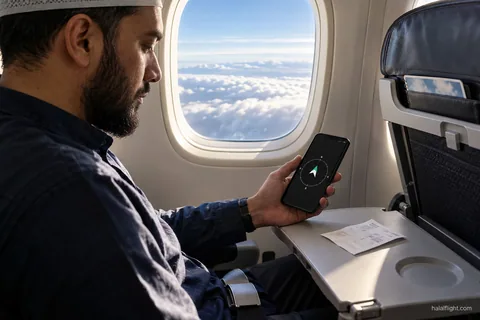
- Check departure boards on arrival and set a phone alarm for boarding.
If it goes wrong
If the inbound flight is late and you may miss the connection, speak to the airline as early as possible, ideally before landing through its app or at the airline desk after arrival. Heathrow advises passengers in this position to go to the airline’s desk to be rebooked. Prioritise getting to the right desk, then deal with food and prayer, using your carried items to break the fast while you wait.
Frequently asked questions
How long a layover do I need during Ramadan?
There is no fixed figure, because it depends on the airport, whether you change terminals and whether you are on one ticket. Work out your usable time by subtracting deplaning, transfer security and the walk to the gate. If you want a calm iftar and prayer, allow noticeably more than the airline’s minimum connection time.
Can I leave the airport to break my fast during a layover?
Only if you are allowed to enter the country and have enough time for immigration, travel and repeating security on return. Many airports advise staying airside on a connection. Check your visa or entry rights first, and keep a safe margin before the boarding deadline.
Will the airport have a prayer room in the transit area?
Many large airports do, but location and facilities vary by terminal and by side of security. Check the airport’s own website for the relevant terminal before you travel, and note whether ablution facilities are included. If you cannot confirm it, ask staff at the information desk on arrival.
Does my Muslim meal request carry over to a connecting flight?
Not automatically. A special-meal request is linked to the booking and the operating airline. If the onward flight is run by a different carrier, contact the airline that sold the ticket and ask them to confirm the request for each sector, ideally well before departure.
What should I carry for iftar on a short connection?
Items that need no preparation: dates, a sealed snack and an empty bottle you can fill after security. These let you break the fast within moments of sunset without waiting in a queue. Keep them in the cabin bag, not the hold, so they are always within reach.