The short answer for halal travellers at LAX
Los Angeles International Airport is a collection of separate terminals arranged around a loop road, and its food is run by many different concession operators. There is no airport-wide statement that a given outlet is halal, so the practical approach is to treat every meal as something you verify yourself. That means three steps: find out which terminal and gate your flight uses, shortlist outlets you can reach without leaving the secure area, and ask each one about the specific dish.
This page is about eating at the airport itself. If you need to know whether your airline will load a Muslim meal on board, that is a different question handled by the airline pages on this site. Here the aim is to help you make a sensible plan for the hours on the ground.
Two principles run through everything below. First, a menu that looks vegetarian or healthy can still contain stock, bacon, gelatine or an alcohol-based sauce. Second, a restaurant that is well known in the city may operate under different suppliers when it opens a branch inside a terminal.
Departure terminal and gate come before the menu
Check-in and boarding do not always happen in the same building. The official terminal map page notes, for example, that some Terminal 2 airlines check in at Terminal 2 but reach their gates through Terminal 3, and that Gates 20 to 28 are now part of the Terminal 3 complex. The Tom Bradley International Terminal also has its own West Gates numbered 201 to 225.
Because of this, a restaurant you found by searching for the terminal printed on your ticket may sit on the wrong side of your journey. Start with your airline's latest message or boarding pass, note the gate range, and only then browse food options.
Things the terminal map page tells you
- Which airlines use which terminal at the moment of your visit.
- Whether a terminal is affected by construction. The page currently describes Terminal 5 as closed for building work, so confirm what applies on your travel date.
- That access to the airport is limited to passengers and people accompanying or assisting them.
Layouts and airline allocations change during redevelopment, so treat any older blog post with caution and rely on the operator's own pages.
Moving between terminals to reach food
A connection drawn on a map is not a promise of a short walk. Before heading to another building for a meal, work out whether you will stay inside security or have to exit and screen again, and how long the route realistically takes with luggage or children.
Southside terminals
The Terminal 6 page says that post-security tunnels link the southside terminals, so passengers can reach dining and retail in neighbouring buildings while connecting, and it offers a tunnel map. The same page lists Terminal 6 as serving Gates 60 to 69. It also states that a valid boarding pass for a same-day departure gives access to dining and retail in any terminal. Treat that as a general statement and ask security staff if your route requires you to leave the secure area.
Other buildings
The pages reviewed do not describe the walking time or shuttle arrangements between every terminal. If your meal plan depends on another building, ask airport information staff or your airline how to get there and how long it takes, and leave a clear margin before boarding.
Reading a Californian menu with halal questions
Many LAX outlets lean on fresh, health-oriented cooking: grain bowls, wraps, salads, sandwiches and plant-forward plates. These look straightforward but often hide several issues.
- Stocks and broths: grains, soups and braised vegetables may be cooked in chicken, beef or pork stock.
- Toppings: bacon bits, pancetta, prosciutto and lardons are common garnishes and may be added by default.
- Dressings and sauces: some contain wine, mirin, beer or other alcohol-based flavourings, and some use gelatine or animal-derived additives.
- Cheese: some cheeses are made with animal rennet. Opinions differ among scholars and traditions on how to treat this, so follow the guidance you normally follow.
- Shared surfaces: grills, fryers and slicers may be used for pork and for other foods.
Ask about each component you plan to eat, not just the headline ingredient. If staff cannot answer clearly, treat that as a no and choose something you can check yourself, such as a sealed product with a readable ingredient list.
Do not assume a city brand is the same inside the airport
A Los Angeles restaurant with a good local reputation may hold a licence to trade inside a terminal under a different supply arrangement. Its airport menu is often shorter, and its meat, bread and sauces can come from other suppliers. A halal claim that applies to a street-level branch does not automatically carry over.
When you see a familiar name, ask the counter three things:
- Is the meat in this dish halal, and who certifies it?
- Can I see the certificate, a label or written ingredient information?
- Is the dish prepared on the same equipment as pork or alcohol-containing items?
The Terminal 6 page points passengers to dining links for that building, and the airport operator's pages are the right starting place for a current outlet list. They will not usually say whether a dish is halal, which is why the questions above matter.
Whether a particular certification meets your own standard is a personal matter. A qualified scholar or your usual halal authority can advise on that.
Packing a takeaway that survives screening
If you carry food from an outlet toward another checkpoint, think about what a screening officer will see. The Transportation Security Administration publishes a searchable food directory that explains how foods are treated at US checkpoints, and it distinguishes solid foods from spreads, sauces and liquids. Check it before packing soups, dips or sauces with an otherwise solid meal.
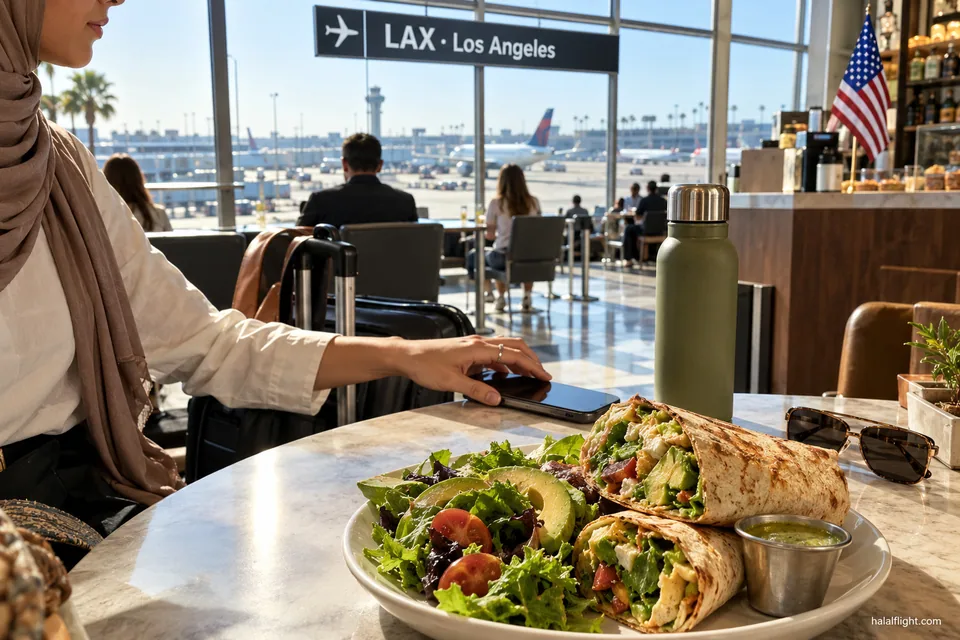
- A wrapped sandwich or a flatbread is usually easier to manage than a loose, liquid-heavy bowl.
- Keep the original packaging and any ingredient label so that you can answer questions about the food and re-check it yourself later.
- Put food where you can reach it quickly if a bag is opened for inspection.
- Eat perishable food within a sensible time, especially in warm weather.
If you are flying onward to another country, rules about carrying food into that country may differ, so check the destination's customs guidance before you pack leftovers.
Prayer and timing around a meal
If you need to pray while at the airport, ask airport information staff or consult the operator's passenger pages for prayer or multifaith space in your terminal. The pages reviewed for this guide did not confirm a prayer room location, so do not plan around one without checking. It is also worth remembering that a prayer space says nothing about whether nearby food is halal.
Build the timeline backwards from boarding. Allow time to clear security, to walk to your gate, to order and eat, and to pray if needed. If the plan is tight, buying a packaged reserve near your gate is more reliable than a long detour for a hot meal.
Travelling during Ramadan changes the planning in other ways, such as when to break your fast on a delayed flight. That topic has its own page and is only mentioned here so that you know where to look.
Checklist: if you cannot confirm a halal option
Use this list before you leave home and again at the gate.
- Note your terminal, gate range and whether your route stays post-security.
- Open the operator's terminal map and dining pages on the day of travel.
- Shortlist two or three outlets near your gate rather than one far away.
- Ask about meat source, stock, bacon toppings, alcohol-based sauces and shared equipment.
- Ask for written ingredient or certification information, not just a verbal reassurance.
- Carry a reserve: sealed nuts, fruit, plain bread or a packaged item with a readable label.
- If nothing suits you, a fruit, vegetable or plain item you can inspect yourself is a reasonable fallback.
- Keep a note of what you ate in case a fellow traveller or imam later asks.
If an outlet is closed or the answer is unclear, do not guess. Choose the reserve and move on; the aim is a meal you are comfortable with, not the most convenient one.
Frequently asked questions
Is there a list of halal restaurants inside LAX?
The operator's pages reviewed for this guide give terminal maps and dining links but do not label outlets as halal. Treat each outlet as unverified until it shows you written certification or ingredient information. Ask directly about the meat source, stock and shared equipment, and keep a packaged reserve for times when nothing can be confirmed.
Can I visit another terminal to eat if my gate is in Terminal 6?
The Terminal 6 page says post-security tunnels link the southside terminals and that a valid same-day boarding pass gives access to dining and retail in any terminal. Routes beyond that are not described there, so confirm with airport staff whether you will need to exit and screen again, and allow plenty of time.
Are vegetarian bowls and wraps automatically halal?
No. A vegetarian-looking dish can still contain stock made from meat, bacon garnish, animal rennet in cheese, gelatine or alcohol in a dressing. Ask about every component and the preparation surface. Whether certain ingredients are acceptable can differ between schools, so a qualified scholar is the right authority for personal rulings.
Can I take a takeaway meal through the security checkpoint at LAX?
Solid food is generally handled differently from liquids and spreads at US checkpoints, and the Transportation Security Administration publishes a food directory to check specific items. Keep packaging for inspection and avoid sauces or soups unless the directory confirms how they are treated. Officers decide on the day.
Is the Los Angeles outlet the same as the city restaurant with the same name?
Not necessarily. Airport branches may use different menus and suppliers, and a halal claim at one location does not prove it at another. Ask the exact terminal outlet what assurance applies to your dish, and ask to see any certificate or ingredient label before you buy.