What an E-number actually tells you
An E-number is a catalogue reference for a food additive that has been assessed and authorised for use in the European Union. The European Food Safety Authority (EFSA) explains that additives serve purposes such as preserving freshness, improving texture or changing colour, and that they can be natural, animal-derived, mineral-derived or synthetic. The number identifies the substance, not the raw material that a particular factory used to make it.
For a Muslim traveller this is the central point. The same code can be reached by more than one route, so no number can be declared automatically acceptable or automatically forbidden for every product. The honest answer to "is E-number X halal?" is usually "it depends on the source and on the rest of the recipe".
- The code names the chemical identity of the additive.
- The label must also show its function, such as colour, preservative or emulsifier.
- Neither the code nor the function states the animal, plant, insect, mineral or laboratory origin.
Many scholars treat doubtful origin as a reason to ask questions or choose another item rather than to guess. Differences exist between schools and certifiers, so individual rulings belong to a qualified scholar.
Origins that matter for the cabin tray
EFSA gives a few examples that show how varied the sources are. Pectin (E 440) occurs in fruit, lecithin (E 322) occurs in egg yolk and soya, and calcium carbonate (E 170) comes from ground limestone. Carminic acid (E 120), a red colour, comes from cochineal insects, which is an animal source even though the product may look entirely vegetarian.
Additives that are often discussed
Several groups come up repeatedly in halal ingredient discussions because their raw material is not fixed.
- Emulsifiers and glycerol: mono- and diglycerides of fatty acids and glycerol can be made from vegetable oils or from animal fat, depending on the manufacturer.
- Colours: carminic acid is insect-derived, while many other colours are plant-based or synthetic.
- Flavourings and carriers: these may involve solvents or fats that the label does not describe in detail.
- Gelling agents: some are plant-based, such as pectin, while gelatine is a separate animal ingredient covered on its own page.
Listing a group here does not make every member doubtful. It simply shows where a question to the manufacturer is reasonable.
Why the same code gives different answers in different products
Manufacturers buy additives from several suppliers, and a supplier may change its raw material between batches or markets. A biscuit sold in one country can therefore be made differently from the "same" biscuit in another, even though the ingredient list reads identically. The label names the additive, and the supplier's specification decides its origin.
This is why certification matters more than any single code. A credible halal certificate covers the finished product, the ingredients that go into it and the production site, so the certifier has already asked the supplier questions that a passenger cannot ask at 35,000 feet.
Why "vegetarian" is not the whole answer
A product marked suitable for vegetarians avoids slaughter-derived ingredients but can still contain alcohol-based flavourings or carry a different concern. Equally, a product that is not marked vegetarian is not necessarily doubtful. Use the vegetarian mark as one clue and read the rest of the list.
Labelling rules and what they leave out
EFSA states that additives must appear in the ingredient list, with their function and either their name or E-number. The United Kingdom's Food Standards Agency publishes its own list of approved additives and E-numbers for England, Wales and Northern Ireland, grouped by purpose such as colours, preservatives, emulsifiers and gelling agents. These lists show what is authorised and under what limits.
Neither source is a halal register. Regulators assess safety, purity and permitted use; they do not record whether an animal-derived raw material was slaughtered according to Islamic rules. For that, the reader needs a halal certifier or a direct answer from the producer.
- Packaged items from the EU or UK follow these labelling rules.
- Items from other countries may follow different labelling systems and different code systems.
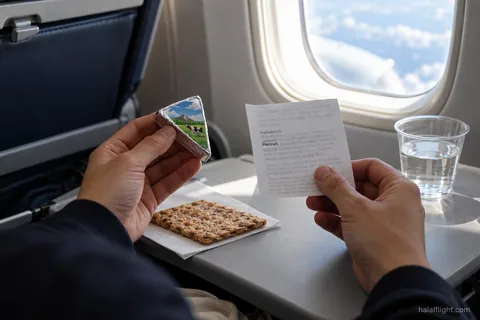
- Airline-prepared meals do not always print a full ingredient list on the tray.
Using ingredient apps and online lists with care
Scanner apps and "haram E-number" lists are tempting on a long flight, but they have limits. A list is written for the average product, while your snack is a specific recipe from a specific factory. A flagged code may be harmless in that batch, and a code that is not flagged may hide a source that matters to you.
Treat an app result as a prompt to investigate, not as a verdict.
A sensible way to use them
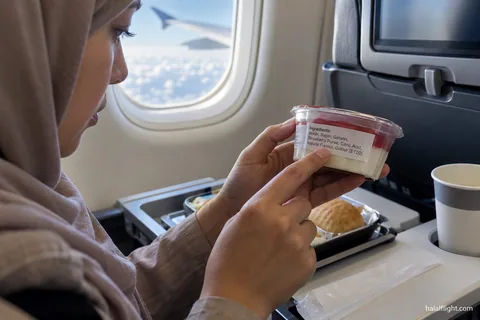
- Note the additive's name, function and code from the printed label.
- Check whether the product carries a recognised halal mark and whose mark it is.
- If it does not, look up the manufacturer's own statement on that product.
- If the origin is still unclear under the standard you follow, choose an identifiable alternative.
Which airline items need the most attention
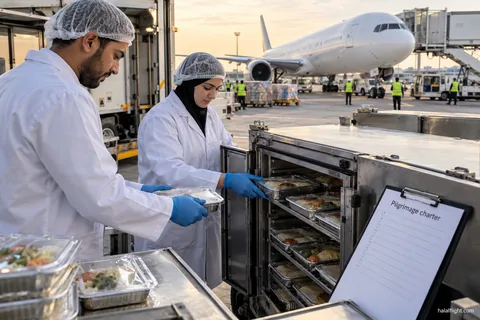
A pre-ordered Muslim meal (often coded MOML) is built to meet the airline's stated halal requirements, but the extras around it can come from general stock. Items worth a second look include packaged biscuits and sweets, sauces and dips, flavoured crisps, fruit snacks, chocolate, and instant noodle or soup cups sold onboard.
Fresh fruit, plain nuts, plain bread and unflavoured items have short ingredient lists and leave little to investigate. When an item has a long list full of codes and the packaging carries no halal mark, that is the moment to ask the crew or to skip it.
Specific topics such as cheese enzymes, alcohol-based flavours and gelatine have their own guides on this site; here the aim is only to read additive codes sensibly.
How to ask the manufacturer or airline
A precise question gets a precise answer. Vague requests such as "is this halal?" often return a generic reply, while a question about a named additive in a named product is easier to answer.
What to include
- The full product name, pack size and barcode number.
- The batch or best-before code if you have the pack to hand.
- The additive's name, function and E-number as printed.
- The question: what is the raw material, and is the product covered by a halal certificate?
For airline-prepared meals, contact the airline's special-meals or customer relations team before travelling, and ask whether it can provide ingredient information for its Muslim meal. If it cannot, you will at least know in time to bring something you can verify.
Checklist for choosing at the seat
- Read the printed list and write down any additive you cannot place.
- Look for a halal mark and check who issued it, not just that a symbol exists.
- Ask whether the item belongs to your pre-ordered meal or came from general stock.
- Prefer a simple item with a short list if the origin of an additive is unknown.
- Keep the packaging so you can contact the producer after landing.
- Carry a reserve snack you have already checked at home.
- Do not try to resolve a whole supply chain during the service; make the best choice available and follow up later.
If you are unsure about a ruling in your own case, ask a qualified scholar before travelling so that you can decide calmly in advance.
Frequently asked questions
Is every E-number made from animals?
No. EFSA describes additives with natural, animal, mineral and synthetic origins. Pectin comes from fruit, calcium carbonate from limestone and carminic acid from insects. Because the code does not name the raw material, check the specific product, its maker and any halal certificate before drawing a conclusion.
Can I trust an app that lists haram E-numbers?
Use it only as a starting point. A generic list cannot know which supplier or country a particular snack uses, and recipes change. If an app flags an additive, ask the manufacturer or look for a recognised halal certificate on that product instead of relying on the app alone.
Does a vegetarian symbol on airline food make it halal?
Not automatically. Vegetarian products avoid slaughter-derived ingredients, but they may still contain alcohol-based flavourings or other items some travellers avoid. Treat the symbol as one useful clue, then read the remaining ingredients and look for halal certification where it matters to you.
What should I ask the airline about additives?
Ask the special-meals team before you fly whether it can supply ingredient details for the Muslim meal and any extras served with it. Give the flight number and date. If no list is available, plan to bring a snack you have checked yourself and keep any packaging.
Should I avoid an item if I cannot identify an additive?
That is a personal decision based on the standard you follow. Many travellers choose an identifiable alternative, such as fruit or plain bread, when an origin is unclear. For a ruling on doubtful ingredients in your own case, consult a qualified scholar.