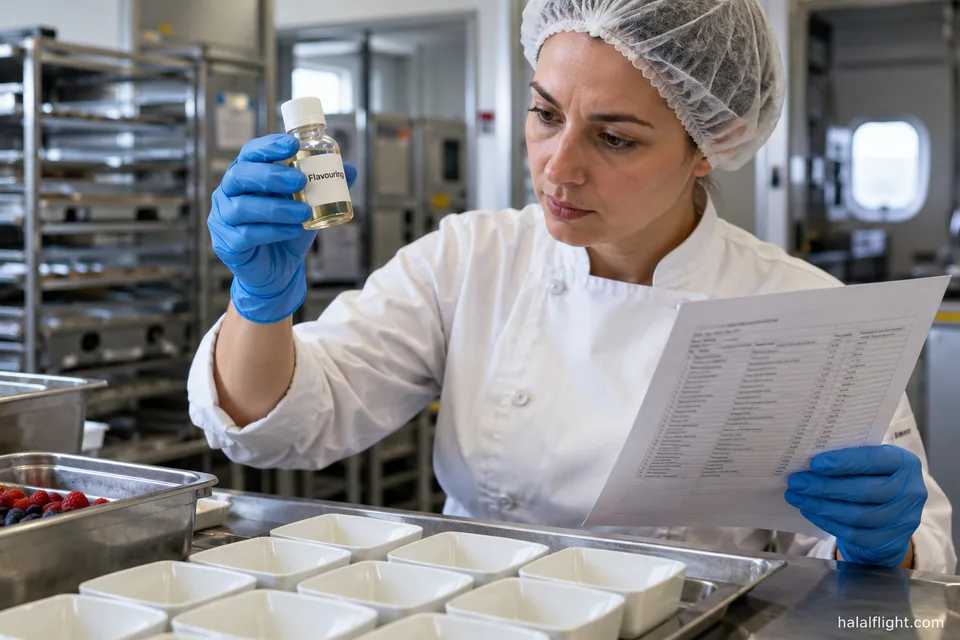
Why flavourings can contain ethanol
A flavouring is usually a small amount of aroma compounds dissolved in something that spreads them evenly through a recipe. That carrier, or solvent, can be water, vegetable oil, glycerol, propylene glycol or ethanol. Ethanol is widely used because it dissolves many aroma compounds and evaporates easily. Vanilla extract is the best-known example, but fruit essences, almond and coffee flavours, and some savoury seasoning blends can be built the same way.
This matters on a flight because the meal you are handed is a finished product, often made by a caterer from ingredients bought in from several manufacturers. The menu may say only “vanilla panna cotta” or “lemon cake”. The carrier is not mentioned, and the quantity of ethanol that ends up in a single portion is normally very small.
Two separate questions follow. First, is any ethanol present at all? Second, if it is, does the standard you follow accept it, and is the ethanol from a permitted source? Different authorities answer the second question differently, which is why this page deals with evidence and conditions rather than one blanket verdict.
What the MUIS ruling on ethanol sets out
The Islamic Religious Council of Singapore (MUIS) publishes an English-language ruling from its Fatwa Committee on ethanol in food flavourings and colourings. Its conditions are specific, and they are worth reading in order rather than quoting a single number.
- Source: ethanol made from prohibited sources, such as khamr, is not permitted. Ethanol that does not come from such a source is not treated as impure.
- Use as a solvent: natural or synthetic ethanol may be used as a solvent in a flavouring, provided it is not from a prohibited source.
- Purpose: ethanol is accepted only for flavouring. Adding it to a food or drink for any other purpose is not allowed.
- Flavouring limit: the ethanol content of a food flavouring should not exceed 0.5 per cent.
- End-product limit: the ethanol content of the final food or beverage should not exceed 0.1 per cent.
These figures belong to MUIS and apply to products assessed under its rules. They do not make every flavouring on every aircraft compliant, and they do not describe what other authorities require. A passenger who follows another school or another certifier should read that body’s own position.
Why scholars and certifiers differ
Halal certification bodies do not all use the same criteria for trace ethanol. Some accept it in flavourings under conditions like those above. Others prefer to avoid ethanol-based carriers altogether, either as a matter of principle or because it is simpler to certify a product that uses a non-alcohol solvent. Importing markets add another layer: the American Halal Foundation notes on its beverage page that residual-ethanol declarations vary by importing market.
For a traveller this means that “halal” on a label from one country may rest on a different tolerance from the one your own community uses. Neither the airline nor this guide can settle which view is correct for you. If you are unsure, ask a qualified scholar you trust, ideally before you travel, and then apply their answer to the checks below.
Origin matters as well as amount
The MUIS conditions treat the source of the ethanol as a separate test from the quantity. Ethanol can be produced by fermenting beverages, by fermenting other raw materials, or synthetically. A supplier statement that names only “alcohol” does not tell you which one it is, which is why a specification or certificate is more useful than a general assurance.
Where it can appear in an airline meal
Think in terms of product types rather than airlines, because the same caterer ingredients appear across many carriers.
- Desserts and cakes: vanilla, rum-style, almond or coffee flavours in sponges, creams, mousses and icings.
- Sauces and dressings: some seasonings and smoked or “grill” flavours use a liquid carrier.
- Drinks and syrups: flavoured waters, mixers, fruit drinks and coffee syrups.
- Confectionery and biscuits: liqueur-style or fruit-essence flavours in packaged sweets served as a snack or with tea.
Deliberate cooking with wine, beer or spirits is a different matter and is covered on the sibling page about wine and alcohol used in airline cooking. A menu line that names an alcoholic ingredient should be treated as that separate question, not as a flavouring question.
Reading the ingredient list for clues
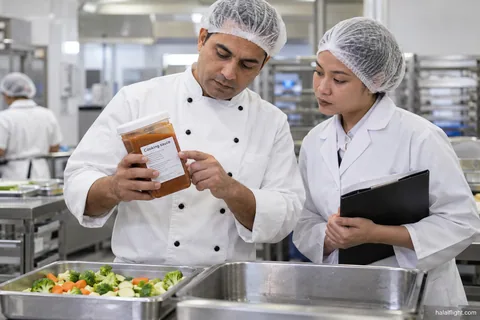
Packaged items such as biscuits, sweets, sauces and portion desserts normally carry an ingredient list. Flavourings are often declared simply as “flavouring” or “natural flavouring”, and the law in many countries does not require the carrier to be listed. That is the core difficulty: the label can be fully legal and still say nothing about ethanol.
What a label can and cannot show
- Words such as “alcohol”, “ethanol”, “rum”, “brandy” or “liqueur” point clearly to an alcohol ingredient.
- “Vanilla extract” may be ethanol-based, but the same flavour may also be offered in a water, glycerol or oil carrier, so the term alone does not decide it.
- A halal certificate logo is more informative than the ingredient list, because the certifier will have reviewed the flavour system. The American Halal Foundation states that it verifies the carrier and source declared for each flavour compound.
- A label that complies with food law is not the same as certifier approval. The two answer different questions.
If you are choosing between two similar items, prefer the one with a recognised certificate or one that lists no alcohol-derived ingredient, and keep the wrapper so the product can be identified afterwards.
Asking the airline or caterer useful questions
Cabin crew rarely hold ingredient specifications, so a question about “the flavouring in the dessert” will usually get a general answer. A better route is to ask before the flight, through the airline’s special-meals or customer-service channel, and to be precise.
- Which item is it? Name the dessert, sauce or drink.
- Who makes it, and is the product itself halal-certified, or is the certificate for the meal service as a whole?
- Which certifier or standard does the airline or caterer rely on, and does it accept ethanol as a flavour carrier?
- Can the airline supply a written statement or specification for that item?
Be ready for the answer that the airline can confirm the meal category but not the carrier of one flavouring. In that case the choice is yours: accept the assurance you have, pick an item you can assess from its packaging, or bring your own suitably packed food. Do not expect an airline to adopt your preferred tolerance for every product on the trolley.
Keeping the question separate from other halal checks
Flavouring carriers are one thread in a larger set of ingredient questions. Gelatine, animal rennet, enzymes and insect-derived colours each have their own origin tests, and a product can pass one test while failing another. The American Halal Foundation’s ingredient guide, for example, groups alcohol, flavourings, rennet, enzymes and gelatine together as items needing source checks. Treating them in one pass on your tray is practical, but a clear answer on ethanol does not clear the rest of the product.
Equally, a clear statement about a solvent should not be stretched into permission for something else. A conditional position on trace ethanol in a flavouring says nothing about a sauce simmered with wine. Keep those cases apart in your own decision making and when you speak to an airline.
Alcohol-free drinks are a related topic, covered on their own page. If your concern is a drink rather than a dessert, that page deals with labels such as “alcohol-free” and “non-alcoholic” and what residual alcohol they allow.
Checklist and what to do if you are unsure
Before the flight
- Decide which standard you follow for trace ethanol, and confirm it with a scholar if needed.
- Book the special meal early and note the airline’s halal statement, including which certifier it names, if any.
- Pack a suitable snack in case a dessert or drink cannot be confirmed.
On board
- Read the wrapper and look for a certificate logo.
- Ask crew to read out the ingredient line if the print is small.
- Leave the item if you cannot assess it, and eat what you can verify.
After the flight
- If you were given a product that you believe breaches your meal request, report it in writing, with the flight number and the item name.
- Ask for the specification or certificate for future bookings.
If you have already eaten something and later have doubts, a scholar is the right person to advise on the situation, not a travel guide.
Frequently asked questions
Is vanilla extract in an airline dessert halal?
It depends on the standard you follow. Vanilla extract is often made with ethanol as the carrier, but some products use other carriers. MUIS accepts ethanol as a flavouring solvent under stated conditions, while some people avoid it altogether. Ask for the product certificate or specification, and take individual rulings to a qualified scholar.
What does MUIS say about ethanol in food flavourings?
The MUIS Fatwa Committee accepts ethanol as a solvent in flavourings if it is not from prohibited sources such as khamr, and only for flavouring. It states that the flavouring should not exceed 0.5 per cent ethanol and the final food or drink should not exceed 0.1 per cent. Read the full ruling for the exact conditions.
Does a halal meal on a flight mean no alcohol-based flavourings?
Not necessarily. A halal-labelled meal means the airline or caterer applies some halal standard, which may or may not address ethanol as a flavour carrier. Ask the airline which certifier or standard it relies on and whether a particular item is certified, rather than assuming one label covers every ingredient.
Can cabin crew tell me what solvent is in a flavouring?
Usually not. Crew see the meal tray and, at best, the packaging or a caterer’s allergen sheet. Carrier solvents are rarely listed. Contact the airline before travelling, name the exact item, and ask for a written statement or certificate instead of relying on a verbal answer on board.
Is ethanol in a flavouring the same as cooking with wine?
No. They are treated as separate questions. Ethanol as a trace solvent in a flavouring is assessed on its source, purpose and final level, while wine in a sauce is a deliberate alcoholic ingredient. A conditional position on one should not be applied to the other.